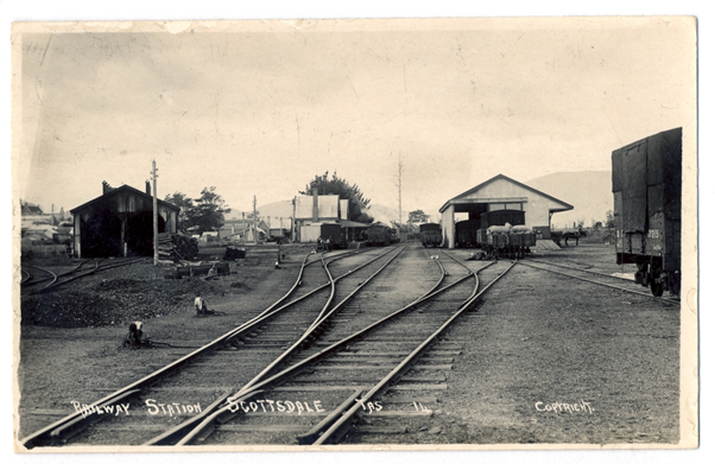
*Pic: Photograph of Scottsdale Railway Station taken by Thomas R.G. Williams c.1907 (source: University of Tasmania Library, Special and Rare Materials Collection)
While the Launceston-Scottsdale railway remains derelict and its future uncertain, its lingering presence is a reminder of the significance of rail to the economic development and social history of Tasmania. Sleepers and iron might be dismantled and sold, but its story need not be forgotten.
While much of Tasmania’s rail network owes its existence to government initiative, the dawn of Tasmanian rail actually began though private investment and financial risk taking.
Aiming to capitalise on transport and export of agricultural produce, the Launceston and Western Railway Company opened the Launceston-Deloraine rail line in 1871. In 1876, the Tasmanian Main Line Company, opened its line from Hobart to Evandale road, where a third smaller rail gauge connected with the Launceston-Deloraine line. Financial difficulties, however, led to the Tasmanian government taking over both businesses and the gauge was eventually standardised. Private investment in rail continued, but servicing secure mining interests in the West.
Since aboriginal dispossession and European settlement, throughout the sparsely populated North East, pioneers had petitioned for public investment. ‘Reproductive works’ initiated from the late 1860s hoped to stimulate economic and population growth through infrastructure spending and road improvements. The arrival of rail was considered a major turning point for the region.
From 1882 onwards, the Tasmanian government constructed numerous branch lines including the Launceston-Scottsdale line as well as extending the Western Line along the North-West Coast. The Launceston-Scottsdale line was operational by 1889 and passed through twelve stations along the way. The railway was extended to Branxholm in 1911, and later, Herrick.
Train travel was slow by contemporary standards. In 1923, a ‘modern’ motor train was trialled between Launceston and Scottsdale. While the journey took over 3 hours, it was deemed a success having shaved 23 minutes off the usual time. Due to increased competition from road transport, sluggish commute times threatened the future of rail.
Seeking to recapture lost trade, in 1926 the Examiner reported the establishment of a speedier motor train service between Launceston and Scottsdale. Passengers from Herrick, would still rely on a steam train to make the connection. Rail remained cost competitive but, compared to road travel, it was still slower. At the time, the fastest service to Launceston occupied 2 hours and 45 minutes compared to just 2 hours by motor car.
By the 1950s, serious doubts concerning the viability of the Launceston-Scottsdale passenger service had emerged. The immediate cause was ongoing competition from road transport, but changing government policy and spending priorities were also responsible.
Rail alignments and structures remained unchanged since they were built in the 19th century and necessary repairs, maintenance and upgrades to engines and track had been neglected. Railway unions went as far as accusing the Transport Commission of ‘sabotaging’ rail services to the benefit of private transport operators.
In 1953 the Examiner reported that the Wynyard-Smithton-Stanley and Sheffield-Railton passenger services would be cut. The tourism potential of the Launceston-Scottsdale line was recognised. It would remain for the time being given its popularity for summer ‘Sunday excursions’, however, indicating the Transport Commission’s intention to suspend passenger trains, it sought to trial a road service to Launceston via Golconda, Lebrina and Lilydale. A bus route bringing passengers from as far as Herrick was already in operation.
The shift away from rail, including trams, was a widespread phenomenon in the post war years across Australia and the English speaking world. Urban and state planners anticipated savings and greater flexibility from promoting road and personal motor car use. Traffic congestion, structural inefficiency as well as the financial burden of maintaining sprawling highways were the predictable consequences of this short-sighted decision.
By 1978, the last passenger trains closed down in Tasmania and the rail network, including the Launceston-Scottsdale line, focused on carrying freight. By the early 1980s there were just three daily services between Scottsdale and Launceston transporting logs, woodchips and other goods however, by 2005, the line was closed.
The demise of passenger rail between Launceston and Scottsdale was a result of a contradictory spending programme on infrastructure. Without improving rail commute times, road transport eroded the profit margins for trains. At the same time, by spending vast amounts on roads, this compounded the competitive advantage of the motor car, bus and truck.
Until recently, and while the North East’s freight trains still operated, enthusiasts hoped that a passenger service might be revived as a result of rail tourism, the rising cost of fuel or renewed state government commitment.
On the mainland, around Perth and the Gold Coast, new rail projects have been embraced for population centres and some low density suburban areas.
Sparse population, the cost of line repairs and transport policies which favour roads may prevent this from occurring in Tasmania. But without renewal and investment, the Launceston-Scottsdale railway may truly be at the end of the line.
*Dr Owen Powell is a farmer based near Scottsdale, North East Tasmania. He has a PhD in geography and environmental science and is standing as a Labor candidate for Bass in the upcoming state election.