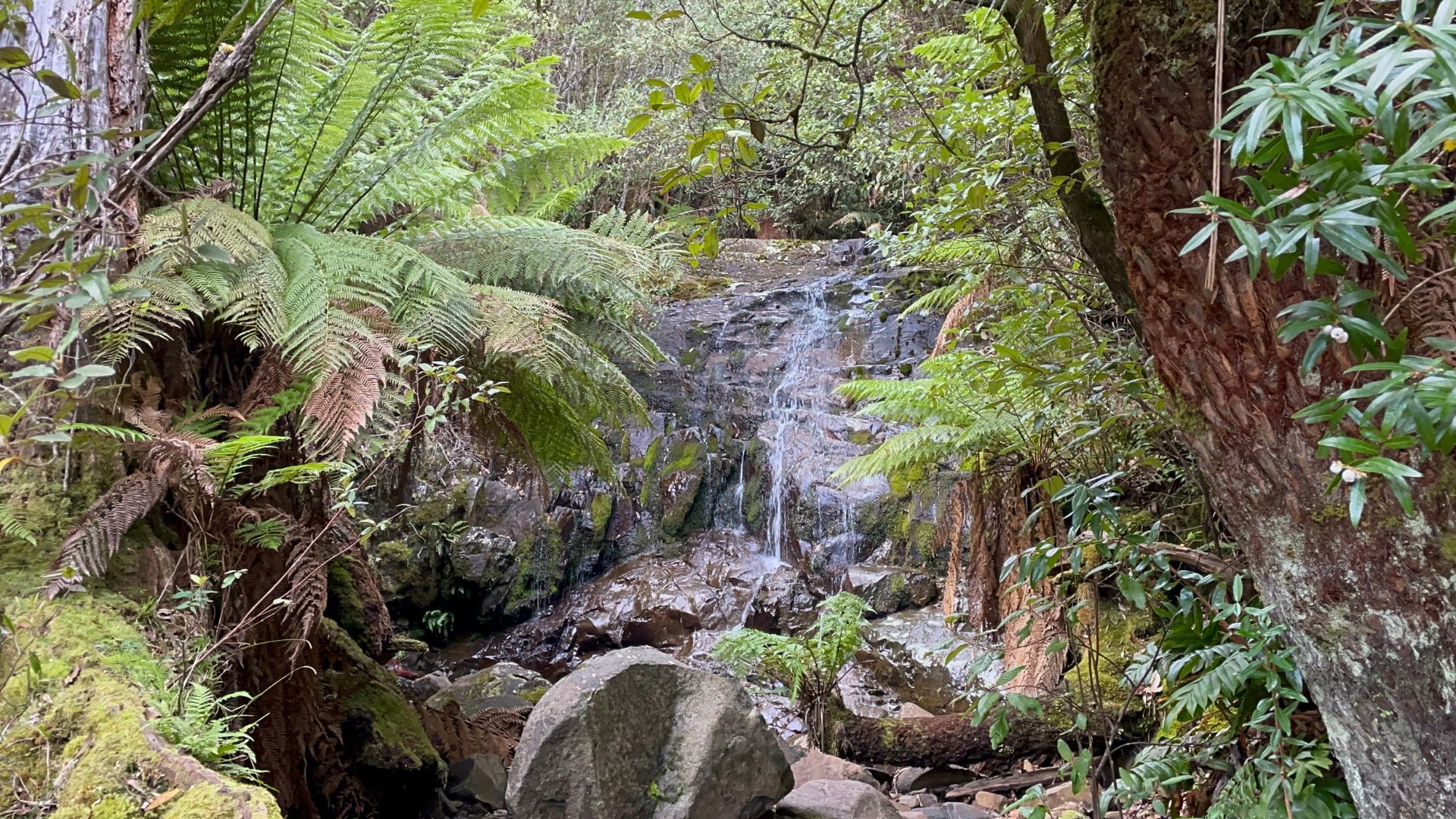
Myrtle Forest is a cool-temperate rainforest nestled in the foothills of kunanyi / Mount Wellington near Collinsvale. A mostly flat walking trail winds through it, leading to a picnic shelter, before continuing on to the Myrtle Creek Waterfall.
On Friday, 1 May, I parked at the track’s entrance gate and began walking along it. The deeper I ventured into the forest, the cooler and darker it became. All the towering mountain ash trees, moss-covered logs, and thick tree ferns enclosed the path in a shadowy, damp, chilly landscape.
As I continued walking, listening to the crunch of gravel and earth beneath my Blundstone boots, I felt increasingly removed from suburbs of Hobart, as though I’d stepped into a hidden green world. Myrtle Forest was quiet and sheltered – calm, yet faintly mysterious at the same time. And picturesque – very much so.
The tall, pale mountain ash trees stretched high above the track, while vivid green moss against dark tree trunks and stones. The cool autumn air carried the scent of eucalyptus mixed with the earthy aroma of damp wood and rainforest undergrowth.
I soon reached the picnic shelter, where I paused briefly to catch my breath before continuing on to the Myrtle Creek Waterfall.
At the waterfall, I stood quietly for a few minutes, listening to the water tumbling over the dark rock shelves and echoing through the forest. It was calming, tranquil, and beautiful.
Afterwards, I retraced my steps back to my car at the entrance gate, reminded once again of the tranquillity of the bushland that surrounds Hobart.
Myrtle Forest Falls (Slow TV)
Bibliography
- ‘Effectiveness of nature-based walking interventions in improving mental health in adults: a systematic review’ (Current Psychology, 2023/2024)
- ‘A Systematic Review and Meta-Analysis of Nature Walk as an Intervention for Anxiety and Depression’ (Journal of Clinical Medicine, 2022)
- ‘City walk or nature walk? Evidence-based psychological and physiological outcomes – A systematic review and meta-analysis’ (Urban Forestry & Urban Greening, 2025)
- ‘Effects of Shinrin-Yoku (Forest Bathing) and Nature Therapy on Mental Health: a Systematic Review and Meta-analysis’ (International Journal of Mental Health and Addiction, 2020/2022)
- ‘The effect of short-term exposure to the natural environment on depressive mood: A systematic review and meta-analysis’ (Cornell University, 2019)
Callum J. Jones is passionate about telling stories. He studied English, History, and Journalism at the University of Tasmania and lived in Western Sydney from 2022 to 2024 while working as a journalist for Professional Planner, a leading online publication for financial planners. Callum has written for Tasmanian Times since 2018 and has also been published in a range of other outlets, including Quadrant and the BAD Western Sydney anthologies.