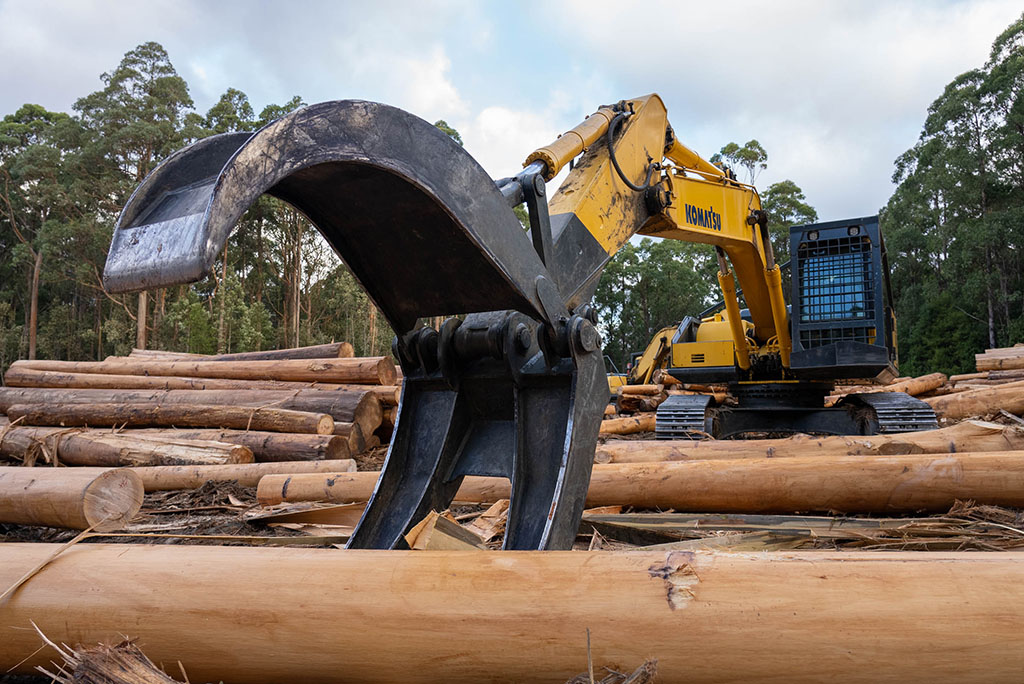
A new report from The Tree Projects, the Wilderness Society and the Tasmanian Climate Collective has found that native forest logging remains the state’s highest-emitting sector.
The report, Tasmania’s Forest Carbon: A 2025 Update, is a follow-up to a 2022 study that first identified the issue.
The new findings confirm that there has been no significant reduction in emissions from the industry. The report states that native forest logging emissions between 2016 and 2020 were, on average, two and a half times greater than the emissions from Tasmania’s entire transport sector. Over the past five years, emissions have only dropped by 5%.
The report highlights two emerging threats that could further increase the industry’s carbon footprint. The first is the growing interest in using forest biomass for energy.
Dr Jennifer Sanger, the report’s author, cautions that while five current or proposed projects require wood biomass, only 35% of the demand can be met by sustainable plantation sources.
“The rest will likely come from native forests, which will only increase Tasmania’s emissions,” she stated.
The second threat is the potential use of native forests for carbon credits. The report identifies this as a problematic strategy, citing “integrity issues” with many such schemes globally.
The concern is that credits could be claimed for forests that were never at risk of being logged, effectively serving as a form of greenwashing that does not reduce emissions.
Hugh Nicklason, a forest campaigner for the Wilderness Society Tasmania, said the report shows the government must take the climate implications of forest policy seriously. “This report confirms that protecting Tasmania’s native forests is one of the most effective steps we can take for climate action,” he said.
“The new government must show leadership by addressing the state’s highest emitting sector, ending native forest logging in Tasmania, and ensuring forest policy supports genuine climate solutions.”
According to the report, ending native forest logging is the most effective climate action available to the state. This would allow Tasmania to become a carbon sink and achieve a carbon-negative status.
The study estimates that if logging ceased, the public forests could absorb up to 75 million tonnes of carbon dioxide by 2050, an amount equivalent to taking every car in Australia off the road for a year.
Edited report (minus images) Tasmania’s Forest Carbon: A 2025 Update here.

Media release – Cassy O’Connor MLC, Greens Climate Change spokesperson, 3 September 2025
Ending Native Forest Logging Best Climate Fix for Tasmania
The logging and burning of native forests is the single biggest source of carbon emissions in Tasmania, confirmed in Dr Jen Sanger’s Forest Carbon 2025 update released today.
While the Tasmanian Forest Agreement saw emissions from native forest logging fall sharply from 2012 – allowing Tasmania to claim net zero status – progress has stalled.
The best, fastest way for Tasmania to take real climate action is to end the logging and burning of native forests.
Native forest logging produces two and half times the emissions of the state’s entire transport sector, but if we did the scientifically and ethically right thing our public forests could store up to 75 million tonnes of CO2e by 2050.
Even today, the science tells us our forests are drawing down about 22 million tonnes of carbon each year.
That’s the same as taking every car off Australian roads for a year.
In this new, cooperative Parliament, the Rockliff Government has a golden opportunity to protect forests and deliver strong climate action for the country.
As it is now, however, they’re moving towards the burning of forests for energy to prop up an industry which is on its knees.
The native forest logging industry is losing international markets to more sustainably produced plantation wood. It wants a lifeline in the form of forest biomass – burning wood from native forests for energy that’s being greenwashed as ‘renewable’.
Already, the Rockliff Government is facilitating native forest biomass burning through the Railton Cement plant, with federal government support.
There are also plans for biomass burning through Greenham’s Abattoir in the north west, at Liberty Bay smelter, and two new e-fuel plants proposing to burn wood to make hydrogen.
While some biomass can come from plantation residues, the plantation estate isn’t large enough and inevitably there will be more pressure on our carbon-rich, biodiverse forests to feed the boilers.
For the climate, for our forests and the incredible diversity of life they sustain, for our children and young people who deserve a safe climate future, and for our brand, to head down the path of forest biomass burning would be a massive mistake.
The science is clear, our beautiful forests are – intrinsically, socially and economically – worth far more standing.
We hope the Premier takes the time to read Dr Sanger’s report. It could be his legacy to deliver real protection for our incredible forests, and the gift of genuine climate action to the world.
Tasmanian Times (TT) is a community-based news and current affairs service covering the island state of Tasmania. It exists to provide a diverse presentation of Tasmanian issues. TT creates and supports independent media content utilising the best of modern technologies and tried-and-true practices of public-interest journalism.
Support us in expanding our coverage and developing new content by and for Tasmanians.
New initiatives on the way include:
- a weekly podcast covering current affairs
- a revamped website
- a monthly cartoon competition
- a user-friendly app for both Android and Apple devices
- a weekly roundup of key stories