
Scalars to vectors to tensors – the joy of math.
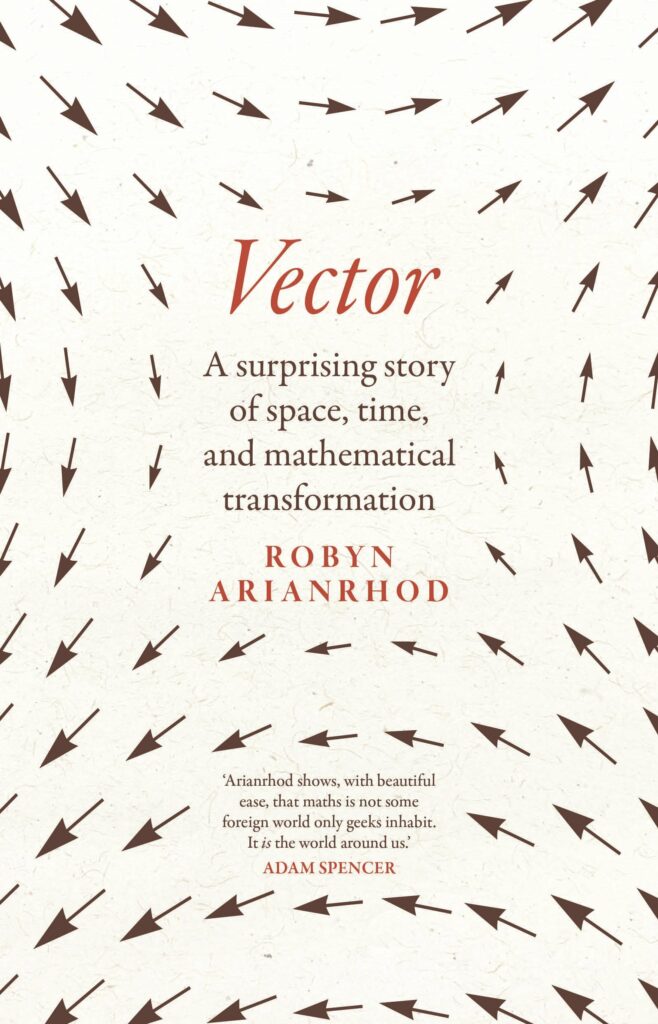
This one’s for the math-literate, and it’s terrific. If you have a general grasp, or reasonable memory, of higher math, you’ll be adequately equipped to read and enjoy Robyn Arianrhod’s latest work, Vector – A surprising story of space, time, and mathematical transformation.
 If you take joy in thinking about how the world works, and how a few simple, tiny and beautiful mathematical tools, which express and do so much, evolve from the collective and individual consciousness of humans over time, you’ll love Arianrhod’s history of vectors, tensors and all the thought and struggle that birthed them.
Disclosure: I was punching above my weight reading this one, but it’s hard to turn away from the author’s warm, conversational and clear-sighted overview of the shared inner lives of the great mathematicians as they incrementally progress our understanding of what can be understood – or imagined – and the uses new math can be put to.
Arianrhod wrote the book to share “the magnificent intellectual creation that is mathematics and mathematical science” – a multi-cultural journey through five thousand years.
The curiosity that drove our species to learn our place in the stars is the same that drove the wonder of mathematicians to discover, or build (depending if you view math as either discovered or invented), field equations, tensor analysis, and quantum mechanics. Either way, every mathematician stands on the shoulders of others; mathematical progress is collaborative.
“Part of what I’ve been trying to show throughout this story is just how long it takes for ideas to develop and find their best form. I think that knowing something of this long journey can help students who are struggling to grasp an idea by showing earlier mathematicians struggled too.” Mathematicians do “the kind of deep thinking needed to make sense of even the simplest things we take for granted today… sometimes without ever realising they might apply to things other than just numbers.”
“[I]t is important to be able to appreciate this kind of intellectual beauty, just as it is important to appreciate beauty in music and the arts.”
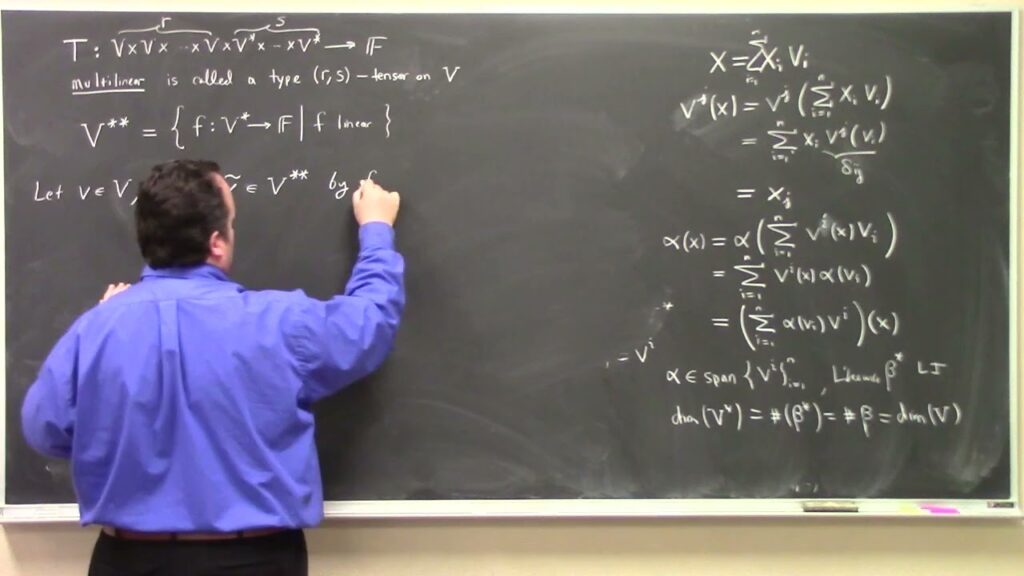
Just as great artistic insight can be expressed in a short poem or a single photograph, so can an enormous amount of insight and information be expressed with a single symbol – a mathematical tool, or a short equation.
‘The great power of mathematics lies in its visual symbolism… [V]ectors and tensors made it possible to…discover new laws of nature, and new technological applications of these laws.” Simply by finding new ways to represent information via mathematical symbols, they, like words, can encompass whole worlds of meaning, and shortcut the way we think about the world and act in it.
If you’re still reading at this point, you can tell I’m recommending Vector. The author’s relaxed writing style is superb, her erudition of her field and its history is genuinely impressive, and her understanding of intersectional issues provides nuance and context which all good histories need.
Despite the uphill battle, for me, Arianrhod’s writing is so good, I’ll be looking to read her other works for a lay audience.
Vector, by Robyn Arianrhod, UNSW Press, 2024, 326pp, ISBN: 9781761170089, RRP $44.99
B.P. Marshall is a scriptwriter and author, who isn’t as much dysnumerate as he is well to the left on the Bell Curve.