Tas That Was
Banking and Finance in Van Diemen’s Land

There was a severe cash shortage in Van Diemen’s Land during the early-1800s. To get around this problem, people exchanged ‘promissory notes’, which were written contracts that said the issuer had to pay a sum of money to the payee at some point in the future.
There were also ‘commissary notes’, which were acknowledgements from the Commissary that it had received x amount of wheat or meat at a certain price.
Promissory and commissary notes initially answered all the purposes of money in Van Diemen’s Land. They passed from hand to hand, backwards and forwards, like banknotes.

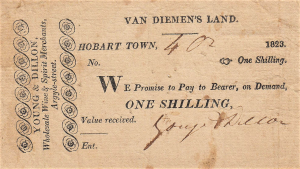
A one shilling note issued by Young & Dillon.
Between 1810 and 1830, the colony’s wool and wheat exports were financed by various currencies. These included the Spanish dollars, rupees, sterling, and U.S. dollars, all of which were acceptable for transactions for several years. This was despite New South Wales introducing legislation in 1822 that established a dollar standard.
Actual Van Diemonian currency was required when the colony started to expand, however. The Sterling Money Act was passed in 1826, and local banks started issuing their own banknotes and coins.
The economy of Van Diemen’s Land was doing well by the 1850s, but it went downhill during the 1860s due to the decline of the intercolonial wheat and wool trade. Various attempts by the local government were made to improve it, but it wasn’t until the 1870s that the development of a mineral export industry helped it recover.
The Bank of Van Diemen’s Land
Several banks operated in the colony during the 1800s. One of them was the Bank of Van Diemen’s Land, which was established after a public meeting in 1823.
Known as ‘the Old Bank’, it was considered to be extremely reliable, having survived recession, inflation, and competition.
In keeping with the dollar standard at the time, the Old Bank’s original $40,000 capital was provided by 200 shares of 200 Spanish dollars. By 1825, it was circulating its official banknotes. It enjoyed a commercial monopoly until the Derwent Bank was established in 1828.
When mineral prices crashed during the 1890s, the Bank of Van Diemen’s Land wasn’t able to survive the large number of defaulting loans. It closed its doors in August 1891 and offered its premises as a £1 lottery ticket. Its headquarters, which stood on the corner of Collins and Elizabeth Streets in Hobart, was eventually demolished in 1958. (The stone lions that stood over the building’s front door are now located at the entrance of St David’s Park!)

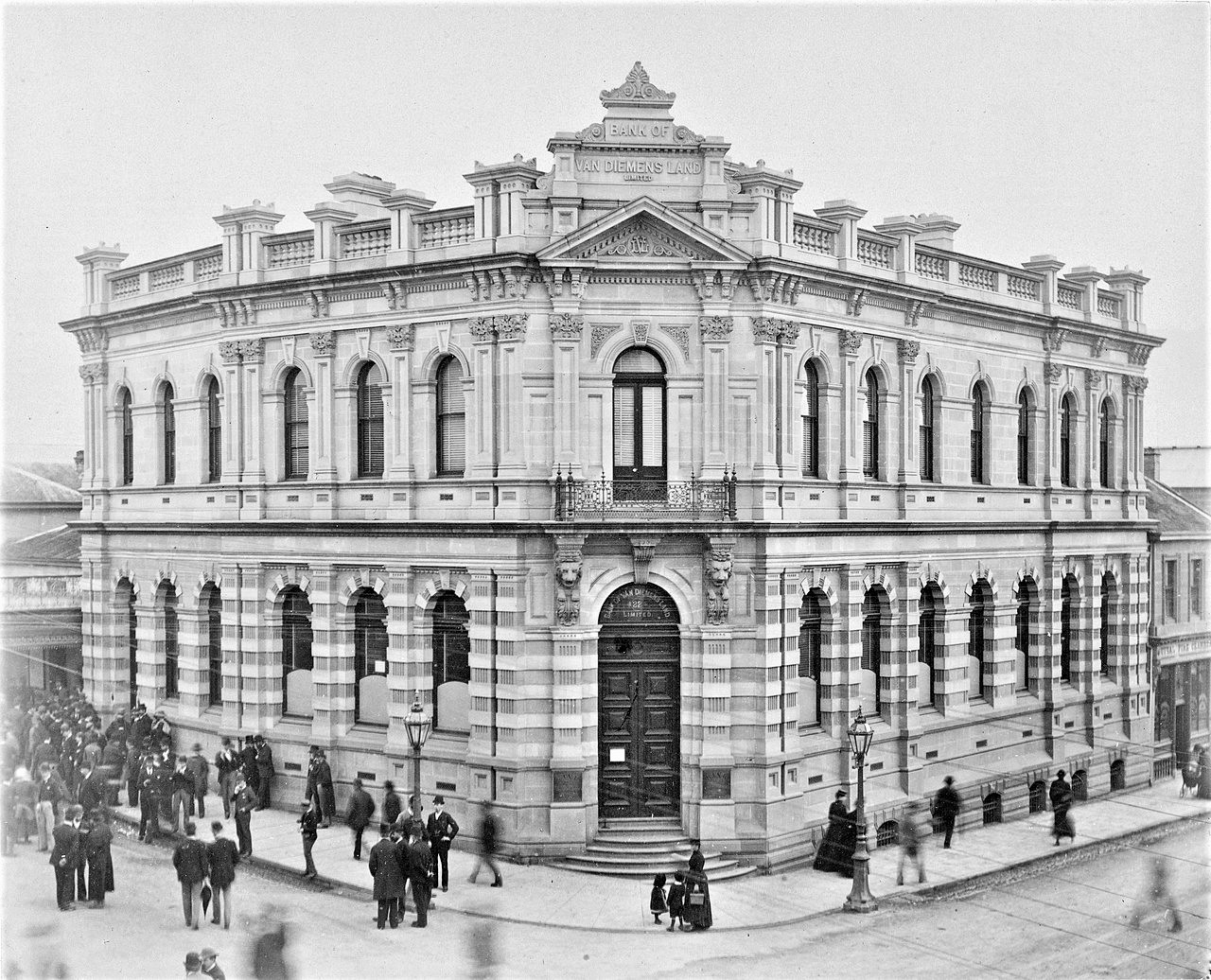
The Bank of Van Diemen’s Land shortly before it closed in 1891.
Convict wages
Colonists had to pay their assigned convicts after 1816. Male convicts could earn £10 a year, while female convicts could earn £2 a year. Some convicts were allowed to seek employment outside their normal working hours.
While George Arthur was Lieutenant-Governor of Van Diemen’s Land (1824 to 1836), convicts who were assigned to colonists were not allowed to earn money. Ticket-of-leave convicts were allowed to earn money through employment, however.
In 1828, Arthur set up the Convict Savings Bank. If a convict earned some money, it was compulsory for them to deposit it into an account with the Bank. It could only be withdrawn with Arthur’s direct approval.
Under the Probation System, convicts who were granted a Probation Pass were allowed to work for money.
By the 1860s, all convicts except those serving life sentences could earn a weekly wage of six pence. It was hoped this would encourage good behaviour and help them become established in the colony after serving their sentence.
How much money convicts could earn and keep was dependent on their behaviour. Those who misbehaved would have their savings taken away from them.
Bibliography
- Australian food history timeline (2021), ‘1893 Height of 1890s depression’, Australian food history timeline, viewed 29 March 2021.
- Barnard, Simon (2014), A-Z of Convicts in Van Diemen’s Land, Text Publishing Company, Victoria.
- Blainey, Geoffrey (2016), The Story of Australia’s People: The Rise and Rise of a New Australia, Penguin Books, Australia.
- Felmingham, Bruce (2006), ‘Banking and Finance’, The Companion to Tasmanian History, viewed 29 March 2021.
- Remembering the Past Australia (year unknown), ‘The Banking System in Van Dieman’s Land in 1828’, Remembering the Past Australia, viewed 29 March 2021.
- Unknown author (1828), ‘The Banking System’, Colonial Advocate, and Tasmanian Monthly Review and Register, page 5.
- West, John (1852), The history of Tasmania, Vol 1, Dowling, Tasmania.