“You make a living by what you get. You make a life by what you give.” – Winston Churchill.
National Volunteer Week is an annual celebration that acknowledges the generous contribution of Australia’s volunteers.
The theme for this year’s National Volunteer Week (18th to 24th May) is: “Changing Communities. Changing Lives”.
The definition of volunteering
According to Volunteering Australia, “Volunteering is time willingly given for the common good and without financial gain.”
Research and statistics
A 2016 survey by Volunteering Australia says that 48% of Australians take part in formal volunteering, 40% take part in both formal and informal volunteering, and 6% only do informal volunteering. The remaining 6% do not do any kind of volunteering at all.
The survey also states that 99% of volunteers would continue volunteering in the future, and 93% saw positive changes as a result of their volunteering efforts.
Most volunteers (58% in 2010) only work with one organisation, with 38% of them working at least once a week. Others volunteer less frequently. But this isn’t a bad thing: volunteering doesn’t have to be a long-term commitment. It can be done in small, simple ways that can still be beneficial.
Whether it’s short- and long-term, volunteering has the potential to improve your quality of life. It has lots of benefits. International research suggests that volunteers are more likely to be healthier and be able to sleep better. This has been consistent in over 50 separate investigative research projects.
It can be a great cure for boredom as well, and is great way to fulfil Centrelink requirements. It can also improve social connections and opportunities for employment.
“If you can’t get a job that requires experience, how do you get that experience in the first place?” says Max MacDonald, who volunteers for Windeward Bound. “Volunteering is the perfect thing to do to get that experience.”
Volunteering only two or three hours a week (which calculates as 100 hours a year) results in the largest benefits for people and for the organisations or causes they’re supporting.
Volunteering in Tasmania
“The value of volunteering is undeniable,” says Dr. Lisa Schimanski, the CEO of Volunteering Tasmania. “Volunteering connects us to ourselves, it connects us to others, and it connects us to our communities. In every location and every realm of life’s activities there are volunteers.”
Her Excellency Professor the Honourable Kate Warner, AC, Governor of Tasmania, has a high opinion of volunteers.
“I really appreciate the enormous contribution [volunteers] make in so many different areas,” she says.
The 2019 State of Volunteering Report states that Tasmanian volunteers contribute, on average, 229 hours a year, or 4.4 hours every week. It also states: “The value of volunteering to Tasmania in the past 12 months was $4 billion dollars, this includes the $3 billion it would cost to replace the labour volunteers contribute to our state as well as $1 billion in commercial and civic benefits contributed through volunteering.”
Despite this, there has been a drop in volunteering participation from 2014 to 2019. Volunteering participation is still reasonably high, though.
Nearly 300,000 Tasmanians (or 68.6% of the state’s population) volunteered during 2019, donating at least 68.2 million hours.
Volunteering is integral to Tasmania, which is why we all must ensure that its voice is heard and that it continues long into the future.
* * * *
From soldier to toy librarian
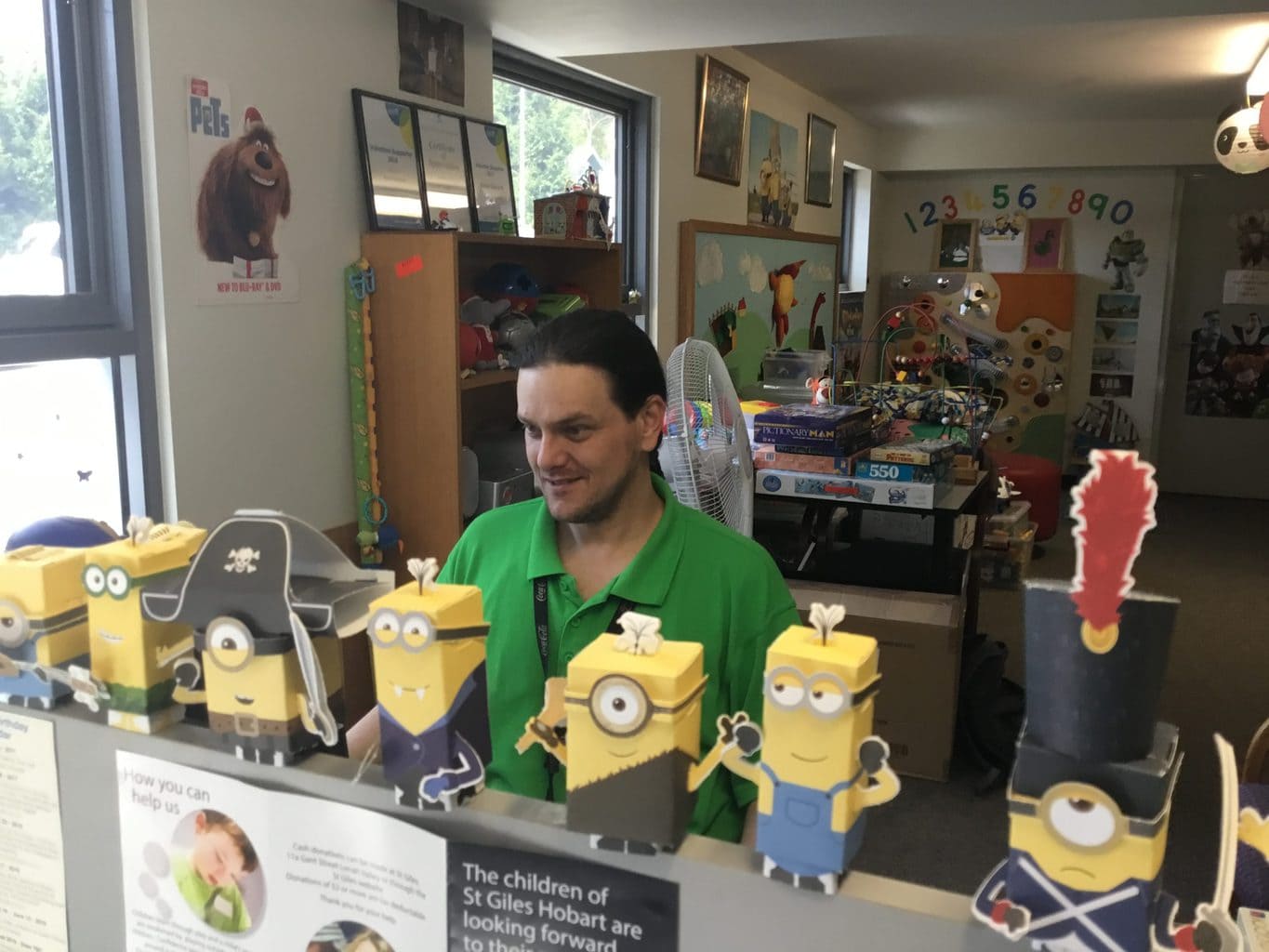
Kevin Edwards at the Toy Library.
All charities and organisations couldn’t do their important work in the community without the help of volunteers.
One such organisation is the St. Giles Toy Library in New Town. It’s fully staffed by volunteers.
The Toy Library’s main purpose is to inspire children who access St. Giles’ services to continue with ongoing therapy through play.
Kevin Edwards is one of the people who volunteer at the Toy Library. He’s in charge of basic operations, as well as cleaning and fixing toys when necessary.
Volunteering is about doing what you love. Kevin’s work helps kids and their families, which he loves.
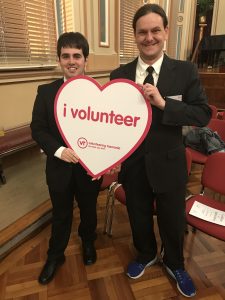
Kevin (right) and I (left) at the Hobart Town Hall in May 2018.
He tries to make the library as stress-free as possible, because “parents have enough on their plate already.”
Kevin started looking for volunteering roles after a chronic illness forced him to leave the Australian Army. When he saw that there was one available at the Toy Library, he “jumped straight in.”
“I’m one of the world’s biggest kids,” he explains. “It was like somebody had created the perfect job for me.”
And so a soldier became a toy librarian and a giver of hope.
In May 2018, Kevin accepted a certificate of appreciation on behalf of St. Giles as part of the Hobart City Volunteer Recognition Program.
He thinks volunteering is important for so many reasons.
“Without volunteers, programs just wouldn’t happen, period,” he says.
“While one person is a drop in the ocean, volunteers as a collective are an ocean capable of making a massive difference.”
* * * *
From nurse to hospital volunteer
According to Volunteering Tasmania’s 2019 State of Volunteering Report, 297,000 Tasmanians over 15 years of age volunteer in Tasmania. Neryl Holloway is one of them.
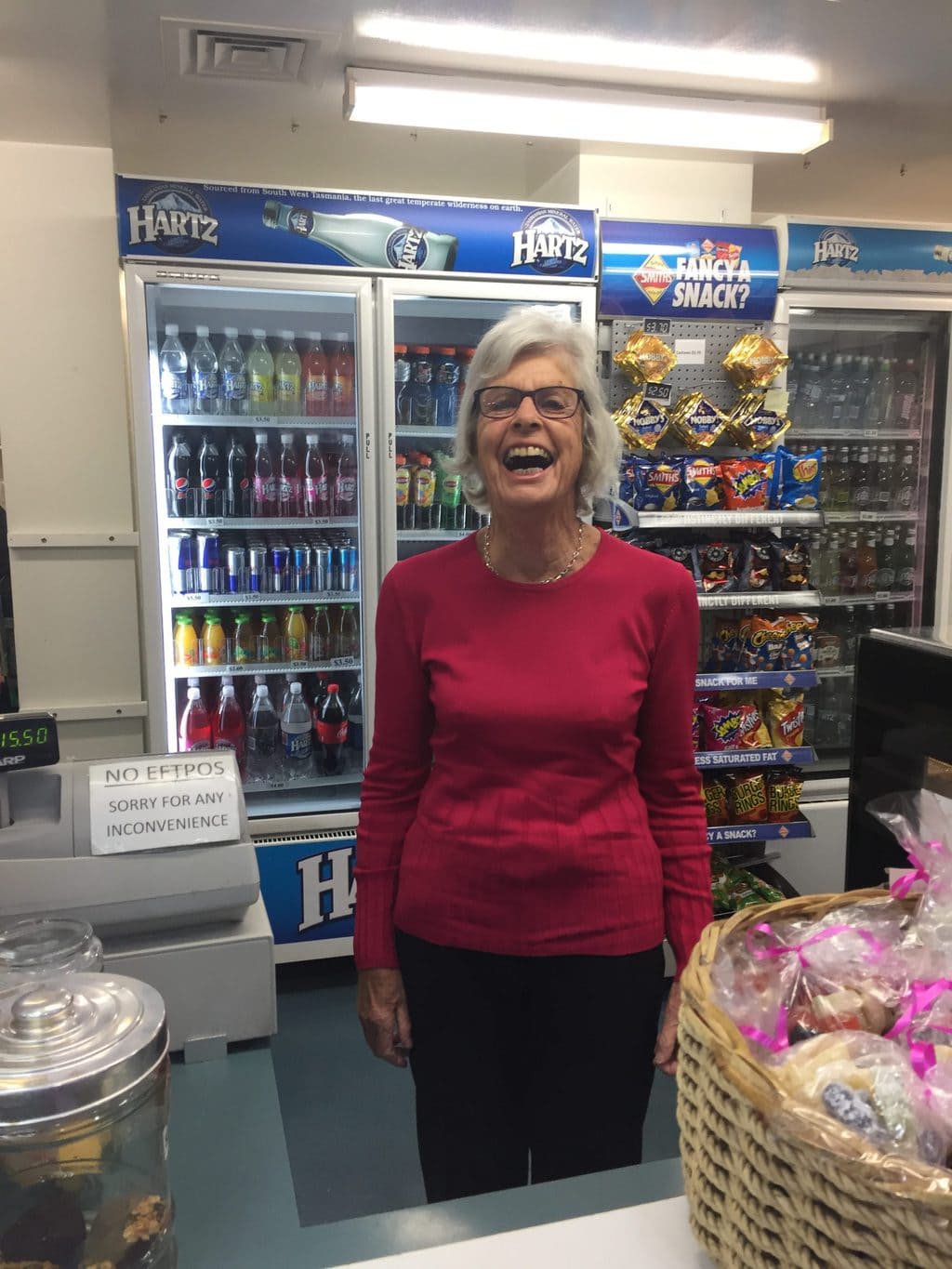
Neryl Holloway at the RHH kiosk.
Neryl describes herself as an average but caring person. She’s been married for 59 years, has three children, and “lots of delightful grandchildren!”
She was a nurse at St. John’s Hospital before she retired. This indirectly led to her becoming a volunteer at the kiosk at the Royal Hobart Hospital (RHH).
“I went to a St. John’s staff reunion,” she explains. “There was a lady, Sheila, sitting next to me, and she said to me, ‘You look healthy!’ I said, ‘I am, Sheila – I’m lucky!’”
“Sheila is now eighty-three, and she works virtually every day at the kiosk at the Royal Hobart Hospital. She works every day because they’re short staffed. So I decided to help out.”
Neryl has received recognition as a volunteer in a sense. The volunteer coordinator at RHH, Marion Cooper, organises occasional dinners at the Sandy Bay Boat Club for all the volunteers, as well as friends from Rotary and the like.
“Marion doesn’t have to do that,” Neryl says. “But she’s a lovely lady.”
In Neryl’s mind, to be a volunteer means you’re giving back to the community.
“It’s also nice to do something and not get paid for it,” she explains. “I just enjoy it. But it’s a shame I haven’t been able to do it lately because of COVID-19.”
“Volunteering is important for me because it keeps my mind active,” she adds. “And then there’s the social aspect of it, which I like as well. It’s so important.”