Economy
Peter Cundall: organic charcoal good for your greens

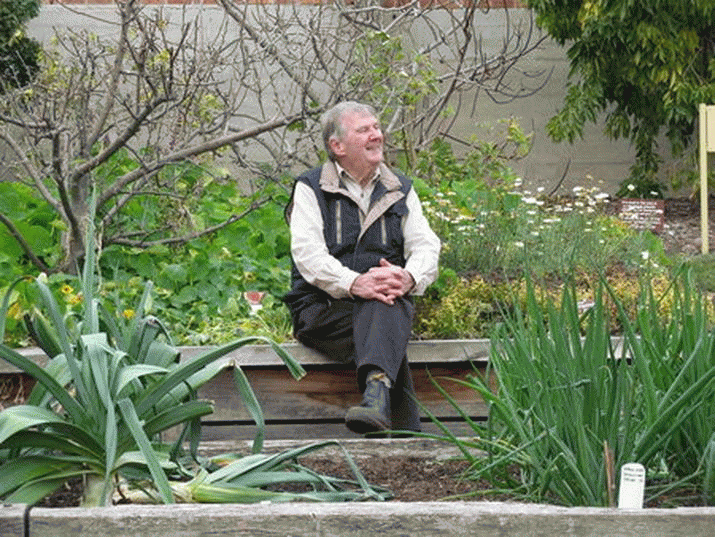

I’VE always believed the most important resource of any country — apart from people — is fertile soil.
This is particularly true of Australia which, while having some rich and fertile soils, also has impoverished areas that require heavy fertiliser applications in order to grow the exotic fruit and vegetables we eat.
As an organic grower, I avoid using disruptive or unnatural chemical fertilisers. Over many decades I’ve proved how easy it is to grow food and ornamental plants successfully using organic methods.
I continually experiment and, in the past few years, have been achieving astonishing results by using enriched charcoal — now commonly referred to as “bio-char”.
Charcoal is simply wood or other forms of organic matter that have been through a process of interrupted combustion. In short, it is partly burned, then retrieved before it turns into fine ash.
I collect my char from our stove or rake it up from the remains of pruning bonfires, the flames of which were quenched with water before the burnt plant matter was destroyed.
Charcoal contains no nutrients, but it is porous and has an ability to absorb and retain minerals and other nutrients. It can then make them available to plants, as needed.
Last autumn, a friend tried mixing pulverised charcoal into a compost heap so it would absorb most of the nutrients released by the decomposing organic matter.
He presented me with a large bucketful of this moist, jet-black, sweet-smelling bio-char.
I tried it by dropping a tight fistful beneath each of a dozen brassica, silverbeet and winter lettuce seedlings, plus some garlic cloves I planted in April last year.
The results have been almost unbelievable. I’ve never before grown such remarkably rich-green and healthy crops during winter. The flavour, too, was brilliant.
The garlic is now knee-high and I anticipate huge yields of superb, aromatic garlic in December.
The most amazing success, however, has been with winter-grown spinach.
I tried four varieties, each sown into rows 2m long with each row spaced 30cm apart.
Before sowing the spinach seeds, I created four shallow grooves in the soil and lined the base of each with composted biochar.
Germination was quick and drastic thinning of the overcrowded seedlings was necessary.
In late winter as the big leaves started to spread, I applied an extra-weak solution of fish emulsion and water. The result is about 4sq m of the most prolific, wall-to-wall spinach I’ve seen. The leaves were enormous and the flavour superb. We’ve been picking leaves non-stop for weeks and the plants are still sprouting.
I’ve even started to make my own, improved bio-char. It is so easy.