Economy
Wilderness and Development … Having your cake and eating it too!

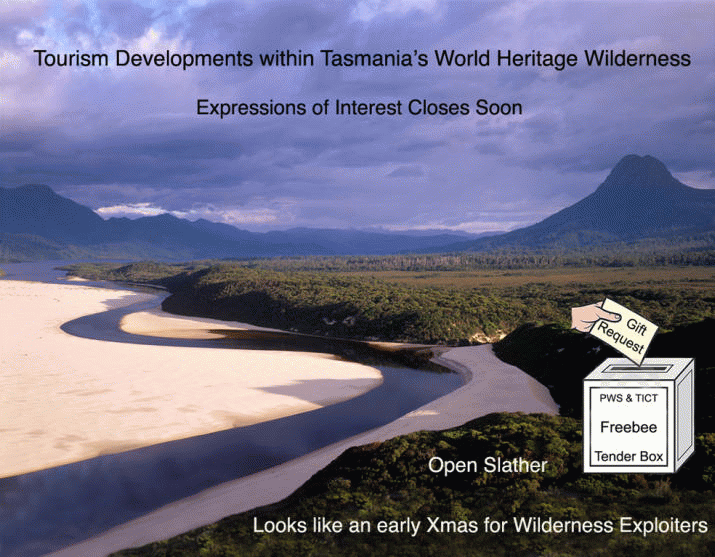

Looks like an early Christmas for Wilderness Exploiters Expressions of Interest Closes November 23rd. PWS & TITC Freebee Tender Box. Entrepreneur Gift Request Open Slather.
It’s ironic that the Liberal government wants to trade on the tourism concept that Tasmania has some of the world’s best representation of primeval wilderness – whilst concurrently advocating for its commercial development.
History attests that Tasmanian governments past and present seem oblivious to the special place Tasmania and its natural heritage is … and seem hell-bent on being like most other over-developed natural places in the world.
Discontent with having development on the periphery of Tasmania’s World Heritage Area, the Liberals have called for expressions of interest towards tourism developments within the island’s wilderness areas.
Some of the developments mooted to date are:
• Float-plane landing and mooring infrastructures at Lake St Clair, Bathurst Harbour, Prion Lagoon and Lake Judd.
• Commercial walker huts on the South Coast and Frenchmans Cap Tracks.
• A Wilderness Lodge at Prion Lagoon
• Quad-bike tours and accommodation structures south of Macquarie harbour.
• Helicopter pad and lookout on the Frankland Range.
• Expansions of tourism Infrastructures at Melaleuca.
• Tourism development/infrastructure at Warners Landing on the Gordon River.
While the Liberals’ wilderness development strategy is assertive in its intent, the reality of investment may not be so certain.
The most significant inhibition of development within the Western Tasmanian World Heritage Area has been its remoteness, lack of suitable access and the reputation for inhospitable weather at any time of the year.
In the western remote areas, the summer season is much briefer than the developed region of eastern Tasmania. Only 3 months of moderately appealing weather can be expected at its best, and in some summers this may eventuate to only weeks.
To date developers have shied away from seriously considering investing in a business that can only offer a short window of opportunity.
Fixed wing planes are restricted to access only in fine weather, whilst helicopters prove too expensive for most tourists. Any constructions requiring materials brought in by helicopter would exclude major developments. For example building materials for commercial huts on the South Coast Track may only be economically viable if brought in by sea. The estimated expenses for upgrading this track to a suitable high visitation standard would exceed $5 million.
The most likely tourism expressions will be concepts accessed via float-planes. This will result in the government (taxpayers), installing for free, the necessary infrastructure that is required for the remote landing destinations.
The construction of standing camps (which PWS call temporary, but in reality become permanent), are the cheapest and expandable means of creating a base station for localized tourism.
Regardless of the state coffers being almost empty, we can expect plenty of government promises of investment into tourism development in the future.
The development of the Three Capes Track is indicative that there is a government ideology of – if you provide a destination attraction then tourists will follow. Public expenditure and accountability has never been the issue, and their endless spin of it being Australia’s best adventure walk that will attract more than 10,000 visitors per year is fanciful. Meanwhile their trumpeting of how much it will return to the Tasmanian economy has been exaggerated beyond belief.
Virtually most of the forthcoming proposals to create tourism developments within the internal zone of Tasmania’s Wilderness Area will not eventuate or survive without a government prop-up. Those that do will set a dangerous precedent for the “open for business wilderness development concept”. This will only result in the reduction of integral wilderness and the degradation of the superlative values and principles of what the region was originally protected for.
The normal trend in Tasmania is for some speculator to moot a development concept and then rely heavily on the state government for financial assistance.
This Liberal government’s call for expressions of interest will be no different whilst they pander to their business cronies!