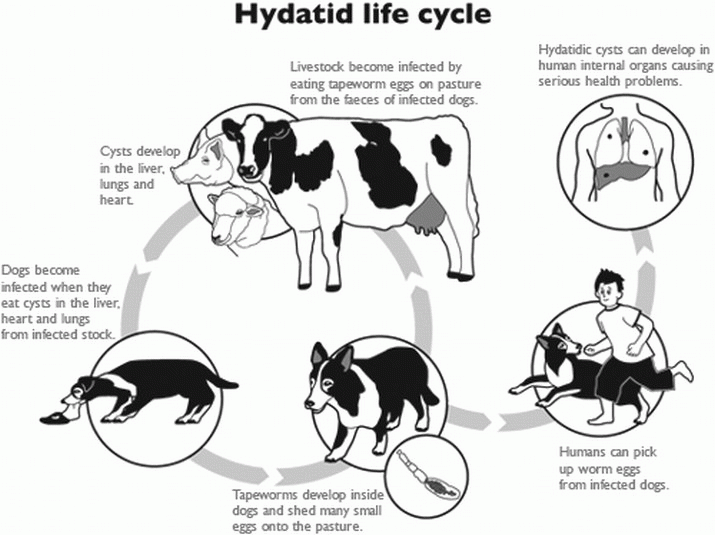
A real shock for DPIPWE – this work was done in a mainland University at least two years ago … A recent publication in the Australian Veterinary Journal is indicating that the hydatid parasite has been detected in Tasmania by a faecal test [i.e. faeces from dogs are E. granulosus coproantigen-positive].
Tasmania was considered hydatid-free since ~1996. I have yet to read the paper but am concerned as it comes during the period of our concerns with fox scat importations and potential hydatid risk. This paper published in Australia’s highest profile veterinary journal would come as quite a shock to DPIPWE.
Read the Abstract below …
Hydatids found in Tasmanian dogs
Charles Sturt University (CSU) research has found a tapeworm which can cause significant human and animal health problems in Tasmania.
The state was thought to be free of Hydatid tapeworm but a large study by CSU researcher Dr David Jenkins has found some Tasmanian dogs and livestock infected with the parasite.
Hydatid disease in humans, livestock and wildlife is caused by a tiny tapeworm (Echinococcus granulosus) infecting dogs, dingoes and foxes. The disease can infect humans, leading to major health problems and sometimes death.
Since 2010 Dr Jenkins, a Senior Research Fellow at CSU’s School of Animal and Veterinary Sciences ( HERE ), has tested more than 1400 samples of dog faeces from rural and semi-rural dogs from eastern Australia.
“More than 1100 samples of dog faeces from mainland Australia were tested and more than 300 samples from Tasmania,” he said.
Tasmania was declared provisionally free of hydatid disease in dogs and sheep in 1996 following a major 30-year eradication campaign where dogs were regularly de-wormed and feeding of offal to dogs was made illegal.
But Dr Jenkins’ research has found the parasite affecting a significant number of the dogs tested on the island state and also some cattle and sheep.
“Of the samples from mainland Australia we found two per cent were positive for the Hydatid tapeworm but in Tasmania we found considerably more, it was close to eight per cent affected,” said Dr Jenkins. “To say that Hydatids is gone from Tasmania doesn’t quite reflect the situation.”
The research, Echinococcus granulosus and other intestinal helminths: current status of prevalence and management in rural dogs of eastern Australia, has been published in the Australian Veterinary Journal ( HERE ).
Dr Jenkins’ research was funded by Novartis Animal Health Australasia Pty Ltd. Read more on CSU News ( HERE ).
Dr Jenkins is based at CSU’s School of Animal and Veterinary Sciences in Wagga Wagga, he is a member of the Graham Centre for Agricultural Innovation.
ABSTRACT: [FROM AVJ website]:
Keywords:
• cestodes;
• coproantigens;
• dogs;
• Echinococcus granulosus;
• hydatid disease;
• intestinal helminths
Objectives
Ascertain the prevalence of intestinal helminths in rural dogs from eastern Australia and Tasmania. Identify farm management practices contributing to the perpetuation and transmission of Echinococcus granulosus.
Methods
Helminth infection in dogs was determined microscopically through faecal flotation. Infection with E. granulosus was determined via faecal antigen-capture ELISA and coproPCR. Taeniid eggs were identified using molecular methods. Data on dog management and owner understanding of hydatid disease were collected via questionnaire.
Results
Faeces were collected from 1425 Australian rural dogs (1119 mainland; 306 Tasmania). Eggs of hookworms were most prevalent, up to 40.2%, followed by whipworms (Trichuris vulpis), up to 21.2%. Roundworms (Toxocara canis and Toxascaris leonine) were least common, up to 6.1%. Taeniid eggs were found in 11 dogs (5 Taenia pisiformis; 2 T. serialis; 4 T. Hydatigena); 2 of the T. hydatigena-infected dogs were also E. granulosus coproantigen-positive. Of the 45 dogs found to be E. Granulosus coproantigen-positive, 24 were in Tasmania, 16 in NSW, 3 in Victoria and 2 in Queensland. Three Tasmanian coproantigen ELISA-positive dogs were also coproPCR-positive. The most common dog ration was commercial dry food, but half the owners fed raw meat to their dogs and some fed offal of lambs (8.9%) or mutton (7.8%). More than half (69%) of owners weighed their dogs before deworming. Few dewormed their dogs often enough to ensure they remained cestode-free and owners hunting wildlife usually left carcases where they were shot.
Conclusions
E. granulosus is still present in Australian rural dogs, including Tasmania, but at low levels. Owner behaviour perpetuates transmission of cestodes.
• David Obendorf, in Comments: On the 23 August 2014 this story appeared in the [b]Examiner[/b]. [b]No increase in hydatids: top vet[/b] – by Jodie Stephens TASMANIA’S chief veterinary officer [b]Rod Andrewartha[/b] has downplayed concerns potentially lethal hydatid infections have increased in the state.
• Download the Jenkins paper with a Tasmanian map of the location sites of the hydatid-positive test results:
Jenkins_et_al_E_gran_in_dogs_AVJ_2014.pdf
• TT MEDIA HERE … … and the Premier announces the China Mission with a whole lot of Tassie businesses in tow, Kim Booth asks, Why all the secrecy over Forestry Tasmania’s Letter of Comfort, and Terry Polglase says a Dispute has been lodged in Industrial Commission over axing of Pathway Planners, and Cheering on The Cleaner in the Cox Plate etc, etc, etc …
AND …
… there’s an Industrial Commission Hearing, Tasmania’s Threat Level, and the axing of Pathway Planners …