History
A tale of two towns

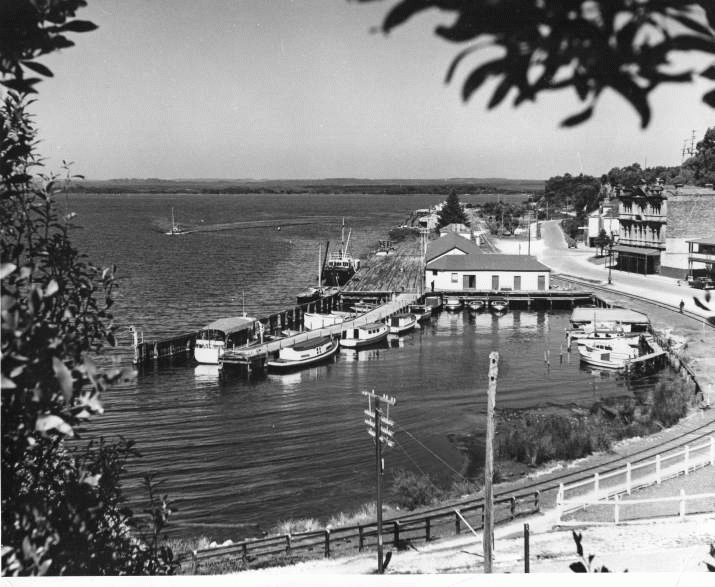

Strahan circa 1950 The last building in right background is the old Bay View Hotel. The main Strahan railway station was opposite the Bay View Hotel. Both buildings are long gone
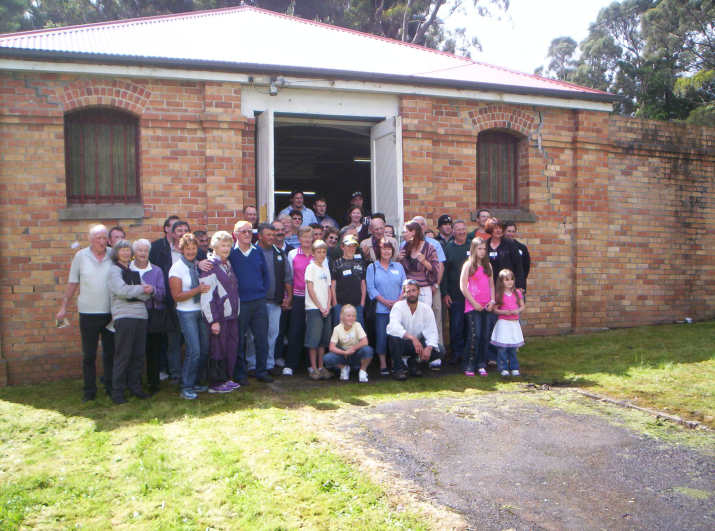
Crane family re-union 2006 at the drill hall next to our old family home. This is my mother’s paternal family who are descendants of the famous convict Thomas Doherty, who was a pioneer huon piner at Port Davey. Bob Cowboy Crane the patriarch of the family and an original Huon piner is on the far right of the photo. The author (me) is partly obscured in light blue shirt four persons from the left.


The reconstructed ABT train at Regatta Point Station

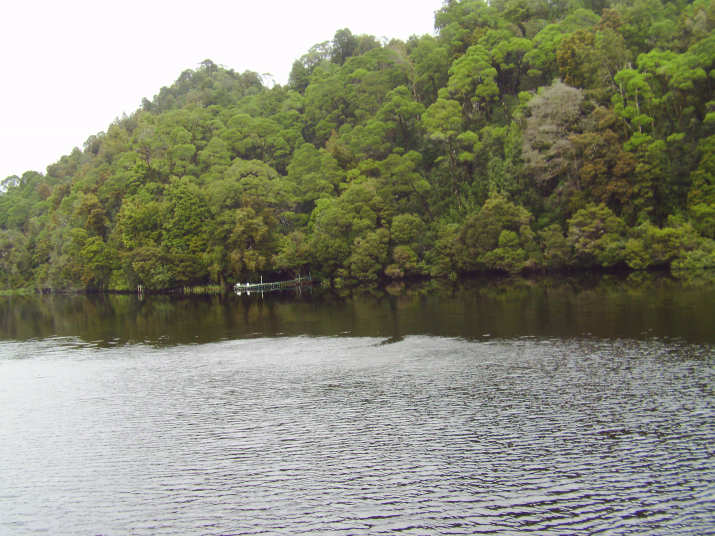
This landing on the Gordon River marks the site of the old Piner’s camp


A small stream discharges itself into the ocean at ocean beach and leaves curious markings on the sand. It is possible, if you pick the right time, to walk for miles on this beautiful often windswept beach and not encounter another human being.

Ormiston at West Strahan was the magnificent federation house built for FO Henry in 1899. Henry was at the time one of Tasmania’s richest men. The house is now used for luxury accommodation
When people ask me what’s my hometown I always say without hesitation, Strahan.
The first five years of my life were spent in Strahan after which my parents moved to Burnie in 1954. I returned a few times as a child to stay with my grandmother at West Strahan. Yet my birth certificate shows me as having been born in Queenstown, then the nearest maternity hospital. When I now return to Strahan, like most tourists, I have to pay for accommodation and I am normally not recognized by the locals. No one speaks to me in the street or waves and at a family re-union in 2006 in Strahan I had to be re-introduced to many Strahan relatives.
Yet I proudly identify as a West Coaster – with my late mother from Strahan and my father from Waratah … that picturesque ex-mining town where a waterfall runs through the main. I recognize the unique jargon of the West Coast – dixie, crib hut, forties, nipper, blackfish, the Black Knight, Stan Roy’s famous keyboard recitals at the Renison pub, Max Smith’s pie, the Penghana fires or the whippet track.
As a young man I was drawn back to work at Luina and Renison Bell and spent over two years working at the Mount Lyell Mining and Railway Company and living in Queenstown. The old single men’s quarters my first Queenstown residence is now part of a motel. I can remember as if it was yesterday: the two–up games there on a Sunday afternoon and the beautiful taste of savory mince on toast that was part of the fare in the dining hall. Always I am drawn back to the West Coast; if I don’t get there for eighteen months or so I get itchy feet. I am never content until I return again, until I see coming up the Lyell Highway the outer limits of the West Coast world –the site of Bradshaw’s sawmill. This is now quaintly remembered by newly named Bradshaw’s Bridge over the ersatz Lake Burbury snuggled at the foot of Mt Owen and cradled in the Linda Valley. To reconfirm my arrival I will walk in the rainforest during or just after rainfall – the refreshing smell of wet rainforest and the audible new torrent of waters rushing to the sea from some nearby brackish creek remind me I am home.
If I feel insecure about my Strahan credentials they are easily quashed by a visit to Strahan. Here are buried my grandmother, grandfather, aunts, uncles and cousins in good numbers – resting until eternity in the cemetery with its panoramic outlook over parts of Macquarie Harbor in the boggy soil among the pines and ferns on the perimeter. My father’s name is scrawled on the inside of a drawer of the beautiful counter of the GPO for Dad worked here in the Post Office and we lived in one side of that post office with a small backyard; but as a child all Strahan was my backyard. Here in the real Strahan village where the sight of a car was rare but a horse and cart less so. My maternal grandfather was a huon piner who worked the Gordon River and drove the last ever trots winner at Strahan. Much nowadays has been written about these men. Some cousins still live here and my mother’s family name is famously now linked with huon pine. I can smile inwardly as the tour operator tells us about the legendary huon piners as we cruise sleekly up the Gordon River on a luxury launch.
My siblings and I are forever defined by Strahan: the Strahan kids, those kids who lived at Strahan and the Burnie kids – those kids born in Burnie after we left Strahan. It puts a marker in the family prestige pecking order – my elder brother and sister both went to the quaint diminutive Strahan primary school almost adjacent to the grand former F O Henry residence Ormiston, one of the finest examples of Federation architecture anywhere in Australia. Mum always talked about FO Henry in quiet deferential tones conveying a sense of a man very connected to the community. This was of course FO Henry the second. Some may remember the self styled Duke of Avram who posed as a sort of Strahan aristocrat, even owning Ormiston from 1982 until 1995; but Strahan’s first among equals was always the pioneer FO Henry. His imposing headstone dominates the entrance to Strahan cemetery to this day.
In a sense I have dual hometowns as moving to Burnie at the age of six often means I recall more vividly my Burnie rather than my Strahan childhood. In a sense we look at the past through a kind of prism from our vantage point in the present. Recently on a return trip to Burnie I visited the Makers Workshop a proud example of the new confident Burnie. The restaurant is on the site of my old high school that, sadly neglected, eventually fell to fire by an unknown hand. It was odd sipping a barista prepared coffee, sitting in what was the once the site of the headmaster’s office, where I got six cuts for playing two up (or odd man out was it?) I looked out at Burnie Beach, neatly separated into two halves by a rock intrusion unaltered perhaps in a million years and I realized human structures come and go but the scenery of geology gives us a fixed point so as to somehow jog the memory about the human structures long gone or inexorably altered. Looking the headland at the end of Burnie Beach in which the old breakwater is wedged and the old Burnie wharves start – Ocean, McGraw, Jones pier, forever in my memory. A headland is a reference point that is fixed, whether you view it from the sea or land, you know you are home. This prompt briefly transfers my recollections back to Strahan as headlands are so important in one’s memory of Macquarie Harbor and for Strahan itself those two key headlands that irresistibly bookend Strahan proper – Regatta Point and Cape Horn. The headland at old Burnie breakwater, like an immovable stage prop, will remain long after the couta stop running and the generation after next fail to understand words like the Pulp, the Titan, straddle trucks and the three mile line. One wants to join Edmund Burke, albeit momentarily, for one philosophical temporary point of agreement about the death of the past.
Quaint and likened to an English village
Visitors to Strahan adore Strahan village – it is promoted as the heart of Strahan – quaint and likened to an English village. However this is not the Strahan village my family knew it was by definition perhaps a village; but a very much different village. This raises for all of us the dilemma about our hometowns. In fact it is one of the key dilemmas for all of us in the modern world. We need the blood of progress running through our towns to sustain them to give jobs and meaning but this cannot but help engender a feeling of sadness when our hometown is altered significantly. The West Coast is littered with towns that died. Strahan almost did but was resuscitated; Burnie perhaps similarly – the loss of the huge paper mill at one time employing thousands was Burnie’s economic coward punch. Most of us hated the ugliness of the mill, but now it’s gone, we seek out photos of the old Pulp smoke billowing from its stacks.
When Mount Lyell made the fateful decision in 1963 to stop shipping ore through the port of Strahan many thought this meant the conversion of this tiny town into the fate that had befallen many other west coast towns: namely a ghost town or a hamlet. Examples existed relatively close by: Gormanston, Linda, Crotty, and Pillinger. Complaints about certain families being treated favorably under the bull system for picking wharfies for daily hire suddenly seemed trite.The Franklin dam proposal in 1978 and the axing of the plans in 1983, created worldwide debate and controversy. Some thought proceeding with the dam would see the re-emergence of the pre-1963 Strahan. The Franklin River dispute that unfolded had bitterly divided my mother’s paternal family.
In the post Franklin dam era there was much despondency about potential jobs lost to Strahan and the green view that the Gordon River was a resource of world significance was largely ignored. Some canny Strahan families however, who were already taking small parties of sightseers to the lower Gordon realized that there was some potential here. The Grinning and Morrison families saw the potential: by the end of the 1970’s the magnificent huon pine ketch the Denison Star was plying her trade up the Gordon River. Today the various Gordon River cruises, with ancillary trips to Sarah Island and Hell’s Gates, are one of Australia premier tourist attractions. Today, to speak in tourist journalese, Strahan is the much vaunted jewel in the crown of the Tasmanian tourist industry. In the old Strahan we had perhaps forgotten, or accepted it as a norm, we had the greatest freshwater harbor in Australian or the one of the oldest penal settlements, that we had the only stands of temperate rain forest in the world showcased by Huon and King Billy pine, two of the world’s rarest timbers and found only on Tasmania’s West Coast. The resuscitation of the Strahan to Queenstown ABT railway with the unique rack and pinion system now gives visitors a chance to ride through unique rainforest and experience the rare rack and pinion system of which there are only a handful worldwide. The railway in part follows the magnificent King River Gorge. By contrast the sludge alongside the banks of the King River serves as a reminder of the destruction older mining methods can bring to a river system. A further legacy can be found in the denuded hills surrounding Queenstown. Strahan has, at thirty kilometers, the longest beach in Tasmania and perhaps it’s wildest and most windswept. Part way along the beach are the Henty Dunes are a vast expanse of sand dunes between 30 and 40 metres high extending several kilometres inland. Macquarie Harbour until around 1815 was home to one of the oldest civilizations on earth the Mimegin band of aboriginal people. Theirs was a unique tale of human survival in a harsh landscape; some traces of their occupancy still exist.
My memories of Strahan have many layers. The first coincides with the first six years of my life spent at Strahan and uncoiled slivers of memory of it that still release from time to time. We lived in a conjoined house attached to the Post Office with a small backyard that backed onto steep bush land. There were no major dangers and I was free to roam nearby to home. I can remember collecting tadpoles from the small pools of water that were in abundance close to my home. With a small jar I would collect tadpoles and empty them in the large forty-four gallon drum Dad provided (and discretely emptied by him on a regular basis I was later told) in the backyard. Always accompanied by our brown and white water spaniel “Freckles “all of Strahan was my playground. I played in a small fern stump nearby the Drill Hall that seemed gigantic to me at this tender age. It was here that I met my two imaginary friends Captain Shiggles and Coosie Wooker. My older brother and sister were allowed to wander even further: Mum simply sounded a foghorn, probably from some old vessel, when dinner or tea was ready to summon them. There was a tiny stream and a clump of tee trees across the road from home –this feature is long gone to make way for parking but long ago I forged paths through the tea trees and was able to lose myself safe in its arbours. A sawmill once stood near this spot but it burned down and was relocated further towards town, standing today near the visitors centre. You can smell the huon pine sawdust form several hundred meters away, so strong and distinctive is the smell. There was an old abandoned engine from the original mill and I would clamber in it and here I suspect I got my first whiff of Huon pine, while Freckles waited patiently below. In the summer evenings Dad would walk along the railway line around Cape Horn stopping to let me float my tiny toy pirate’s raft in the gentle waters of the many mini coves that formed on the adjacent seashore. I was the first post war baby in our family and the first wave of what were to become known as ‘baby boomers”. To celebrate perhaps Dad and grandfather got me a racing pidgeon, sent with many other Strahan pidgeons in the train to be released on the North West Coast and to race back to Strahan and other West Coast towns. I was not always so lucky with birds at Strahan: I can remember vividly being being attacked and pecked by our rooster as I explored the backyard chook pen. I was traumatized, perhaps still am but three hours later, when I gingerly ventured into the back yard the rooster was hanging upside down beheaded and plucked. Dad was seated in the backyard in his trousers and singlet, grimly smoking his customary Army Club cigarette, with the axe beside him. Yet just about every memory of Strahan as a child was positive and joyous. Smells curiously enough are a great link to the past. The smell of fireworks always takes me back to Empire Night at Strahan. A time when the town gathered together; a time of great camaraderie that can perhaps only be replicated in an isolated community or town. Errant sparks blowing from bonfires, the townspeople rugged up holding their sparkers, throwing their tom thumbs.
To keep his hand in after the war had finished
I can remember Mum and Dad and playing golf in the rain, as I sat in the clubhouse and marvelled at the huge and varied multi – coloured golf umbrellas moving about on the links. Dad also went to rifle shooting, predictably with his 303, perhaps to keep his hand in after the war had finished. These seemed to me, in retrospect, the salad days for Mum and Dad, once they moved to Burnie somehow the sport, the CWA and social life in general stopped. Dad had shift work to contend with; Mum additional young children to care for. Dad liked Burnie- he had moved from Waratah to begin his first job there on the cusp of the depression when a pre- paper mill Burnie was a pollution-free, smaller and gentler town. Mum despite strong family support and a network of good neighbours and friends was never fully happy in Burnie: she pined for Strahan.
The Strahan village concept is a key feature of the tourist advertising drawing thousands to my home town each year, but it is not exactly the Strahan village of my parents and my elder siblings. Nor did they call it a village either; to them a village was in England or Enid Blyton books. There is however, a lost Strahan village which can only be largely re-imagined. As I stand there in early autumn 2014 and walk from Banjo’s bakery and survey the new spick and span Strahan village I note to myself some parts of the lost Strahan village are still here. I turn my eyes right to Hamer’s Hotel remembered in conversation my mother had about the extraordinary woman Dot Hamer. Mum went to Strahan primary school with Dot an independent woman, who virtually single–handed, built up and retained Hamer’s Hotel despite strong personal privations. Dot Hamer and Mum have long gone and Hamers, despite passing to Federal Hotels and thence to the RACT to run, still has descendants and relatives of the core Strahan families drinking in the bar. Huon Piners pictures adorn the walls as if to remind visitors there was a once a different Strahan. I can remember Mum recalling in conversations the names of some of the core Strahan families –I recall families like Crane, Abel, Hamer, Hamill, Grinning, Ludbey, Kearney, McDermott, Morrison, White, Luttrell, Bailey and Penny. Most of these were part of the lost Strahan village; a village that has lost, among other things, the Bay View Hotel, the West Strahan railway station, Marsden’s Bakery, the Zig Zag track, the original Huon pine Regatta Point hotel, my grandparent’s home in Pontifex Street with its wonderful holly tree and the bustle of Mt Lyell Picnic Day.
Mum always recalled funny stories about the Strahan picture theatre (Pontifex Pictures) and its owner Fred Bennett. On numerous occasions the power would fail during a movie much to the annoyance of a packed house. The movies in those times were always a double bill – one flick before intermission; another after. Patrons were so keen to see the movie they would wait hours for the power to come back on. Once the blackout occurred exactly on half time so after a protracted wait and no power Fred, probably wanting to get to bed, declared the evening terminated, but as the audience had seen half the show he offered to refund half their money! Fred’s house still stands intact today. Uncle Jimmy was a gifted amateur comedian and smoked during the pictures largely to show off his trick of concealing a lighted cigarette in his mouth, so that when the usher shined the torch on him, no sign of the fag could be detected. Mum talking about her teenage years wryly recalled the piano player who accompanied the silent movies. The silhouette of the gin bottle could easily be seen on the wall to all but the piano player. She remarked it was not uncommon to hear the dialogue read aloud by several theatergoers as many people in those times could not read. Dad recalled once when the flying squad from Queenstown conducted a raid on Hamer’s Hotel where after hours drinks were being consumed.
The police were taking names and one of the Strahan locals, well pickled, thought they were selling raffles tickets and asked to buy some – standup old fashioned West Coast humour, which in today’s sophisticated urban environment, may not have traveled so well. Small towns have their tragedies, which given the closeness of the community and the isolation, are disproportionately large in their impact. Large portions of Mum’s maternal family were fishermen and drowning was not uncommon. Mums return trips to Strahan were largely to bury her mother, father, several cousins and a younger brother who was tragically killed a year or so after she left Strahan at work on the regatta point wharf. After one funeral there was a huge brawl in the pub between the maternal and paternal sides of Mum’s family. Luckily she did not witness it. Today the huon piner’s story is largely laced with romance and nostalgia but Mum pointed out there was a dark side. Not all the piners were frugal with their money, some were, but others just worked for weeks at a time to just return to Strahan and drink gamble and brawl. Then they would just head off again to the Gordon River camp. Young kids would be sent into the pub to try and prise a pound or two from their fathers to ensure there was enough food on the table for the next lengthy absence up on the Gordon
A wizened old woman with her hair in a net
Although I left Strahan forever in 1954, I was fortunate in that many summers until I reached high school age, I went to Strahan to stay with my grandparents. I have fond memories of my grandmother in particular, a wizened old woman with her hair in a net, who was a first sight quite daunting. That demeanor however belied a remarkably charitable woman. My mother recalls that her mother, despite the fact her family was in grinding poverty during the depression gave my grandfather’s bluey to a swaggie who was wandering around West Strahan. When my grandfather who was out of work himself, inquired as to its whereabouts, my grandmother explained she gifted it to the swaggie as he looked so cold and down at heel- this would have only been marginally down the scale from my grandfather! She would often pull out her old cow skin purse and find amounts as high as ten shillings, which she would thrust into my hand, exhorting me not to tell my mother. I can still see her as if it were yesterday standing under the old holly tree predicting with great precision a forecast for rain later that day. I can still see her old wood burning stove and her meat safe. My grand parents had a large yard and my grandfathers hunting dogs and carts were in the far recesses of the yard.
I can also remember the train journey from Burnie to Strahan – and again it evokes the characteristic and unforgettable aroma generated by a steam train: that mix of oil, smoke and cinders in the air. Musically, Ray Davies in his masterpiece album created for the Kinks “The Village Green Preservation Society” explores from an English perspective the theme of nostalgia for the villages of the past. Significantly one of the most haunting songs is called “The last of the steam powered trains”. I can also call to mind, as if it were yesterday, the stop at Guilford Junction where there was a cafeteria on the station and the train stopping there for thirty minutes or so. This is my first recollection of eating food in a commercial establishment. The station and station buildings at Guilford Junction sadly no longer exist. This is why recall is so important for the West Coast, we know more about Pompeii than we do about Linda, which once hosted the Australian ball room dancing championships and Australia’s richest foot race. It is hard to imagine walking down the main street of Zeehan that it once boasted nearly forty odd pubs had a stock exchange and that Dame Nellie Melba sang there in the Gaiety Theatre. To go to Strahan from Burnie by road entailed a trip via Deloraine and the highland lakes as the Murchison Highway was yet to be built. Sometime in the mid nineteen fifties my brother, father and I set out in my brother’s Morris Oxford at the crack of dawn to travel to Strahan. On a deserted stretch of road in the Central highlands – we encountered black ice and the car ended up overturned in the middle of nowhere. We made our way to a roadman’s hut. I can vividly recall that this was the most modest of houses I had ever been in: a single room with a roaring fire and newspaper for wall paper. The cabins at Corinna on the Pieman River luckily have preserved an intact roadman’s hut – very much a piece of Tasmanian history. Travellers by road to the West Coast from any part of Tasmania in those days all shared the memorable experience of traversing Mount Arrowsmith. Dangerous in those times, exhilarating and visually splendid. Older Tasmanian truck or bus drivers have many a story of Mount Arrowsmith, especially under snow.
In the late nineteen fifties I was still going to up bush at Strahan with my uncle cutting wood by hand with a horse and cart. My grandparent’s family still kept horses, usually half draft horses as these are the best horses for bush work. My grandmother had tank water and in summer supplies of water often ran low. The horse had to be taken over to nearby Manuka River for a drink after a day’s work in the bush. As a young perhaps as nine, I would be placed on the back of Prince and the horse would gently take me over to Manuka Creek take a drink and bring me back. I often reflected on my mother who, rather uniquely, died not having driven a car but she could ride a horse. She had a sharp eye for a well conditioned good trotter – picking winners on looks alone at the Wivenhoe trots. There is an even more wonderful story about the horse Prince. My uncle had married his pen friend. She was a sophisticated German woman who married my uncle sight-unseen and settled with him in Strahan. We made an outing to the heads and ocean beach in the horse and cart. We were flying along ocean beach wind blowing back in our faces, when Prince started defecating, the excrement blowing back in our faces. His newlywed wife must have wondered what she had come to – a far cry from a sophisticated world city like Berlin! I feel privileged somehow I traversed an era between the horse and the car courtesy of Strahan.
I spent three years working in Queenstown from 1969 onwards and travelled to Strahan a few times. Not much had changed it seems in the intervening decade- people were still riding horses around the town in cowboy hats. Yes they were still townspeople not (sic) Village People! My great uncle and his horse whizzed past; he standing up in the dray with several hunting dogs following him. I was now in my last years as a teenager and the Beatles, University and the sixties had happened and it all seemed a bit unsophisticated to my smug new world view. It seemed I could leave Strahan to be forever trapped in quaint time warp. I returned over a decade later to find that you had to pay for parking and that a Strahan village had been constructed – part of it over the place where Mum sold sponge cakes for the CWA at a street stall just along from Hamers. The new Strahan played on my university graduate snobbery to some degree- decent wine could be now procured in Strahan. Strahan was now the darling of the chardonnay set.
A kind of pilgrimage
No matter how populous the world gets and despite the advent of mega cities there is still a yearning within us for the village – the form of human organization which once constituted the largest gatherings of humans together in one place. The Chinese have an official term for hometown, namely jia xiang but most Chinese prefer the colloquial lao jia which literally means’ the old home”. Each spring festival the country has a fifteen day holiday and millions of Chinese return to their home town a kind of pilgrimage, but also a mix of familial piety and the need to see that old home yet again and to reconnect to the rural ancestral roots. I do the same and I suspect many of us do here in Australia – return to the hometown and stare at the house where we were raised
This year marks sixty years since my late mother and father left Strahan to commence a new life in Burnie. In October all of my sisters and my brother and their families will converge on Strahan. Most of them were not born there but Strahan is the glue that still binds my immediate family together and it’s hard to explain why. It might be as simple as the fact Strahan is a great place to holiday. The Mount Lyell workers at Queenstown who built the historic shacks at Lettes Bay in Strahan certainly thought that. My younger siblings born in Burnie are really honorary Strahan people and my older brother and sister will be there to complete the loop to explain what it was like to live there in the times when it was a quaint unique and isolated town where sometimes the daily paper didn’t arrive to the next day. We will stare at the lao jia, the old home, with a kind of longing for the past and to remember our parents because it’s where we know they had the best days of their lives.
When I tell my family about my mother’s family using work horses at Strahan or how my grandfather at Waratah walked to Yolla to court my grandmother they seem politely disinterested. Perhaps I was when Mum told me Granny Crane hid behind a log near Sandfly as Martin Cash rode by. Or when my older brother tells of how his school went on an excursion to Mount Lyell with the historian Geoffrey Blainey, who was put on the payroll of the Mount Lyell Company to write his famous book the Peaks of Lyell. Dad told a story about how he was listening to the radio as a youngster at Waratah and his father, who was going to bed, told him it was bedtime for him too. Dad replied he would when Bradman got out. When his father arose for work very early the next morning, Dad was still glued to the radio and when he was asked to account for himself by his father, simply replied that Bradman was still not out. He was making his famous record breaking triple century. I realize these stories seemed a little trite to me at the time but I am now conscious they need to be told. Each generation with its oral history, its remembrances, no matter how trite, is a bridge to the next generation.
We must tell and we must listen.
So one Friday morning in early October I will begin another journey to Strahan. Like Cavafy’s poem Ithaca is it perhaps the journey that is most important. I will drive to the top of Tasmania and whisper the sweet onomatopoeia of a not fully forgotten koori language those beautiful extant words- Tungatinah, Liapootah, Wayatinah. Drive by the penstocks with the neatly cupped water running urgently to the power stations. Up to the top of the world, to the mountains of the moon, to Bronte Park and see the boulders daubed in vivid orange moss and gaze at the unfolding button grass plains. Here at the top of Tasmania at Derwent Bridge where the mighty Derwent, simply called the big river by our first peoples, is a mere rivulet that gradually gathers strength as it makes its way to the sea at Hobart. I ponder on the site of the old Derwent Bridge Hotel, with its gigantic log fire and the barman with the perpetual DT’s. Here where Dad saw one thousand pounds cash and a royal routine on the table in the halcyon days of the Hydro. Past the saddle and the cap and all the other mountains that start the West Coast. Down treacherous Arrowsmith with its far away valleys and hairpin curves and its one thousand travellers stories. Over the Franklin hurtling free bloated with rain water from the rain we know will be still soaking Queenstown. Catching out of the corner of my eye the temporary waterfalls rush down the mountain side to complement the ever present seep of water over the rocks.
The stunning beauty of Mount Owen
I enter the Linda Valley with the stunning beauty of Mount Owen reaching into the low clouds denying the viewer of its summit. Here at Linda the stark concrete shell of the Royal Hotel and the solitary phone box sentinel like and to imagine long forgotten gold nuggets in Cemetery Creek Looking up at North Lyell devoid of vegetation like a thousand bald heads as I climb up to Gormanston asking myself if perhaps we are not on the set of High Plains Drifter. Gormanston almost deserted with its eerie modest dwellings; Gormanston once with its own pub and footy team and its own families like the Rowes and the Newsons. The last siren has long blown over the gravel football ground and it is fast disappearing back into the rocky landscape. Down Mt Lyell looking at Queenstown far below at the bottom of the Queen River Valley shrouded in rain and mist, on one side Roaring Meg where water falls sheer and sudden from the mountain side creating its own plumage. On the other side, still standing, the chimney of the Smelters where I toiled for two years helping to produce blister copper once proudly shipped across the world from Strahan’s Regatta Point wharf where my grandfather and two uncles toiled from time to time as casual day labour
That poignant moment as I drive through the outskirts of Queenstown with its unpretentious dwellings; Queenstown – my birthplace, my place of employment for three years. Dear Queenie – this most ebullient of towns; on life support now but still refusing to die. Comforted by the rush of waters down Conglomerate Creek, but unable to buy a Max Smith’s pie in Stitcht Street anymore, I head on past the former Mount Lyell offices to the Strahan Road. That winding Strahan road with seemingly one million bends and its glaring white gravel outcrops. Here I pass the ghost of my grandfather riding his trotter from Strahan to the races at Queenstown as he had missed the train. Family folk lore says it still won. Tears choke me as I perhaps see the ghost of Mum on the bus to give birth to me at the Lyell District hospital. Soon to arrive home- to the old home– no Golden Fleece here at journey’s end, yet we are told my older brother will finally reveal the secret of Wobba’s creaming soda at one time Strahan and the world’s best cordial.
Readers wanting to do more research on the early history of Strahan and of the Huon piners legend should read The Huon Pine Story by Garry Kerr and Harry McDermott Mainsail Books ISBN 0 95779170 4
The latest edition (6th Ed.) of Geoffrey Blainey’s book is The Peaks of Lyell Hobart: St. David’s Park Publishing. ISBN 0-7246-2265-9. It remains, to this day, a significant history of Queenstown, the Mount Lyell Mining and Railway Company and to some extent the wider West Coast.
Glossary:
A Dixie is a metal container secured by clips used for transporting then reheating food
Crib hut is an onsite lunch room
Forties – a card game unique to the West Coast
A nipper is a junior worker but not generally an apprentice
The Black Knight was the name given to Arthur Hodgson the only player to make a Tasmanian team directly from a minor league (WTFA) .He later played for Ulverstone and Carlton in the then VFL.
Penghana fires- Penghana was the site of the original town of Queenstown completely destroyed by fire in 1898. Queenstown people used the analogy to mean something is very old or a long time back in the past.
Whippet track – whippet racing was once a popular working man’s sport – faster than greyhounds over a short distance they raced along a lane in Queenstown. Whippets were trained to race to a particular color not a lure.
The Pulp was a colloquial name for the huge mill that dominated the industrial landscape of Burnie until its closure in 2010
The Titan was a colloquial name for a paint pigment factory at Blythe heads just outside Burnie. The name comes from titanium dioxide a key material in the manufacturing process. The factory has been closed for over a decade and no traces of it remain the site having been completely remediated.
A straddle truck was an elevated truck with a hollow centre specifically for transporting dressed timber
The bull system was a casual daily labour hire system where a management representative picked a certain number of workers out of an assembled throng to be engaged for work for the day
Bluey – a working man’s coat obviously a navy blue colour
Hydro is an abbreviation of the Hydro Electric Commission which was once responsible for generating, distributing and selling energy in Tasmania. This was predominately through damming rivers and generating power by using the energy of falling or running water. Older Tasmanians use the word to mean both the organization and more colloquially household energy supply.
Brief CV of author:
Greg Cure was educated in the Classics at the University of Tasmania. He was a senior strategic manager for many years in the Australian government. He was awarded an Australia Day Award (Australian Government division). He is an author, social critic, poet and freelance management consultant. He has spent a good portion of the past decade working as a teacher of both English and Business in China. He is the author of “Where did all the good times go” an examination of the 1960’s R&B musical revolution in the UK and this work has also been translated into Chinese. He has contributed articles to magazines in China. In his early years he worked in the mining industry on the West Coast of Tasmania as well as spending several years as a builder’s labourer. His hometown is Strahan and his maternal grandfather was a Huon Piner.