Economy
Joe’s pretty pleased with himself …

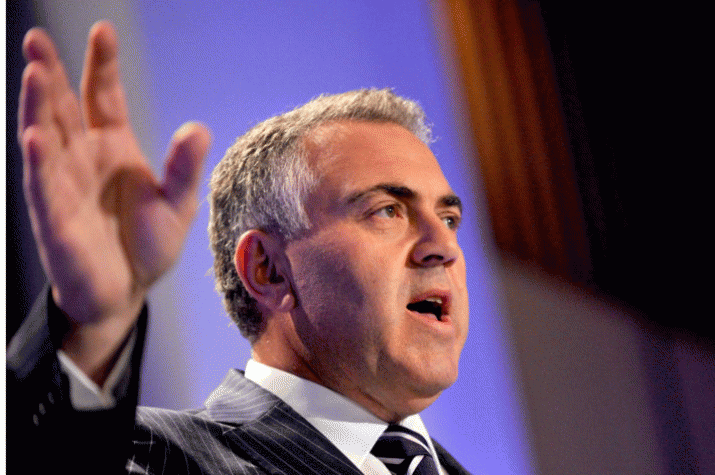

The dust is yet to settle on Smokin’ Joe’s first Budget, but despite the largely negative reaction, I suspect he’s pretty pleased with himself.
In a few weeks, media focus will have shifted, the ghettos won’t be awash with unemployed graduates rummaging through garbage skips, and people may even be accepting of the need to make a modest contribution to the financial security of their local GP.
This may be the harshest Budget in a generation. But compared to what incoming Governments have foisted on the populace in the past, it’s actually pretty tame: If you’re looking for real pain, Howard’s first Budget as leader springs to mind as does Malcolm Fraser’s razor gang a little earlier.
I’ve done some analysis on public sector numbers, and believe me, these guys have been handed the ultimate ‘Get out of jail free’ card. There’s scope for massive cuts in programs and delivery, and although possibly 40,000 jobs could be cut without the world ending, that hasn’t happened.
Yet.
Whether or not there was a Budget emergency can be debated until the end of the current political term, which expires in around half that of a Harvey Norman ‘buy now, pay later’ contract. We probably will be having that debate, given the Liberals’ relentless, if shallow claims about the former government’s financial management credentials.
If nothing else, these guys are consistent in their negativity.
Hence my growing belief that the Budget is actually a pretty clever piece of political manipulation. Just poorly delivered by a team of blue-tie wearing backbenchers.
As an observer of social media trends, I worry about many of our Liberal politicians, and not just for their penchant for the combover – often, the naivety of these people is almost inconceivable. Many of them behave as if in their university years they were dumped by a cute hippie chick in favour of a hipster leftie, and spent the next 30 years plotting some kind of macro-economic revenge.
So where the newly-elected Government could have been spruiking a positive message (better infrastructure, investment in medical research), we’re instead confronted with continued childish rhetoric about Labor’s debt, and Labor’s Budget mess.
But I think that’s part of a bigger agenda.
The following graph plots Budget forecasts of nominal GDP growth to the actual outcomes.


What it shows (probably to the delight of conservatives) is that historically, the economy has outperformed forecasts under Liberal Governments. If history is a guide, that should continue. Combined with the very modest economic outlook in the Budget, the potential for upwards revision seems quite likely.
Yes, many headline Budget initiatives are unpopular. But I suspect the Government is quite prepared to sacrifice some elements to appease a hostile Senate. That may even be a deliberate strategy.
Ditching the requirement for the poor to pay an extra $70 each year to visit the doctor would scarcely impact on revenue, and paint a picture of a Government that is prepared to negotiate – even if that means the $20 billion slush fund for doctors is wound back.
Making Gen-Y jobseekers move back in with the parents is also likely to touch a raw nerve in Liberal heartland, so a backdown on punitive treatment of younger jobseekers is also likely.
Here’s another graph, pinched from the internet.


It’s a picture of the elephant in the Budget room – the Australian dollar against the US. Despite what you might hear on breakfast television, this baby is going down – with significant benefits for the domestic economy. Those planning a trip to Europe should book now, and exporters should give the Treasurer a call to find a supplier of cigars, before the cost skyrockets.
But the impact of currency on both our terms of trade, and the retail environment barely rate a mention in Treasury forecasts. That’s a shame, because if the Aussie Dollar drops to 60 cents against the US, we may as well throw the Budget forecasts out the window, along with those plans for a European holiday.
Overall, I’m forming the conclusion the Budget is a fishing expedition – an attempt to throw some challenging social reforms into the sea of public opinion then assess the reaction.
If there’s a grumbling consensus, then the real agenda will emerge next year – radical cuts to workers’ rights, a genuine attempt to cut the size of the public sector, and implementation of some of the more extreme economic reforms raised in the Commission of Audit.
If not, then the Government has a backup plan.
Should the economy grow more than predicted (which it will), there will be a substantial war chest of company tax receipts arriving just in time for the next Federal poll.
Most of the cuts to welfare indexation can be scrapped (credit will be given to the Government for fixing Labor’s mess). Funds can again flow for health and education. We could even face the prospect of economic sunshine – all thanks to claimed Liberal economic management.
More responsibility can be shifted to the States, with a carrot in the form of a 12% GST together with more pressure to privatise assets like hospitals and real estate.
But until the next election rolls around, there isn’t really that much in the Budget to impact on the lives of middle Australia – a demographic now staunchly pro-Liberal.
I could be wrong – raising the scary prospect that the Budget is a genuine attempt to steer Australia’s economic future. A vision of a country where young people pick fruit until they are 30, then somehow transform into productive members of the community. A place where we accept that only the rich and privileged should benefit from tertiary education, and the poor learn about duty and responsibility from Church wardens in our schools.
And if that sounds like the Menzies era, then consider whom our new political leaders consider a role model.