Coroner & Legal
Focusing on systemic corruption and injustice

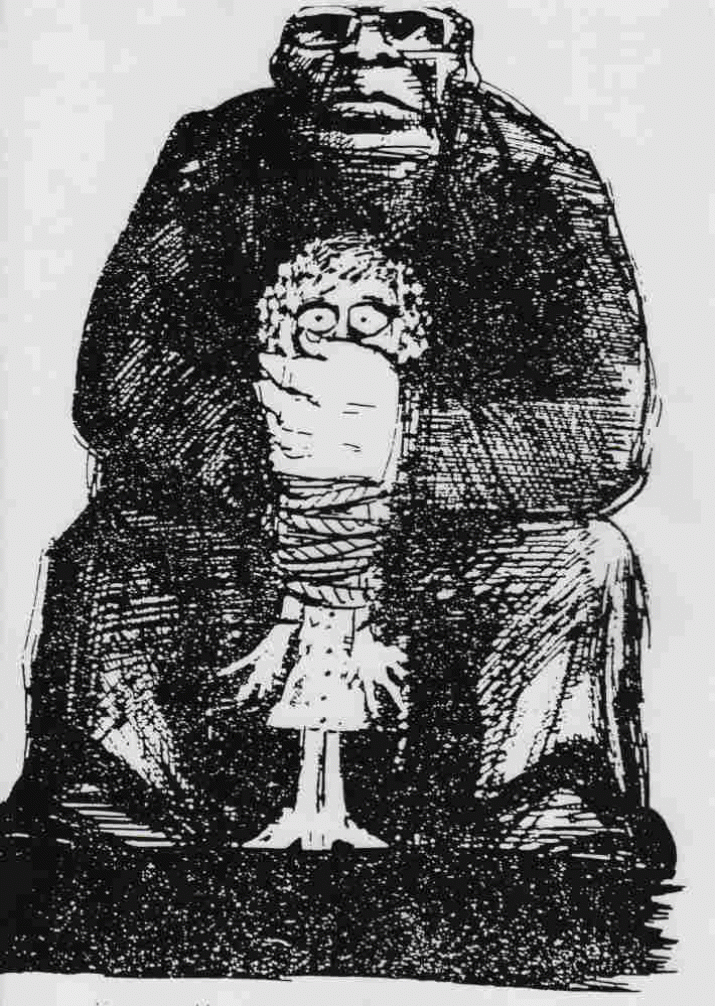

Image: Richard Wilson
David Obendorf has raised some critical questions in his comment on the recent article by Ivo Edwards about the fox eradication program ( here ).
[i]Reputations are on the line here, make no mistake. Being bunkered and putting up firewalls to hold back any scrutiny is not the answer. At some stage hierarchies need to be accountable for their public policy and decision-making processes. It wasn’t as if critics had not indicated the discrepancies in every aspect of this so-called ‘eradication program’ since 2001-02. Many public servants who proudly have their names affixed to the volumes of Tasmanian fox literature associated with this public hunt have now fallen silent or moved on. Some have joined other organisations. Some organisations, like the Tasmanian Conservation Trust, received direct state government recompense for their (apparently) tacit support. No-one was allowed to ask questions and, more importantly, no answers backed by substantial evidence were provided[/i].
What is the answer to these important questions, including those raised in other comments about the treatment of courageous public servants who reluctantly become whistleblowers in Taz-mania?
• An overhaul of the legislation dealing with public interest disclosures (PID)?
What does it take to encourage honest and ethical public servants to come forward in the public interest in the Taz-mania David Obendorf writes about – a state riddled with nepotism and cronyism, often with the appointment of unsuited gatekeepers or bullies into top positions of government agencies?
The 1990’s saw many whistleblowers in Tasmania speaking out about corruption, bullying and fraud in the public sector. Allwyn Johnson, David Obendorf, Terri Roberts, Trish Mobb, Dave Dannals, Sue and Pat Holloway, Kevin Moylan, Phillip Tattersall, Mick Skrijel, Michael Longbottom, Stan Hanusewicz, Geraldine and Geoff Allan, Tibby and Arnold Sierink over the lawyers funds fiasco and several others whose cases did not reach the media including a shocking case in the RSPCA.
Since the mid 1990’s Whistleblowers Tasmania has been calling for two critical provisions in the Public Interest Disclosure Act [2004] to give the legislation some chance of being effective:
• A witness protection unit independent of Tasmania Police, and
• Compensation provisions for a whistleblower or witness who brings proven matters of public interest to public attention.
Significantly the major shift since the proclamation in January 2004 of the Public Interest Disclosure Act has been the fact that a number of public servants have become the whistleblowers from the top of some of our justice and public watchdog bodies:
Dr Jocelyn Scutt Anti Discrimination Commissioner, Dr Patmalar Ambikapathy – Children’s Commissioner, former Ombudsman Jan O’Grady, Warwick Raverty – expert Advisor on the Resource Planning and Development Commission, former CEO of the Tasmanian Integrioty Commission Barbara Etter and last year former Director of Risdon Prison Barry Greenberry. It says alot about the systemic culture of corruption and integrity of those within the public service, that the majority of these whistleblowers are non-Tasmanians.
In Jocelyn Scutt’s final annual report to the Tasmanian government in her position as Commissioner of the Anti-Discrimination Commission reported that her employment experience was one of workplace mobbing, where she had been subjected to: bullying, pressure and other means … to curtail the integrity of the Commission’s decision making” in regard to dealing with complaints. She cited her experience as including incidents of “defamation on several occasions…. false imprisonment, abuse of process, contempt of court and victimisation” to the extent that she required police protection.
Upon Jocelyn’s departure from Tasmania she said that she had considered legal action against the state government and but such a process would require having confidence in Tasmania’s justice system.
http://www.smh.com.au/articles/2004/10/27/1098667839242.html?from=storylhs
Tasmania still relies on a sub-standard ethics commission when it requires a fully-fledged anti-corruption commission.
Any such body must gain the respect of Tasmanians. That can only occur if their procedures are transparent, the officials are independent of government and their sole function is to act ‘in the public interest’. Only then might we start to restore some honour to the island state – a state culturally crippled by entrenched bullying and systemic corruption. Many might say, ‘The parliament will never do that’ or ’It would cost too much’. Considering the cost to the taxpayer of campaigns to ‘shoot the messenger’ the compensation awarded to individuals who expose willful inappropriate action or intentional incorrect action pales into insignificance compared to money saved from the usual State-sanctioned cover up of such wrongdoing
But how else can our island develop real protection mechanisms – backed by legislation – for the increasing number of persecuted public servants fleeing the Tasmanian public sector, or Tasmanians in the private sector who contract for government agencies or corporations regulated by government? Tasmania needs to move promptly to the establishment of an effective independent anti-corruption commission.
The days when governments were content to rely on a tokenistic overseer of public malfeasance are over. Democracies in the 21st century want anti-corruption watchdogs that operate with integrity and transparency and earn the trust of all in the community not just the politicians nod regardless of what political party they represent..
The current Tasmanian Integrity Commission is a toothless watchdog.
It is over two years since Barbara Etter suddenly left her position as the inaugural CEO of the Tasmanian Integrity Commission. In that time, many corruption/whistleblower cases have been extensively covered here on tt – about Tasmanians whose cases have either not been taken to the TIC, or have been rejected without any reasons being publicly given.
Established just three years ago, Tasmanian Integrity Commission was criticised for lacking sufficient investigative and enforcement powers. In addition the Public Interest Disclosure legislation in Tasmania is still grossly inadequate in the face of numerous examples of systemic bullying in the public sector.
Tasmanians would be justified in questioning whether incremental changes in the powers of the Commission are an adequate response to the number of cases extensively analysed on Tasmanian Times, but not reported in the Tasmanian mainstream media.
Replacement CEO, Dianne Merryfull, when responding to community criticism claimed that the TIC had sufficient powers. Dinah Arndt reported in The Examiner on 11 September 2012 :
[b][i]‘Powers enough for Integrity Commission[/b]
Tasmania’s fledging Integrity Commission has enough muscle for now, according to its new chief executive.
A month into the role, Diane Merryfull has rejected claims that the state’s watchdog is a toothless tiger.
http://www.examiner.com.au/story/317777/powers-enough-for-integrity-commission/
She said the commission, set up two years ago, was already using strong coercive powers. That’s why Ms Merryfull is happy to wait for a parliamentary review of its operations due next year.
“They can reflect on our operations over three years and decide what to recommend to parliament and government as to whether or not we need more powers,” she said.
“I’m focused on using the powers we’ve got to their extent to do the job that we’ve been asked to do.”
With the state government rapidly tightening its belt, the commission must cut $83,000 from its $3.2 million budget this financial year.
Some have questioned the need for a commission at all. The chief executive says it is a necessity, not a luxury, because it’s the only voice for integrity across the sector, and the only oversight of Tasmania Police.[/i]
Unfortunately the situation for police oversight has not improved with the adoption of the TIC, until the establishment of the TIC, Tasmania Police were only made accountable by their own internal mechanism of police oversight of police.
The TIC has done nothing to address the number of police issues in terms of procedures, oversight and investigation and this can be seen by the fact that the first year report from the TIC highlighted that over one third of all complaints brought before the TIC were against Tasmania Police. It is also worth noting that the former CEO of the Integrity Commission ‘Barbara Etter’ came out in 2012 questioning Tasmania Police’s investigative procedures:
[i]Across all jurisdictions there is a movement towards having integrity bodies or accountability bodies, and there’s a reason for that: to put integrity and ethics at the centre of public life and at the centre of the public’s values. I don’t think that’s something Tasmania wants to be without.”
Complaints have dropped off after an initial flurry when the commission began operating on October 1, 2010. That included corruption claims dating back decades.
Last financial year the commission dealt with 108 complaints, compared with 131 in 2010-11.
Ms Merryfull is at pains to say the number of complaints is no indication of how effective the commission is.
During 2011-12, the commission trained 440 State Sector employees, 300 local government staff and 130 chief executives.
It also held information sessions for MPs, police and councilors.
“I’d like to make sure the public knows the full range of what we’re doing,” she said.
“Obviously, the investigations get a lot of attention and exercise people’s interest, but there’s a lot of other work we’re doing with agencies . . . that may not be so visible to the general public but which all contributes to a strong and ethically sound public sector.”
Since April [2012] the Commission has been using a new case management system that should make it easier to identify systemic problems. For now it is too early to pinpoint any trends. Ms Merryfull said the commission’s 17 staff were focused on handling each complaint on its merits.
Not even the court action lodged by the commission’s former chief executive Barbara Etter – who left 15 months into an $865,000 five-year contract – appears a distraction.
“I don’t want to comment on that except to say the Commission is more than one person, and it’s doing its job,” Ms Merryfull said.[/i]
Only one year later in November 2013, two months after Chief Commissioner Murray Kellam’s report to parliament in September on the TIC audit of Tasmania Police complaints completed in 2012, Dianne Merryfull was singing a completely different tune.
[b][i]Watchdog wants new tag, bigger teeth[/b]
http://state.governmentcareer.com.au/news/watchdog-wants-new-tag-bigger-teeth
Tasmania’s Integrity Commission wants to take on certain police powers to enhance its corruption investigations.
In a recent submission to a parliamentary review, the government watchdog said it wants high-tech spying tools employed by police forces to monitor people’s behaviour through their digital devices.
The Tasmanian Integrity Commission says it cannot fully perform its function without better tools to investigate. Those tools include access to Tasmanian Police databases and the technology to intercept phone calls.
It also wants to be legally elevated to the status of a law enforcement agency.
Many members of the public would be keen to see greater powers given to the group to investigate corporate and government corruption.
Tasmania’s Integrity Commission chief executive Diane Merryfull says there needs to be a number of new rules for it to be truly effective. Ms Merryfull says the watchdog cannot assess the extent of public service corruption while reporting is not mandatory.
If it were compulsory to report cases of serious misconduct, the Commission would find it easier to hold agencies to account, she says. “We have no way of knowing that’s why we want to have mandatory reporting, so we can keep an eye on how agencies are dealing with misconduct that comes to their attention.”
The Tasmanian Integrity Commission wants the ability to publish reports to both houses of parliament, outside of sitting times, to increase awareness of the organisation and its processes.
Such changes have been tabled before a parliamentary committee for consideration[/i]
The investigation into the disappearance of Bob Chappell in 2009 is the most significant case which indicates the serious failure of the justice system in Tasmania. In light of the overwhelming evidence associated with flawed police investigations and irregularities during the trial of the case, the Labor/Green government has rejected holding a Commission of Inquiry into the case and a coronial inquest into the disappearance of Bob Chappel has never been completed. With no body found, no weapon, no motive and no confessions, the case was entirely circumstantial. Sue Neill-Fraser received one of the harshest sentences given in recent Tasmanian legal history with an initial sentence of 26 years reduced to 23 years after appeal. This case must haunt all Tasmanians until such time as a full and independent inquiry is held to establish how our legal system has failed so horrifically and Sue Neill-Fraser has lost her basic civil liberties – the right to live at freedom in our society.
Tasmanians need a wake-up call to the extent of systemic failures within our justice system. With so many instances of cronyism, nepotism, bullying and systemic corruption in the Tasmanian public service, the issue of changing this entrenched culture should be front and centre stage in the lead-up to the state election in March.
Tasmania, unlike states such as New South Wales, Victoria, Queensland and Western Australia has not yet had a royal commission of inquiry into our justice system. Also unlike these other states, Tasmania does not have a properly functioning anti-corruption watchdog.
Therefore there is a substantial difference in the overall accountability of our public service as a whole, including the courts and judiciary, police, and the correctional services system. A canker permeates right through to nepotism and cronyism in governmental departments, the ‘Tasmanian disease’.
Tasmania’s community needs to focus and pressure all political parties to address systemic corruption. The Greens silence since becoming part of the Labor government’s fifth term in office has been a great cause for concern for many Tasmanians who supported them with votes in the hope they would bring a better transparency and accountability into government.
The Liberal Party has also failed to truly address the inadequacy and shortfalls of the TIC but would be in a fantastic position, if elected on a ‘clean-up slate’, to establish genuine oversight and differentiate themselves from the old administration.
Such an approach has been a key feature of recent incoming Liberal governments in states such as New South Wales, Victoria and Western Australia, which have all used their first term back in power to promote independent commissions against corruption so as to rebuild public confidence.
Which candidates standing for the upcoming state election, due to be called before May 17 are going to publicly support the establishment of a fair-dinkum, independent anti-corruption watchdog in Tasmania?
A group of interested individuals are gathering on 15 February from 10am to 5pm at the Friends Meeting House, 395 Argyle Street, North Hobart, for a community discussion forum titled Systemic Corruption and Injustice in Tasmania – Joining the Dots. The morning session will be a discussion of the many cases that have been written about extensively over the years on the Tasmanian Times website and the afternoon session will discuss some strategies for community action. For further information contact email: opal@intas.net.au