Coroner & Legal
Death of the Forestry Department: Part 1


Mr Darling: The Forestry Department is rotten, stinking, and until the matter is cleared up …
The Acting President (Mr Shoobridge): The member is out of order in using the word ‘stinking.’
Mr Darling: I will withdraw the word ‘stinking,’ but will leave ‘rotten.’
Legislative Council debate, 17 October 1945
Forestry scandals in Tasmania are nothing new. This three-part article summarises some remarkable scandals from 70 years ago. Their exposure was behind the State overnment’s decision to establish the Forestry Commission in 1947, replacing the Forestry Department created by the Forestry Act 1920. The catalyst was a little-known Royal Commission into ‘irregularities’ in forestry administration.
Prelude
There had been rumours of corruption and improper Ministerial influence in the years leading up to the Second World War. Sawmillers in the North-West were said to be paying Forestry Department officers for information, and for favoured treatment when applying for Crown forest lease and permit areas.
The Forestry Department conducted an internal investigation in 1943. Acting on the results, the State’s Labor government asked the Audit Department to inquire into particular allegations. The inquiry was never completed. Four inquiries followed into the administration of Tasmanian forestry: one by a select committee of the Legislative Council, one under the provisions of the Public Service Act, one by the Parliamentary Standing Committee on Public Accounts, and one by the Commonwealth Controller of Timber. All four were inconclusive.
One reason was that sawmillers were reluctant to talk. A Forestry Department Inspector heard that a certain sawmiller might accuse a certain Forestry officer of corruption, but that officer might one day be in charge of forestry matters; the miller was afraid that he would then be treated unfairly, in revenge.
In July 1944, the Solicitor-General asked Stanley Burbury, a prominent Hobart legal practitioner, to investigate matters arising from previous inquiries, this time with the assistance of the police. The inquiry lasted more than a year. Burbury reported in September 1945 that there was no evidence for any wrongdoing:
‘My conclusions are therefore stated upon a strict view of the evidence obtained. Some of such evidence might give rise to suspicion in some minds, but in compiling the report and making my comments, I have not concerned myself with rumours and hypothetical assumptions unsubstantiated by evidence. It may be said that some of the evidence is suggestive of bribery. But I have not considered it any part of my function to state hypothetical cases against the persons concerned upon insufficient evidence.’
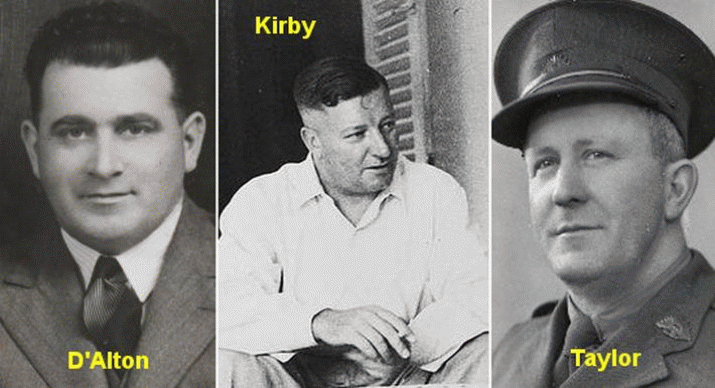
Burbury was particularly coy about one of the matters he investigated. He said that Minister for Forests T.G.D. (‘Tommy’) D’Alton ‘took a somewhat unusual, direct, and personal interest in applications’ by certain companies making applications to the Department. Burbury excused the Minister on the grounds that D’Alton was ‘impatient of departmental delays’.
The Burbury report was regarded by some members of Parliament as an expensive whitewash. Among the discontents was Joe Darling, M.L.C., a famous cricketer who had been elected to Parliament as an Independent in 1921. On 15 November 1945 Darling made sensational new charges of corruption under cover of Parliamentary privilege. One charge concerned the Premier, Robert Cosgrove.
State Cabinet met on 19 November and agreed to appoint a Royal Commission to investigate allegations of bribery and corruption in forestry matters. A bill to establish and fund the Royal Commission received Parliamentary approval two days later. Ironically, the 76-year-old Darling never saw the Royal Commission in operation. He died on 2 January 1946, two weeks before the Commission began taking evidence, following gall bladder surgery.
The Kirby Commission
The Royal Commission was headed by Judge R.C. Kirby of the NSW District Court, who was granted leave by the Commonwealth from duties with the Australian War Crimes Commission. The Solicitor-General instructed R.F. Fagan to assist Kirby. A crowd of lawyers appeared for the Premier, the new Minister for Forests and the many people named in the Commission’s terms of reference.
The ‘Forestry Commission’, as it was called in the press, sat for four months. Witnesses who had been interviewed by Burbury and the police repeated their statements before Kirby, this time under oath. Examinations and cross-examinations were reported almost daily in Tasmanian newspapers.
Kirby completed his report quickly and presented it to the Governor on 25 May 1946. He dismissed many of the alleged ‘irregularities’ as untrue, unsupported by evidence or not worth pursuing. However, Kirby found that two Forestry Department officers, Melville Garrett and Donald Chisholm, had repeatedly accepted bribes from sawmillers. Garrett and Chisholm were sacked from the Department in July 1946, indicted on corruption charges and bailed. When their cases were heard in the Criminal Court in Hobart in September, the Crown said it would not be prosecuting. No explanation was offered.
Kirby also found that former Minister for Forests D’Alton had accepted bribes and had acted improperly. D’Alton was a boilermaker and union leader before entering politics. He was elected as a Labor MHA for the northwest electorate of Darwin (now Braddon) in 1931, taking on his first Ministry in 1934 and becoming Deputy Premier in 1941. In 1944 he resigned from parliament and served as Australia’s High Commissioner in New Zealand. Although D’Alton had returned to Tasmania when his NZ position lapsed in early 1946, he had refused to appear before the Royal Commission.
D’Alton’s first trial in the Criminal Court, in September 1946, concerned the charge that in early 1943, while Minister administering the Forestry Act, he had ‘corruptly solicited or received or obtained for himself’ Huon pine to the value of £94 from Zeehan sawmiller R.J. Howard. The timber was said to be an inducement for D’Alton to favour Howard in dealings with the Crown. In 1943, the Tasmanian Wooden Shipbuilding Board placed orders with Howard worth more than £12000. The Minister with responsibility for the Board was D’Alton.
During the trial, D’Alton said he had heard Howard was in Hobart one day in March or April 1943. He met Howard on the street and paid him £95 in cash for the timber, from a box he kept in his office for greyhound ‘racing purposes’. Howard said he gave D’Alton a receipt for the money, but did not keep a copy. D’Alton was unable to produce the receipt in court. He said he had destroyed the receipt, along with other private papers, when he left Hobart for New Zealand.
The jury acquitted D’Alton and Howard.
A week later, D’Alton was remanded in connection with a second charge, this time of accepting money from two Melbourne businessmen in return for favours (see part 2 of this article). The Solicitor-General successfully applied to a Victorian police magistrate to have the two businessmen ‘taken under police warrant to Tasmania to stand trial on charges of corruption in business and bribery of a public officer’. Lawyers for the businessmen applied to the three-member Full Court of Victoria to review the magistrate’s decision. By a two to one majority, the Full Court said that the businessmen could not be taken to Tasmania.
The Crown in Tasmania now had three options. It could appeal to the High Court of Australia to reverse the Victorian court’s decision, it could proceed against D’Alton alone, or it could drop all charges. On 1 October 1946, the Solicitor-General told the Criminal Court that the D’Alton prosecution would not proceed.
No further legal action was taken by the Crown based on Kirby’s findings.
Bob Mesibov is a former Tasmanian forester with an interest in local history. His website http://www.circularheadhistory.info/forests recounts little-known stories from the forests of Circular Head.
• The full Royal Commission report is in the Tasmanian Parliamentary Papers for the year 1946.
Part 2 will run next Monday. Part 3 the following Monday
• John Biggs, in Comments: I was fascinated to read about Burbury’s whitewash. That was completely in character of defending the Establishment whatever the evidence. Years later in 1956, Burbury then Solicitor General was chairing a University committee of enquiry into the conduct of Professor Sydney Sparkes Orr. Orr had been largely instrumental in getting a Royal Commission into maladministration at the University; the Commission found the Council and Vice-Chancellor Hytten wrong on several counts. In revenge, Hytten, with Council member Burbury leading the attack, tried to sack Orr, unsuccessfully until a prima facie case of his seducing a student came to light. When Orr tendered his resignation from the Chair of Philosophy (to protect his family not as an admission of guilt, he said) he would be due six months salary, but Burbury said: “What we shall do to Orr will cost us less than six months’ salary.” (It cost the University much much more, including its reputation). When Bill Hodgman, Orr’s lawyer (and father of Michael) accused Burbury’s committee that what it was doing was illegal, Burbury cheerfully admitted: “Of course it is!” Burbury was a thoroughly nasty piece of work but that didn’t prevent him (it probably helped, given the nature of Tasmanian Establishments) becoming Chief Justice then Governor of Tasmania with the main hall at UTAS being named after him.