Economy
Bass Strait: The Tasmanian Government can act right now

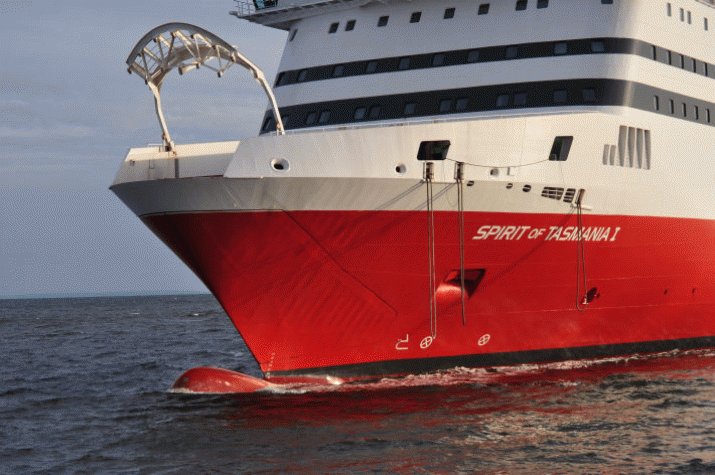

BASS STRAIT – The way ahead under an Abbott Coalition can be very positive but the Tasmanian Government can also act right now
The Abbott Government is expected to shortly engage the Productivity Commission and the Australian Consumer and Competition Commission in a joint review of both Federal Bass Strait equalisation schemes on grounds of equity and efficiency.
For equity and its economy, Tasmania deserves to have the same surface and air links as other states.
A federal review process will presumably allow consideration of existing restraints on the movement of people, all types of vehicles, and freight. Such review is important for the whole Tasmanian economy.
Facilitating the movement of people, with a vehicle or without, and being able to travel for any purpose is critical. Bass Strait shipping should be seen as adjunct to and be compatible with the existing national highways it connects.
Whilst a part of the accommodation sector seems to be adequately catered for by the existing status quo, the singular focus of federal support for accompanied vehicles for driving holidays for mainlanders, holiday packages or travel experiences, needs to change.
The accommodation sector plays an important role in the Tasmanian economy and can measure precisely its impact on the economy. What can’t be measured as well is the opening of a comprehensive highway based transport link connecting the capital cities of Hobart and Melbourne – for the first time since the sea lanes alone connected the colonies. It is reasonably believed by many that the drawing potential of such a link can be very substantial.
Many Tasmanian service industries are larger than the accommodation and food services sector. Such industries need access to people as a vital part of doing business. They need all year, highway fare equivalence to guarantee them access to greater numbers of customers, not just those with a focus on driving holidays.
These service industries together have a far greater chance of growing the Tasmanian economy than a trickle down economic impact from the relatively smaller accommodation sector benefitting from driving holiday packages.
Redirection of federal funding, whilst maintaining equalisation, will treat all industries equally. It will also provide the opportunity for retaining Tasmanian residents by increasing the amenity of living in Tasmania through low cost, every-day, consistently priced access to the rest of Australia.
With this support, sufficient critical mass may be achieved for many industries and activities. Overheads of businesses across Tasmania can be spread over more customers and offer the possibility of lower prices for many goods and services. Also a competitive air and sea access policy, as exists with between all other states, should be of advantage.
The Abbott Coalition says it intends to also review the existing freight equalisation scheme. All sea freight needs to be covered. Southbound coverage of consumables, will allow Tasmanians the benefits of fair competition that others interstate enjoy. Lower prices can be expected.
As part of a completely equitable surface link or national sea highway, international exports will then be able to be carried as on any other part of national transport network, at highway equivalent costs. WTO concerns or relying on just a direct international shipping link to Tasmania, if it ever eventuates, will no longer be a difficulty.
Any ships from Asia bringing in consumables direct to Tasmania should also justifiably need to compete with consumables from the mainland, to be fair to mainland suppliers. Such is the case with international shipping services directly connecting other Australian ports.
The impact of an equitable link can be immediate. There is large unused shipping capacity available, many under- utilised ports and uncapped and relatively untargeted federal equalisation funding. Significant drivers of wealth in Tasmania can promptly take advantage of a fully equalised sea highway to the largest population corridor in Australia at Tasmania’s doorstep.
A comprehensive sea link can make Tasmania, rich with natural and developed strengths, far more productive and turn an existing sea barrier into a highway. Funding a better link to Tasmania is also economically dry as all other states are already fairly connected.
Efficiencies can result – shorter and quicker crossings, higher passenger vehicle ratios by encouraging more passengers per vehicle, savings to the Commonwealth by some leaving car at home and travelling as foot passengers, as passenger traffic increases less carbon emissions per passenger, better use of public and private investment on both sides of Bass Strait, greater freight movements and other efficiencies through better integration of the economies of Victoria and Tasmania. Air series to Tasmania may increase with a more viable economy. Many types of other services across Tasmania can also improve.
This review can be about getting the corridor and the economy of Tasmania working better, once and for all. It would be very hard for any ACCC or Productivity Commission review, established with sufficient terms of reference, to find against fair interstate linkages and the need for same competition policies as are enjoyed by all other states.
What should not be forgotten is that the Howard Coalition promised Tasmania that Bass Strait would be part of the National Highway and accepted that “the Federal Government has a special responsibility to achieve equality for Tasmanians in developing opportunities for their state”. Consistent with this undertaking, the Abbott Coalition continues to well fund two major equalisation schemes, both introduced by the Coalition, and is, now appropriately, to review them.
Application of federal equalisation schemes that skew or limit access or favour some industries over others should have no place on an interstate inter-capital national sea highway needed and used by all.
With a rapidly approaching Tasmanian state election, it should be remembered that the impact of one of the federal equalisation schemes can be easily redirected, right now, by the Tasmanian Government through its TT Line. This move could go along way to deliver transport equality for both passengers and vehicles.
Given the current state of the economy, it would be a pity if the Tasmanian Government chose not to take more advantage of this very valuable asset, obtained largely as a result of a public campaign for Bass Strait transport equality.
• Mercury: New Lyons MP questions TT-Line’s interstate commitments