Opinion
Heritage in Hock

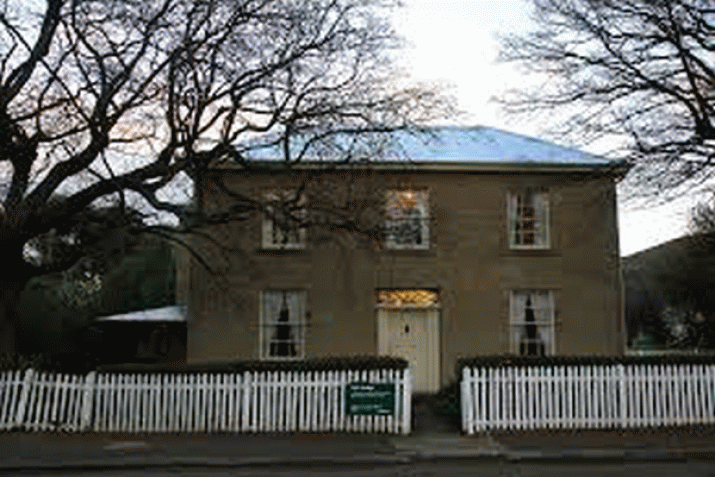

Parliament Fails Tasmanian Built Heritage
The Parliament of Tasmania’s key measure to protect public ownership of, and public access to, much of the built heritage of Tasmania has failed.
In 2006, the three major political parties in Tasmania collaborated in a financial experiment to remove from the State’s books the costs associated with a significant slab of Tasmania’s built heritage and to instead cover it by private debt financing.
This experiment has gone “awfully wrong” and, despite current interest rates being at record lows, local communities in Tasmania will pay by having parts of their built heritage privatised. The first location will be the Coal River Valley community and the loss of Oak Lodge, Richmond. It has been very instructive to read extracts from the Hansard record of the second reading debate of the NATIONAL TRUST BILL 2006 (No. 46). [http://research.lawlex.com.au/tempstore/TAS/Hansard/B06-46SR.htm, accessed 10 August, 2013]
The National Trust (Tasmania) was placed into administration on 29th December 2004. According to the 2006 Hansard record, the then Minister for Tourism, Arts and the Environment stated:
“The Trust was placed in administration for the long-term benefit of the organisation and to allow time for the Trust’s credibility to be restored. It was in the public’s interest that the Government intervene to assist in preserving the Trust as a viable entity and help ensure its sustainability in the future. A government advisory council comprising of five members was also appointed during this period.”
“The government advisory council has taken time to consider the most appropriate future governance arrangements for the Trust. This was achieved through consultation and regular communication with Trust members. The advisory council’s recommendation to establish the Trust as a body corporate with a board of directors has been accepted as being the best way forward. To continue the Trust under its previous governance arrangements would undoubtedly have meant the eventual winding up and disappearance of the Trust.”
“The initial board will be appointed by the Government in order to ensure that the significant amount of government funding is appropriately managed. While the initial board will be government appointed, the directors will be required to act at all times in the best interests of Trust members and volunteers.”
“The decisions made will be based on sound management principles, and where appropriate, in consultation with members and volunteers. Whilst not included in the bill, counterpart regulations will require the board to hold regular regional forums to meet with Trust members and volunteers to discuss their ideas.”
“This position has been widely disseminated through the circulation of papers, forums, information sessions and open letters to Trust members and volunteers. It is clear that while some members are apprehensive about the proposed changes, the majority support the move to the Trust becoming a body corporate as being the only real way forward.”
“This bill allows for the appointment of the initial board of directors, including the inaugural chair, by the responsible minister. It establishes the initial board of six non-executive directors and a managing director. Of these six non-executive directors, three will be deemed elected. This allows Trust members to begin electing members to the board. Trust members will start to elect members to the board after its first year of operation, with a new member being elected each year for three years. Within three years the make-up of the board will include three elected members, three members appointed by the minister and a managing director.”
“The long-term goal for the Trust is that it becomes sufficiently self-sustaining to be independent of government. The bill makes provisions for the responsible minister to relinquish responsibility for appointing three board directors if and when the Trust is judged to be self-sustaining. This will result in the Trust members being responsible for electing all six directors of the board.”
“Under this bill, the board will be more accountable in its operations, according to current best practice. The bill clearly defines the board’s roles, responsibilities, powers and functions.”
“Finally, the bill includes suitable transitional provisions to ensure smooth transition from administration to the newly established body corporate. All property, investments, funds, debts and legal proceedings are transferred to the body corporate. The initial board and managing director will resume responsibility from the date of proclamation, and the functions and the powers of the administrator will cease.”
“In conclusion, this bill provides the Trust with the chance to exit administration and move forward to re-establish itself as an important and progressive player in Tasmania’s historic heritage sector. It also heralds a greater commitment on the part of the Tasmanian Government to support the Trust. This year’s State Budget has committed $970 000 over the next four years to assist the Trust in its work as it moves forward.”
The then Opposition spokesperson, Mr Hidding stated, according to the Hansard record:
“We hear from the minister in the second reading speech just delivered that this bill is necessary because the Trust is about to exit administration. I am going to place on the record that I do not believe that is true. That is because this bill before us has a flaw in it – a deliberate set of circumstances built into it. To all intents and purposes, for the elected members of the Trust it means it does not come out of administration at all. I refer to the proposed membership of the Trust and the methodology of appointment of people to the Trust as their terms expire.”
According to the Hansard record, the then Leader of the Greens stated:
“ Mr Speaker, I am very pleased to make a contribution to the future of the National Trust. The Greens are long- time diehard supporters of proper protection of our cultural heritage, in particular our built heritage, in Tasmania. Indeed, if you look to the inaugural speech of one of our previous leaders in this place, now Senator Christine Milne, you will find she made a major point of her commitment to legislation to protect Tasmania’s European cultural heritage. When she was elected we did not have the Historic Cultural Heritage Act that we now have and in fact it took a number of years to achieve that legislation.”
“Having had a look at that scenario, I think I understand why the Government has decided that body corporate is actually a better way to go at this juncture. I did explore the issue of their becoming a simple incorporated association, but appreciate that because of financial and governance issues it probably was not an appropriate structure, and it is certainly not one that I have had members of the Trust advocate to me. We have to recall that the Trust has quite substantial assets that are worth a lot of money, approximately $3.5 million.”
Mr Michael Hodgman – “At least.”
Ms PUTT – “At least. If it were sold on the open market, it would probably be worth a lot more, but that is not going to occur, one would hope, so those assets are not necessarily going to be realised unless something goes awfully wrong.”
Mr Michael Hodgman – “It is relevant as to borrowing powers – equity.”
Ms PUTT – “Yes, that is right.”
According to the Hansard record, the then Minister for Tourism, Arts and the Environment stated:
“When the Trust went into administration on 31 December 2004 their debt was some $765 171. As of last Tuesday the level of debt was $ 576 000, so during the time that the Trust has been in administration the level of debt has been reduced by $189 000, which is a 24 per cent reduction over that time. That is a significant inroad into the debt held by the Trust and it should be noted by members that that is just the initial work done by the administrator.”
The NATIONAL TRUST BILL 2006 (No. 46) was supported by all political parties and by all Members of Parliament.
When one examines the current situation it is apparent that none of the aspirations of the 2006 Bill were fulfilled.
The prescription in the Bill for bringing the National Trust (Tasmania) out of administration has obviously not been for the long-term benefit of the organisation.
The National Trust (Tasmania)’s credibility has not been restored, it has been destroyed.
The Government’s intervention has not been in the public’s interest in that the National Trust (Tasmania) has not been preserved as a viable entity and that its sustainability in the future has not been ensured.
The regulations associated with the Bill were supposed to make National Trust (Tasmania), a democratic, consultative organisation. As a member I believe that this is not the case.
It is apparent from the Parliamentary debate, as recorded in Hansard, that the National Trust (Tasmania) was to be debt financed, that is, the historic property assets of the organisation were to be used to raise loans. I believe that this is not appropriate for an organisation that is custodian of heritage property. When a loan on a house or to a business defaults, the consequences are mainly limited to those directly associated and are usually transitory. If a loan secured by a publicly-owned, built-heritage property defaults, the loss is born by the whole community and is permanent. It is now apparent that the debt of National Trust (Tasmania) cannot be serviced even at a time of record low interest rates and that the National Trust (Tasmania) owned property, Oak Lodge, Richmond, is to be sold. The banking sector is to stand condemned for accepting sub-prime mortgages over heritage properties, mortgages that could not be reasonably repaid.
It was also mentioned in the Parliamentary debate that the National Trust (Tasmania) needed $250,000 p.a. from the government and that $300,000 p.a. was being provided. This estimate of the National Trust (Tasmania)’s requirement for its basic annual finances has proved woefully inadequate.
It is highly unusual for an organisation to come out of administration with a high level of debt. In the case of the National Trust (Tasmania), all debts were retained, and this was recognised at the time by Parliament. It is apparent that the Administrator of National Trust (Tasmania) picked all the low-hanging fruit when it came to making significant savings and that there were few savings to be had once the organisation was out of administration.
National Trust (Tasmania), by its actions in wanting to sell Oak Lodge, Richmond, has effectively eliminated bequests as a future source of assets and income. Who would leave property or items of value and historic interest to National Trust (Tasmania) knowing that they will be sold to service National Trust (Tasmania)’s massive debt and running costs.
The National Trust (Tasmania) has demonstrated no ability to raise funds from the public to solve its debt problems. Despite a public offer of seed money from the Premier, the National Trust (Tasmania) has been unable to initiate an appeal. “Selling the farm” seems to be its only means of making money.
Ms Putt, in the Parliamentary debate stated: “those assets are not necessarily going to be realised unless something goes awfully wrong.” Something has gone “awfully wrong” and that “something” was supported by all political parties.
The Parliament of Tasmania should put “something” effectively right and return Oak Lodge to the Coal River Valley community without them having to raise half a million dollars for a property that was donated to that community with National Trust (Tasmania) as the, unfortunately-chosen, nominated custodian.
Risk management is consideration of all consequences. Politicians have decided that the risk of voter back-lash on built heritage management is less than that concerned with financial management despite the issues being linked.
Visitors come to Hobart to visit MONA and MOFO and are occupied for a day or so. It is other attractions, such as built heritage and the environment that keep them in Tasmania.
Dr. Michael Wadsley runs an engineering calculation consultancy from Richmond, Tasmania. After receiving primary, secondary and tertiary education in Hobart, he was with CSIRO and Monash University in Melbourne. He has used his research background both to discover more about the people and places of Tasmania’s heritage and to uncover the basis of the challenges facing Tasmania’s built heritage today.