Economy
FBT hysteria

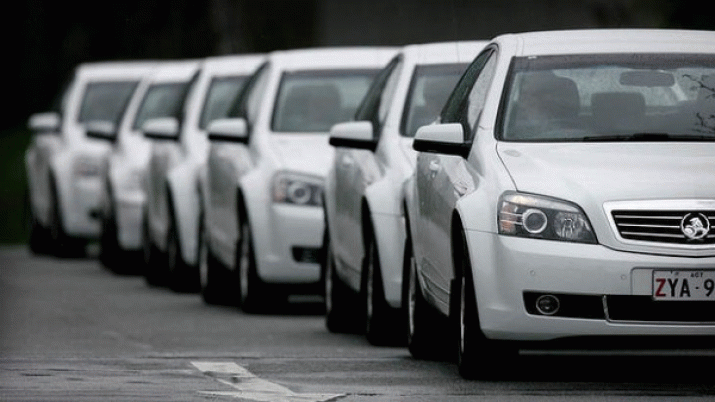

Hysteria from interest groups whenever governments announce plans to trim handouts usually indicates an absence of suitable contra arguments. Government plans to change the fringe benefits tax treatment of motor vehicles is a case in point.
How dare the government contemplate reducing allowable claims for motor vehicle expenses to amounts actually incurred in earning assessable income?
It’s reminiscent of the outrage that accompanied the curtailing of entertainment expenses, which critics said would destroy the restaurant industry. Before the changes, a little imagination combined with few scruples made it possible to categorise many social engagements as deductible entertainment events when they were really just mutually agreed taxpayer-funded piss-ups.
Before the introduction of FBT, non-cash employee benefits were caught by Section 26(e) of the 1936 Tax Act. However, the two-line sub-section was more honoured in the breach than the observance, and a whole new act, the FBT Assessment Act, replaced it.
Rather than pay FBT on a log-book-determined amount of private use and hence confine motor vehicle claims to amounts actually incurred in earning assessable income, an employer could elect to apply the statutory formula, a percentage dependent on annual mileage, to the cost of the car in order to calculate the amount of fringe benefit.
Following the Henry Tax Review, the statutory formula of 20% was adopted regardless of distances travelled. A $50,000 car now results in an annual fringe benefit of 20% or $10,000. The value of a benefit is the deemed net value to the employee and is the first step in calculating FBT. Grossing up the benefit and then applying the FBT rate of 46.5% results in FBT of $9,600. The employer claims a deduction for all vehicle costs plus the FBT paid and reduces the employee’s salary accordingly as part of a salary package. The employee receives a reduced salary but not before effectively getting a tax deduction for otherwise private expenses, offset in part by the FBT paid.
If business use is low and one’s marginal tax rate is not too low, it’s worth salary packaging in the manner described. The higher the tax rate and the amount of private use, the greater the tax savings. The median level of tax savings generated by a salary sacrificed car is believed to be about $3000 per annum.
Colin Brinsden from AAP, as run in The Sydney Morning Herald …
Read the full article with full links on John Lawrence’s blog, Tasfintalk, here