Environment
A Hundred Year Plan for Human Survival

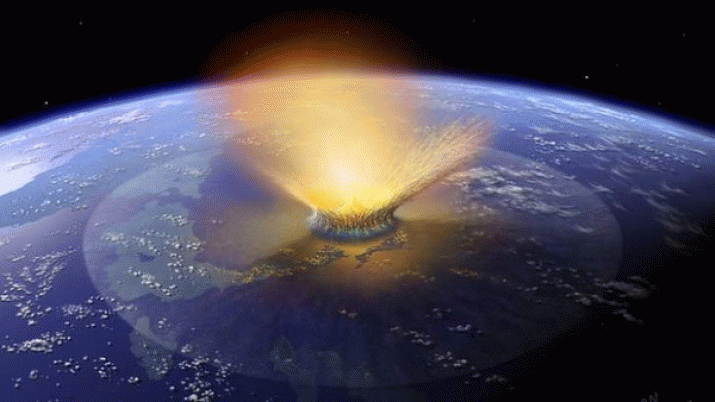

Pic: Deep impact: An artist’s impression of a huge meteorite striking Earth 65 million years ago, sending the dinosaurs and many other life forms into extinction. Photo: Reuters
Is the stage now set to create a hundred year plan to deal with the twin perils of asteroids and carbon?
The Obama administration recently issued a “grand challenge” to one and all to find asteroids that could harm us and figure out how we can defend ourselves from doomsday rocks [1] and then a few days later President Obama pressed on to launch a presidential initiative to tackle the carbon crisis, which has been caused by burning too much fossil fuel. [10]
There will be little point in winning back a safe Earth beyond the fossil fuel dilemma, if we look up to see a civilization-killing asteroid arrive to take us out.
Reporting on the US initiative with asteroids in the Sydney Morning Herald, Mark Matthews wrote, “….. orbiting somewhere near Earth are an estimated 13,000 asteroids big enough to possibly level a country – and NASA has no clue as to when, where or whether they might strike. Worse, astronomers think their sky maps might still be missing an additional 50 to 100 asteroids so massive – roughly a kilometre across or larger – that they could end civilization if they hit Earth.” [1]
With millions of asteroids in the Asteroid Belt and many times more flying among the planets, getting on top of asteroids is a major survival challenge for our civilization.
“We want to prove that we are, in fact, smarter than the dinosaurs,” [1] declared NASA’s deputy administrator Lori Garver, referring to the great lizards that are believed to have met their Waterloo when a monster from space struck the Earth 65 million years ago.
We can look at the Moon to see how often the Earth has been struck by asteroids and comets, but the event that became a wake-up call happened in February 2013 over the Russian city of Chelyabinsk.
This asteroid was only 17 metres in diameter, but exploded with the power of 33 Hiroshima type atomic bombs and if this space rock had been just a little closer to the ground, it could have flattened the city with thousands killed. [2]
Following the Chelyabinsk event, the Russian Deputy Prime Minister Dmitry Rogozin called on the nations of Earth to united to build a planet defence system.
“This system should become global and universal in its technical and political sense and is a matter of agreement in the framework of the United Nations,” Rogozin said. [3]
Now Russia and the United States have declared that they will work together to defend our planet from asteroids and have invited other nations to join them, including “….. Canada, Europe, China, and Southeast Asia, …..” [4]
That would include Australia in the firing line for recruitment to planet defence.
“The meeting also covered other kinds of natural emergencies, such as recent years’ extreme weather in Russia and United States, but it was cooperation to counter space threats that stole the limelight at the news conference.” [4]
Russia seems to be unfairly target by asteroids, as with the larger object from space exploded in 1908 over Siberia, 80 million trees were flattened in an area of 2,150 square kilometres.
A storm of such asteroids exploding close to the ground could terminate a nation and as many asteroids are made up of rocks and rubble held together by their own gravity, an asteroid strike on the Earth could become a firestorm of destructive meteors.
This was the fate of the first humans living in central and northern America, when an asteroid storm struck 12,800 years ago, also taking out many animal populations, including the mega fauna. [5]
Asteroids landing in the ocean can be just as devastating as those striking land, as when 2.5 million years ago a 2 kilometre wide asteroid hit the Pacific Ocean, generating a mega-tsunami hundreds of metres high. [6]
If we were able to identify and track every asteroid in the Solar System that could do us harm, this would not be enough.
The second largest body in the Asteroid Belt is Vesta, 525 kilometres in diameter.
When NASA’s Dawn explorer arrived at Vesta in July 2013, scientists thought they would find surprises, but no one expected to see a 21 kilometre high mountain that had been created by an asteroid impact. [7]
Asteroids frequently crash into each other and when they do, rock of all size can be flung into space, with some of this eventually arriving to hit the Earth, where many pieces of Vesta have been found.
As a consequence of this violence of the asteroids, we can never know when a 17 metre wide space rock, or larger, will arrive, as our visitor could be the result of asteroids hitting each other in space today.
To be able to fare better than the giant lizards when it comes to our cosmic survival, we will need to make a radical change to the very nature of our civilization, as to be able to defend our planet from space will mean building a robust industrial presence beyond Earth.
If our civilization awakens to the challenge of building our planet’s defences, the first need will be to construct solar power stations in space for power, tapping into the virtually unlimited energy-well of our star.
The Sun has so much fuel in reserve, it will continue burning fiercely over the next 5 billion years, until expanding to the orbit of the Earth as a red giant star.
Nature may only have a billion years to pursue the work of evolution on Earth, before the third rock from the Sun becomes too hot for life.
The construction of sunshades may extend our tenure on Earth, but eventually our descendants would need to move on, if they wish to survive.
By securing direct access to stellar energy from the Sun, we would be able to launch industry beyond Earth to create the foundation for planet defence.
Nations like Australia could play a leading role in rising to this challenge, working in collaboration with other willing nations.
The land Down Under could apply its technology and educated population to build space industries, create space ports, make this a national project and found our very first space agency.
The benefits would include an increased demand for skilled workers in the new space industries, the economic benefits of creating whole new industries and inspiring the students to enter careers in science and engineering, to participate in the adventure.
Young Australians would be able to dream of becoming astronauts and flying among the stars of the Southern Cross.
Responding to the threat from the stars would also open the way to solve another mega headache that we now face on Earth, with our carbon crisis.
We are told by the leading climate scientist James Hansen, that with atmospheric carbon dioxide (CO2) above 350 parts per million, we are going to cause very dangerous changes to our climate. [8]
Our planet’s atmospheric CO2 is now passing 400 ppm and is set to skyrocket, with the Earth beginning to add to the load from places like a fast warming Arctic region, where the permafrost is melting and the ocean floor methane hydrates dissolving.
In the future that we are creating now by releasing fossil carbon, we run the risk of causing vast algal blooms in dying oceans that release toxic hydrogen sulphide gas that can kill like on land and weaken the ozone layer, allowing higher levels of solar and cosmic radiation to reach the Earth’s surface. [9]
To survive in this future, we would need to live on Earth more as if we were living in space, wearing protection and living in protected environments.
With billions of tonnes of carbon to extract from the biosphere, especially the sea and no time to waste in doing so, we have a monster challenge ahead to win back a safe planet.
As a civilization that can split atoms, we know the chemistry of extracting carbon from CO2, but it takes a lot of energy to achieve this.
The energy needed could come from the Sun via solar power stations in space, making space development the ultimate green solution to problems on Earth.
By beginning to extract excess carbon from the biosphere, we will buy time to deal with the carbon crisis and begin a steady transition away from carbon energy.
With the Sun’s energy, we could also reprocess extracted carbon back into a useful resource for Earth and space industries, which could include using carbon-based materials to build protected environments on Earth in the dangerous years ahead, until we can win back a safe planet.
By expanding beyond Earth and building cities in space, we will no longer have all our eggs in one basket, should a very large asteroid come calling that is just too big to deal with.
In time, as our industrial strength in space increases, even a monster may be rendered safe, by nudging it aside, or mining the beast into oblivion for the resources.
By having a plan to defend the Earth and also win back a safe planet, we will be offering hope to the people of Earth, that we can survive and build a better future.
When hope burns brightly in the heart, the creative human spirit will be inspired to rise to the challenge to solve any problem.
We certainly have no justification to ignore the problem, when we know that even a small asteroid exploding in the air can destroy a city.
We cannot deny the reality of asteroids and nor can we deny the science of carbon, if we wish to invest in a future that includes survival.
Following on from his concerns about defending the Earth from asteroids, President Obama has now launched a new initiative to battle the carbon crisis.
“We don’t have time for a meeting of the Flat Earth Society,” he said. “Sticking your head in the sand might make you feel safer, but it is not going to protect you from the coming storm.” [10]
If Obama’s leadership with space defence and meeting Earth crisis come together in a unified vision, then it may be seen that building solar power stations in space is a key to dealing with both problems.
In the age of democracy, the key to action is not only in the hands of the rulers, but also resides in the will of the people to demand action.
When a critical number of people on Earth awaken to the needs of our cosmic survival, on Earth and in space and demand action, then our world will be rolled over into a new age.
The Green Party in the Australian State of New South Wales are proposing a plan to stop using fossil fuel generated electricity by 2030. [11]
Every small act helps, but considering the immense size of the carbon crisis, the action needed to transit out of carbon energy and carbon danger will be much greater, demanding global collaboration.
Considering the challenge we face to defend our planet from asteroids and win back a safe Earth from the carbon crisis, we may need a hundred year plan to turn the super-tanker of our civilization around.
Just as the Apollo program set an explorer from Earth onto the Moon within ten years, so the Earth and space defence plan may have decade-by-decade objectives, beginning with the construction of solar power stations in space.
A spin-off benefit will be to clean up the junk now in space from the first space age and keep space clean, as industry is established beyond Earth and the asteroid defences developed and deployed.
Industry in space, using stellar energy from the Sun and resources from the Moon and asteroids, may produce a vast range of robots that can be deployed to help clean up the mess of the industrial era on Earth, including junk floating around in the ocean.
Carbon may be extracted from the air at ground level, or at high altitude floating platforms.
It may also be possible to pump air into space, where the carbon can be extracted and clean air returned to the atmosphere.
Extracted carbon could be used in space industries, where with access to stellar energy, carbon can be process into a wide range of useful forms.
The initial cost will be high, but essential for our survival.
In time there will be no further cost to Earth, as space development becomes self-sufficient and the return on the investment will become infinite, from across the Solar System and among the stars.
In my document ‘Creating A Solar Civilization’ I describe this as the Liberty Line. [12]
By reaching for the stars, beginning with our Sun, we will be able to design a stellar economy without poverty and start building this future on Earth now.
By century’s end we can aim to have developed the ability to deal with any threat to the Earth and by building a presence beyond Earth, no longer have all are eggs confined in one Earthly nest.
By investing in this future, human communities will be able to live in orbital cities scattered across the Solar System that will generate an Earth gravity via rotation.
In his media address after being elected to the leadership of the Labor Party and for the second time, becoming Prime Minister, Kevin Rudd said, “….. here in Australia we’ve got to make our own luck and we can. We’re good at it and if we work at it we can actually bring our future home securely.” [13]
The same may be said of the whole Earth, that we must make our own luck, beyond the threat of asteroids and beyond the carbon crisis, as we look to a stellar future and a healthy planet.
By reaching to the stars to “make our own luck” we will have invested wisely in a cosmic survival insurance policy, which will generate hope on Earth from the time the work begins.
We will also be opening the way for some rather amazing stellar exploration.
(Kim Peart will be running for the Senate in this year’s election, with a particular focus on space development as essential for Australia’s future.)
NOTES
[1] ‘NASA aims to reduce asteroid threat’
Mark Matthews 20 Jun 2013 The Sydney Morning Herald
http://www.smh.com.au/technology/sci-tech/nasa-aims-to-reduce-asteroid-threat-20130619-2oisc.html
[2] ‘Meteor travelling at 18 kilometres per second released about 33 times the power of the Hiroshima atomic bomb’
Ilya Khrennikov 18 Feb 2013 The Sydney Morning Herald
http://www.smh.com.au/technology/sci-tech/meteor-travelling-at-18-kilometres-per-second-released-about-33-times-the-energy-of-the-hiroshima-atomic-bomb-20130218-2em5w.html
[3] ‘Russia Calls for United Meteor Defence’
Space Daily 36 Feb 2013
http://www.spacedaily.com/reports/Russia_calls_for_united_meteor_defense_999.html
[4] FEMA, Russian Ministry to join Forces against Space Threat
Space Daily 27 Jun 2013
http://www.spacedaily.com/reports/FEMA_Russian_Ministry_to_Join_Forces_Against_Space_Threat_999.html
[5] ‘Comprehensive analysis of impact spherules supports theory of cosmic impact 12,800 years ago’
Space Daily 27 May 2013
http://www.spacedaily.com/reports/Comprehensive_analysis_of_impact_spherules_supports_theory_of_cosmic_impact_12800_years_ago_999.html
[6] ‘Ancient asteroid delivered deadly double-punch’
Stuart Gary 20 Sep 2012 ABC Science Online
http://www.abc.net.au/science/articles/2012/09/20/3594552.htm#.UcqkO-CDqS0
[7] ‘Space Mountain Produces Terrestrial Meteorites’
Dauna Coulter 3 Jan 2012 Space Daily
http://www.spacedaily.com/reports/Space_Mountain_Produces_Terrestrial_Meteorites_999.html
[8] ‘Storms of My Grandchildren’
by James Hansen, Bloomsbury, 2009, p.223
[9] Extinction Events, Wikipedia
Kump, Pavlov and Arthur (2005) have proposed that during the Permian–Triassic extinction event the warming also upset the oceanic balance between photosynthesising plankton and deep-water sulfate-reducing bacteria, causing massive emissions of hydrogen sulfide which poisoned life on both land and sea and severely weakened the ozone layer, exposing much of the life that still remained to fatal levels of UV radiation.
https://en.wikipedia.org/wiki/Extinction_event
[10] ‘US president Barack Obama lays out new US plan to fight climate change’
ABC News Online 26 Jun 2013
http://www.abc.net.au/news/2013-06-26/obama-lays-out-plan-to-fight-climate-change/4780474
‘The President’s Climate Action Plan’
Executive Office of the President June 2013
http://m.whitehouse.gov/sites/default/files/image/president27sclimateactionplan.pdf
[11] ‘Greens plot exit from fossil fuels by 2030’
Ben Cubby 24 Jun 2013 Sydney Morning Herald
http://www.smh.com.au/environment/energy-smart/greens-plot-exit-from-fossil-fuels-by-2030-20130624-2osol.html
[12] ‘Creating A Stellar Civilization’
Kim Peart First written in 2006 and then revised in 2012
http://www.islandearth.com.au/index.php?option=com_content&view=article&id=46&Itemid=64
[13] ‘Kevin Rudd’s Speech’
The Age 27 Jun 2013
http://www.theage.com.au/opinion/political-news/kevin-rudds-speech-20130627-2oydw.html