Economy
Smelter for sale … a few months after power deal signed …

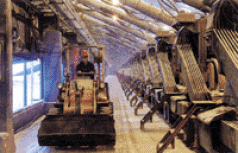

Multi-national miner Rio Tinto is planning to sell its Bell Bay smelter in Tasmania’s north.
The company says it is streamlining its aluminium product group following a strategic review.
It plans to sell 13 operations in Australia and New Zealand, including the northern Tasmanian smelter.
Bell Bay and five of the other assets up for sale will be managed by a new business unit, Pacific Aluminium, before being put on the market.
It is unclear when the smelter will be sold, but the company says it will done at “an appropriate point in the future” and may not occur until the economic climate improves.
The Bell Bay smelter employs 550 people.
Financial analyst Dale Long says Rio Tinto’s 2007 Alcan acquisition hurt the company.
“Essentially what Rio did proceed with some time ago, they bought the Alcan business which has been, let’s say, not one of their better purchases in times gone by,” he said “a this is a direct result of that
“They want to divest that because it’s been hurting their balance sheet over the last few years.”
The company estimates its annual spending in the state is $187 million and it deals with over 400 local suppliers.
George Town Mayor, Doug Burt, has been employed at the Bell Bay smelter for 40 years and says it has been business as usual this morning.
“That will continue, that’s the message that we are getting from the company and certianly from a local government perspective it’s business as usual.”
• Meanwhile, earlier: Power deal seals smelter jobs
16 December 2010:
The state’s biggest power contract has been re-signed just before an independent inquiry into the energy industry starts.
Rio Tinto Alcan has signed a long term energy contract with Hydro Tasmania.
The company produces around 180,000 tonnes of aluminium each year at its Bell Bay smelter, consuming 320 megawatts of power annually.
The existing contract ran until 2014 and has been re-signed with Hydro Tasmania until 2025, securing the smelter’s future for another 15 years.
The smelter is the state’s biggest power consumer buying about a quarter of all power produced in Tasmania.
…
In a 1999 submission on electricity prices the company argued against being charged 3.7 cents per kWh. the submission said that those prices were totally uncompetitive for smelting aluminium. At the time Hydro had a proposal to charge a wholesale price of 4.1 cents kWh.
…
Former Greens advisor now energy consultant, Chris Harries, has questioned the need for details of the contract to be kept secret.
“There’s a great suspicion that there’s an inherent subsidy in these contracts,” he said.
“The aluminium smelter in northern Tasmania is very small by world standards and probably would close, except for the fact that it obtains its power at such a low rate.”
Hydro Tasmania’s chief executive Roy Adair insists the prices and terms of the contract reflect current market conditions.
“I would like to emphasis and I think it’s been said before ‘do we sell below the our costs of production’? That’s absolute nonsense as well. I mean clearly I have said this is a profitable deal for us.”
Mr Harries also questioned why the contract was signed before the energy inquiry started.
“This is the biggest contract that Hydro Tasmania makes and it’s being made just before that inquiry gets underway and that’s not a good thing.”
What The Australian said: Rio refines its aluminium angle
• Some interesting background … including how the Electricity Supply Industry Expert Panel made its decisions.
Download: Statement_of_Approach.pdf
Posted by Ruth Forrest, one day ago
http://www.ruthforrest.com.au/index.php/issues/35-murchison-matters/78-power-prices
‘The Treasurer finally agreed to an independent inquiry into the three energy entities, Hydro Tasmania, Transend and Aurora Energy. This inquiry will conduct a broad investigation including the current efficiency and effectiveness of the Tasmanian energy industry with particular reference to the existing regulatory framework and the cost and operation of the energy industry elsewhere in Australia and the primary factors that have driven recent power price increases.
The inquiry will also consider the financial position of the state-owned energy businesses and the impact of interaction between the three state-owned businesses on the effective operation of the Tasmanian energy industry and Tasmanian energy prices.
Follow the link below for information on how the Electricity Supply Industry Expert Panel will conduct its review.’
http://www.electricity.tas.gov.au/news/release_of_statement_of_approach