Politics
How to destroy the uniqueness of Salamanca

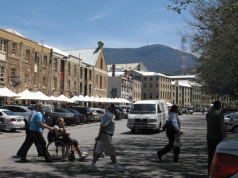

The Salamanca Market administration is currently working on a new license agreement between the HCC and the individual stallholders. The new agreement is supposed to steer the market into a new direction, to rejuvenate it and increase visitor numbers.
Like many other stallholders I was in favour of this.
Hobart’s iconic Salamanca Market is the city’s biggest tourism drawcard and anything that helps to create a more interesting and attractive market is worthy of consideration.
In a few words: I thought this change could just be a good thing.
How disappointing is the outcome!
HCC developed the Salamanca Market Draft License Agreement Matrix, August 2011 (HERE) and is currently asking for comments. The document is nothing more than a draft and the final version may change considerably.
I cannot understand though why HCC saw the need to produce a draft that is a very confrontational document. It is a draft that was designed to give council absolute control over the market to the detriment of the individual stallholders. It is a document, which – if the final version is not very different from the draft – will destroy the uniqueness of Salamanca Market.
These are some of the points proposed in the draft:
– No security of existing product lines: Council to have full control over product lines. Council reserves the right to force stallholders to change their product line. Nobody’s business is safe any longer. If you have built up e.g. a successful woodcraft business over decades, council has the right to force you into a totally different product line. Uncertainty of product line endangers every stall holders business (item 29).
– No security of location: Council reserves the right to move stallholders to other market locations. This is contrary to council’s long held position that stalls are businesses and can only be sold as a business. After security of product line, the location of a stall is most important. Many stallholders have bought a Salamanca Market business just because of the location of the stall. Uncertainty of location endangers every stall holders business (item 56).
– No security of a regular Saturday market: Council reserves the right to regularly operate the market on any day of the week (item 94). Item 94 does NOT deal with the rare change of a Saturday market to a Sunday market -due to e.g. ANZAC day- as item 93 covers that point.
– No legal liability by Council for anything: the draft clears HCC of any responsibility for any liability claim even if caused by a negligent act by the Council and its employees. In my opinion this item (item 83) is contrary to Common Law. Common Law rights cannot simply be signed away like this.
– Credit checks on stallholders: stallholders actually give Council up to three months credit by paying the site fees in advance (which other tenant pays rent three months in advance?) but Council insists on the right to run credit checks on stallholders AND on the right to pass this information on to third parties (item 12 and item 40).
– Full disclosure of turnover and sales figures: why is this necessary? Will fees be based on these figures at some time in the future? Will the market be commercialised in such a way that low turnover stalls are squeezed out in favour of high turnover stalls that will then create more revenue for the Council? Is this the first step to a future privatisation of the market (item 74).
– A substantial hidden fee increase: Summer rates to be 20% higher, winter rates to be 20% lower. However, the summer market covers seven months, the winter market only five months. This results in a hidden fee increase on top of the regular fee increases (item 38)
To sum up: the draft is a confrontational document that devalues the business of every stallholder and creates uncertainty for all of us. I do not say that things should be left as they are. Innovations are surely needed to create a better market.
This draft however is a major step into the wrong direction. It only makes sense if Council’s long-term plan is to sell the market to a private entity that would run it to generate a maximum profit. A restrictive license agreement that hands all the power to the “owner” of the market is a major step into that direction, a direction that would ultimately transform the market into just another shopping mall.
First published: 2011-09-23 09:54 AM