Article
Forestry Industry Business Failures 101. Big Red. ‘Misleading’ Examiner eviscerated. CRC terminated


I’m losing count of the number of independent, industry and Government reports I have read over the past 20+ years that have mentioned this issue.
It is an issue to goes directly to the heart of the competitiveness, profitability of, and ultimately to the level of business and community support for the forest industry.
I recently stumbled across yet another independent report that discussed it, which prompted me to write this. URS is an international consultancy firm that covers a vast range of business activities including forestry, so their views are hard to discount. This 2008 report looked at the opportunities for farm forestry in Australia, a subject of great interest to me, as some of you will know, with my proposal for a blackwood growers cooperative.
URS Forestry (2008):
Market Opportunities for Farm Forestry in Australia,
RIRDC Publication No. 08/105. https://rirdc.infoservices.com.au/items/08-105
Under the heading of Hardwood Sawn Timber the report says:
“Prices for [public native forest] hardwood sawlogs in Australia have traditionally been set administratively with the pricing arrangements varying considerably around the states. Victoria is moving to market-based systems for the pricing and allocation of native forest logs through the introduction of log auctions. Victorian auctions have so far provided preliminary evidence that logs sold through open market processes will receive prices significantly above administered prices.”
The only other time the issue is mentioned curiously enough is when the report discusses market opportunities in Tasmania, where it says:
“Dominance of public [native forest] ownership and administered pricing [is] likely to act as a constraint on private and farm forestry investment.”
Does anything else really need to be said!
That about sums up the current state of the forest industry not only in Tasmania but nationally. Tasmania is not the only State with this problem. All States except Victoria use administered pricing to dominate and control forest product markets.
So what is “administered pricing”?
Here’s a definition I found on the internet: “Administered Pricing, also referred to as rigid pricing, or inflexible pricing, refers to the setting of prices by a public or private entity, and not by market forces. Monopolies, cartels, oligopolies or regulated economies are all examples of market structures in which certain entities in the market determine the market price.”
In other words the price is “negotiated” between the customers (sawmillers, pulp companies, etc.) and the Government (we all know how good Governments are at getting the best deal). There is no tendering or auction, no competition and no transparency at all. Some customers have been the beneficiaries of this cosy arrangement for over 100 years!
Pretty nice deal really.
Of course the forest industry in Australia is dominated by State public servants and their cosy customers who are strongly opposed to any changes to their anti-commercial, anti-competitive behaviour. Another example of this is currently playing out in South Australia. The private forestry growers in Australia (who should be pushing to have this situation changed) are still a small and powerless group. In fact large parts of the private forest sector in Australia support the current administrative and market arrangements of the State governments, a situation that can only be classed as truly bizarre.
The TFGA is a local case in point.
Another quote on this issue that I found that is a telling commentary comes from well known local forestry consultant Robert Eastment in his testimony to the Tasmanian LegCo Committee on Forestry Transition (27/5/2011, p. 15):
“Again, I think there is a need for the hardwood sawmillers who are remaining in the industry to change their operations. I would like to see a much higher return from the sawlogs out of native forests. I would like to draw the committee’s attention to what has happened in Victoria over the last four years. They have moved away from having any form of set sustainable levels. You go through VicForests and you will see now that they have taken away all administered supply in Victoria. They stopped it and there was a lot of pain to many people. I was heavily involved in this. They have moved the supply of logs in Victoria to an auction system. They have logs coming up and if you are a sawmiller and want those logs then you now have to bid for them. There has been significant restructuring of the hardwood sawmilling industry in Victoria. Probably two thirds of the industry has left the industry because they had antiquated sawmills and very poor returns.
The people who have remained in the industry of sawmilling hardwood logs in Victoria now are paying upward and above three times what the logs used to be sold for, and in some instance four times as much. They are producing fewer logs and the Government has a considerably higher revenue stream through that auction system. The sawmillers who have remained in the industry, because they have invested significantly in technology, processing techniques and producing products that markets want, have a higher revenue stream. Some of them have openly said, ‘We’re more profitable now than we were before, yet we’re paying significantly more for our logs. We’ve been driven to restructure our business’.”
I have highlighted what I think is the important message here. Yes a smaller, more efficient, more profitable industry and more money for the Government. Is anyone interested? Not surprisingly the LegCo chose to ignore much of Robert’s inconvenient testimony.
As I’ve said before growing trees for wood production is a commercial activity. It’s about money and making profits.
That’s all!
Nothing else!
It shouldn’t be government employment program or a sheltered workshop. It’s way passed time for the forest industry to grow up and become a real business if it wants to have any future at all. And it is certainly way passed time for Governments to reform their forest agencies to put them on a proper independent and commercial footing.
Are Giddings, Hodgman and Co. listening?
As a professional forester I’ve been watching the demise of Australia’s forest industry for over 30 years with a mixture of bemusement and frustration. Some people just never seem to learn do they?
• Dinah Arndt, Chief Political Reporter, The Examiner: Lennon joins mill limbo criticism
FORMER Labor premier Paul Lennon wants the state government to step in and clear up confusion about the future of Gunns’ Bell Bay pulp mill.
Mr Lennon said that it wasn’t good enough that his protege Premier Lara Giddings and Attorney-General Brian Wightman refuse to clarify whether Gunns still has valid permits to continue the controversial $2.3 billion project.
In an unusual alliance, he yesterday joined the Greens and Liberal parties in calling on Labor to step in on the matter – rather than leave it up to the Environment Protection Authority to determine after an August 30 deadline passed.
“It’s unacceptable that we’ve got to this position where the head of the EPA has to advise us whether or not the project is still alive. We should never have gotten to this point,” Mr Lennon said.
“I just don’t accept that the government can wash its hands of the project given its importance to Tasmania, and even less can I accept that we’ve even gotten to this point where we don’t even know if we’ve even got a project. Whether you support the pulp mill or not is not the issue: its future should be known.”
Mr Lennon advocated the project during his time in politics and the laws now creating the confusion.
His latest comments are shared by the Greens, which tabled legal advice in Parliament yesterday that indicated the entire project may be finished due to particular permits lapsing.
Greens deputy leader Tim Morris said that Mr Wightman “must step in and launch court action to clarify this situation”.
Opposition Leader Will Hodgman called for the same, saying Tasmanians deserved to know what was going on.
Mr Wightman insisted in Parliament that he saw no need to intervene.
REad the full article in The Examiner HERE
• Friends of the Tamar Valley: Gunns’ Tamar Valley Pulp Mill –‘Examiner’ Newspaper Report is misleading
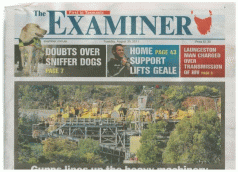
A recent front page report by northern Tasmanian newspaper The Examiner: ‘Machines roll in amid quiet on pulp front’ (30/8/11), indicated that machinery had been delivered for the start of pulp mill construction.
http://www.examiner.com.au/news/local/news/business/machines-roll-in-amid-quiet-on-pulp-front/2274265.aspx
A closer study of the photograph used on The Examiner’s front page clearly shows all but one of those ‘big machines’ is in fact log-handling equipment totally unsuited to earth-moving.
And rather than their recruitment as earthmoving machines, Friends of the Tamar Valley suggests a downturn in the forestry industry generally is a more accurate reason for the ‘neat row of five, big, yellow apparently unused earth-moving machines’.
FTV believes it is an example o fmisleading reporting that could influence stock market investors, local businesses, and the wider Tasmanian community into mistakenly assuming work at the pulp mill site has begun in earnest.
The permits for ‘substantial commencement’ on the project expired at midnight on Tuesday 30th August.
• Tasmanian Times, Wednesday: Is this responsible reporting?
• Richard Colbeck: Funding blow for forestry research
SENATOR THE HON RICHARD COLBECK
Senator for Tasmania
Shadow Parliamentary Secretary for Fisheries and Forestry
Shadow Parliamentary Secretary for Innovation, Industry and Science
M E D I A R E L E A S E
2 September 2011
The exclusion of the Cooperative Research Centre (CRC) for Forestry from the latest Federal funding round is another blow to Australia’s forest industries.
“Australia’s forest industries are under real pressure from anti-forestry groups who, through misinformation, demonise them in the eyes of the community and damage markets,” Coalition Forestry spokesman Senator Richard Colbeck said.
“Research and development funding is critical if the forest industry is to adjust to new conditions and continue meeting Australia’s domestic demand for wood products.
“The CRC for Forestry was applying for funding of $23 million to support a five-year continuation of its work and it was seeking to specifically address the forest industry’s challenges.
“This CRC has been making a valuable contribution not only with science-based work, like carbon capture, but also with socio-economic studies aimed at helping forest communities transition to ensure sustainable futures.
“CRC for Forestry chief executive Geoffrey Duff has warned that all of that work is now in jeopardy and the centre may not have a future.
“The exclusion of the CRC for Forestry from the Federal Government’s latest funding round is just another blow to the industry.
“It seems the Federal Government just doesn’t understand the significant contribution made by Australia’s working forests.
“At a time when even senior Labor union figures are talking of a manufacturing crisis, this out-of-touch government continue to make anti-industry decisions.
“Our forests not only produce essential wood products for everyday use but they add significant value to local economies, provide employment for tens of thousands of people, and in fact are the lifeblood of some regional areas of Australia
“The funding blow follows on from a number of irrational, negative decisions made by Labor including the exclusion of biomass from renewable energy programs and the recent deal that will cut the Tasmanian forest industry in half.
“Obviously the Government is beholden to Greens anti-forestry ideology and has lost the capacity to make the evidence-based policy decisions that they promised,” Senator Colbeck said.
• Australian Financial Review: Forest agreement vital for Gunns pulp mill;
PUBLISHED : 02 Sep 2011 00:37:26 | UPDATED: 10 hours 8 minutes ago PUBLISHED: 02 Sep 2011 PRINT EDITION: 2 Sep 2011
Gunns is in the final stages of securing the equity portion of the $2.5 billion Bell Bay pulp mill, according to boss Greg L’Estrange, but a satisfactory ending to the Tasmanian Forest Agreement saga is critical.
Gunns is also expected to tell the government today whether it will accept the compensation, believed to be $23 million and slightly less than Gunns was seeking, for handing back its native forest logging contracts in Tasmania.
Gunns spent $88.4 million in the 2011 financial year to end logging of native forests, up from $66.8 million the year before. It stands to receive a fraction of the $200 million valuation of the contracts 12 months ago.
“We have been running a process for a long time and we are in the final stages of that competitive process,” Mr L’Estrange said.
A final decision on any pulp mill partner depended on a satisfactory outcome to the Tasmanian Forest Agreement, he said.
While Gunns has yet to get the final approval from the Environmental Protection Agency on whether it has met “substantial work” requirements, the are workmen, temporary offices, trucks and a crane on the site in the Tamar Valley.
“The forest agreement is integral to providing the right investment climate in the state,” Mr L’Estrange said.
“This has been a constant message from both debt and equity providers. Their support will be gained after a resolution of the forestry agreement.
“This is the only manufacturing opportunity for Australia, that I know of, that also has green credentials. The project is compelling and a lot of people misunderstand the project,” he said.
He was confident about the future of the pulp mill, but local resident and anti-mill campaigner Lucy Landon-Lane was not.
Mrs Landon-Lane, who owns an organic walnut farm about two kilometres from the pulp mill site across the Tamar River, said the action group Pulp the Mill was taking advice on whether Gunns was operating under legal permits.
“The community is determined that this is not going to happen,” she said.
Three protesters were arrested yesterday for blocking trucks going into the site.
Gunns shares have been suspended for nearly four weeks.