Economy
Charge industry, cut household tax, says Garnaut

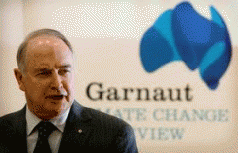

LOW and middle-income households would receive $5.75 billion worth of income tax cuts under a proposal to tie the introduction of a carbon price to sweeping tax reforms.
In his strongest speech since returning as a Labor adviser, Professor Ross Garnaut rejected suggestions a carbon price would damage the economy, arguing it would boost national productivity if linked to tax and welfare reform. He said the cost would be small compared with recent fluctuations in the exchange rate, petrol prices and interest rates.
Professor Garnaut recommended polluting industries be charged $20 to $30 per tonne emitted, increasing 4 per cent a year, with emissions trading starting in 2015. The scheme would be overseen by an independent carbon bank, similar to the Reserve Bank.
Launching an update to his 2008 climate review, he said about half of the revenue raised should be spent making the tax system fairer and more efficient, possibly in line with last year’s largely ignored tax review by former Treasury secretary Ken Henry.
Professor Garnaut backed Labor’s model of a fixed carbon price – effectively a carbon tax – starting next year, graduating to an emissions trading scheme with a market-set carbon price.
”We can get a long way towards a large productivity raising reform of tax and social security in the bottom half of the income distribution,” he said. ”Such an adjustment would increase incentives to participate in the labour force at a time when Australia faces shortages of labour and inflationary pressures.”
The Melbourne University economist was scathing of the Coalition’s ”direct action” approach of choosing some emissions reduction projects and paying for them out of the budget, comparing it to communist ”central planning”.
He also attacked claims by the Coalition and some business leaders that Australia should not introduce a carbon price because emissions trading had been blocked by the US Congress. He said the US was moving seriously to meet its target of a 17 per cent cut in emissions below 2005 levels by 2020, but had been forced to do it through more expensive regulation.
”I don’t think that we should shoot ourselves in the foot just because the American House of Representatives has shot America’s foot,” he said.
On the contentious issue of charging a carbon price on petrol, Professor Garnaut supported doing so but said the price increase should be offset …