Economy
The Flooding of Hobart and Launceston


This is the future of Hobart, not speculative fiction but is based on the ‘known knowns’ of processes that are happening know. The warming of the Earth means more moisture in the air and more intense storms and rain events. At its simplest, this means that there is more rain over Greenland and the movement of the Greenland ice sheet into the ocean has accelerated because of this. The latest research says that it is ‘very plausible’ that will result in a sea level rise of at least a metre within this century, a rise of tens of centimetres every decade (Note 1).
This ice loss was not predicted in the last IPCC report and ice loss in Greenland and Antarctica is beginning at least a century earlier than predicted. The ice-melt has accelerated faster than anything predicted, tripling in volume between 2007-2010.
The science estimates that the Greenland ice sheet will become unstable and collapse into the sea between CO2 levels of 400 and 560 parts per million (ppm). Currently we are at 390 ppm, and despite all the talk and commitments, the actual global emissions of CO2 are tracking at, or above, the worst case scenarios for global warming; what is called the ‘Business As Usual’ emissions of our consumer society.
The trick here is that when politicians and the media say ‘390 ppm’ it is a bit of a lie to the people. When feedbacks and other gasses, like methane and nitrogen compounds, are taken into account on a CO2-equivalent (CO2e), level the world is actually sitting on a 440 ppm CO2 level. We have already entered the realm of dangerous climate change.
The other trick is scale. When geologists, or glaciologists, talk about ‘unstable’ and ‘collapse’, they aren’t talking about tomorrow. The disappearance of the Greenland and Antarctic ice sheets will take centuries and the sea level will rise ten metres at least. In 300-400 years the shoreline of Hobart and Launceston will look something like the picture above. Tidal movements, storm surges and river flood peaks will add to this picture. At the moment, figure for a metre or more of sea level rise over the next few decades. Take a moment to look at the maps and think about places and streets you know and what they will become.
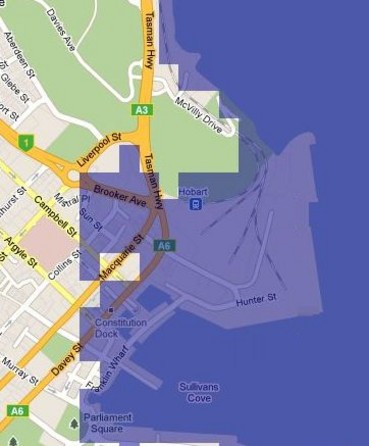
Hobart

What will life be like for your descendants?
We can only speculate on what life will really be like then, but we can certainly draw solid conclusions based on what is happening now.
Firstly, consider peak oil and peak coal, these two are the basis of our current civilisation and the cause of global warming. For the last few years I have been basing my estimation of peak oil on several mainstream organisations, all of which predicted peak oil about 2025-30. The CSIRO estimates peak coal for Australia at 2050. But all that changed in 2010. The world’s premier energy organisation, the International Energy Agency (IEA) announced that peak oil occurred about 2004-06. By 2025, the IEA estimated that oil will be reduced to about 16 billion barrels per year, a drop of 54 billion barrels in available resource. The head of the EU energy group concurred. To add weight to this, the US Geological Survey reduced Alaskan oil reserves by a staggering 90% in 2010 (Note 2.)
Our current lifestyle and society is based on oil and coal. By the end of this century, there will be no more oil and very little coal. In 300 years, Tasmania will certainly be without these products. This means no more cars, trucks, airplanes, rail, cruise, or container ships. No more plastics, advanced medicines (MRI, dialysis, x-rays, chemotherapy, etc.), the internet will not exist, nor satellite or other advanced technology. No solar power cells, computers, powerlines, dishwashers, microwaves, lawnmowers, DVDs and the like. The reason for this is that these technologies rely on the rare materials found in remote places; Bolivia, Mongolia, and shipped by oil to high-tech factories dependent on oil. Steel, paper, glass, and other refined materials will be scarce. When you think about it, most of the utopian ‘post-carbon’ technologies depend on high-energy and scarce resources to make them, all of which rely on oil energy to produce and transport (think bike-paths; but the bikes are made in China).
Travel between Hobart and Launceston will be counted in days. Travel to the mainland will be by sailing ship. Travel to Europe will be measured in months. News and letters will be received infrequently. Tasmania will be very isolated.
The environment will be different. The warming that has started will have raised the sea level by at least ten metres. The north of the state will be much drier, drought will be frequent. The south of the state will have more big storms and days of rain and floods. Snow will not fall on Mt Wellington anymore, and rarely elsewhere. Summer temperatures will hit 40 degrees and winters rainy and mild. The continuing acidification of the oceans, the growth of the oxygen-free hypoxic zones in the ocean and nitrification, processes that are geochemical, have started and are unstoppable, and will mean the sea will have very few fish, crabs or shellfish: it will be empty.
Tasmanians will have to rely on the food and material that they can produce locally, without fertilisers, pesticides, or oil-driven farm or mining machinery. Mangoes, avocados, bananas may be grown but will be scarce and expensive. If we imagine our present diet without anything that is imported (bread from Victoria, onions from South Australia, tomatoes from New South Wales), what is left?
What about the population. Will there have been war and famine? How many people will live in Hobart, 1000? 3000? By then there will be no hydro power, the big dams long since silted up and stopped workimg. Basslink will have failed and in the absence of high-tech oil-based materials will not be fixed. Tasmania will live without electricity, except for a few small and local supplies. Will there be Lords, peasants and convicts? The future society of your great, great, great grandchildren is unknowable. But we have a few certainties; oil and coal will be gone in a century, the sea will rise ten metres, the weather will change beyond recognition to a drier, hotter and more monsoonal one. The environment will change; the sea will become empty, the large animals will disappear, the Tarkine will dry and burn, the buttongrass plains will become dry grass, snow will go and rivulets become seasonal flows fed by rainstorms.
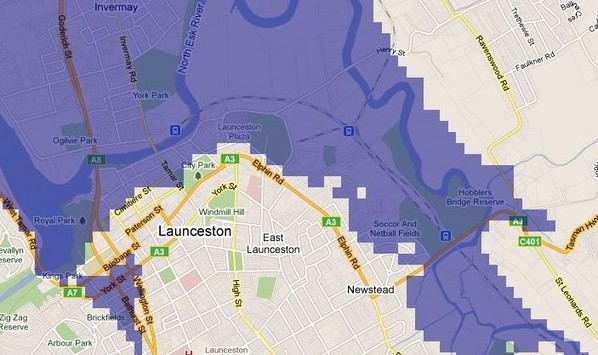
Launceston

Tasmania’s present population is sustained by an import of food and materials which will cease in the near future. Tasmanians will have to feed, clothe and provide for themselves in isolation. When Hobart and Launceston are flooded, Tasmania will be a very different world. The brightness in this is that love, children, art, music, culture, philosophy and dancing will still be part of this world, as different as it will be.
There will be children’s stories as well; the metal bird that carried people to distant places, the horseless carriage that barked and made a funny smell; mountains made of boxes that people lived in and went to in tiny moving rooms; the picture boxes that moved and talked to people in another world and time. Animals that once lived; the elephant, bigger than a horse, that people rode; the long dead lion; huge sea whales that might still live somewhere; the scary shark that no one has ever seen but might still get you if you do the wrong thing and swim in the dead sea.
You can use this flood map program to have a look at sea level changes around the world. You can set it to a variety of sea levels. There is a margin of error. The sea level rise is shown to be less over vertical topography like cities (as the satellite measured the tops of skyscrapers), and best over natural terrain. However, it is a straight measure and does not account for flow, ponding, or water-current changes.
For example, it shows almost no changes in the topography of Fraser Island. Since Fraser is a sand island, changes in sea level, storms, surges, and currents are likely to greatly change the shape and structure of the ‘Great Sandy Island’; the biggest in the (present) World. See: http://flood.firetree.net/?ll=-27.8390,138.1640&z=13&m=7
Note 1Testimony to the US Senate, 2010.
[Director of the International Polar Year [IPY] Program Office] MR. CARLSON: Let’s talk next about the Greenland ice sheet. A clear consensus has emerged during IPY that the Greenland sheet will disappear as a consequence of this current global warming. The Arctic Council has underway an urgent assessment of that change to understand the net mass balance change of the —
SEN. KERRY: Is that a new — is that an IPY assessment or is that previous confirmation? I have not heard the judgment that it will to a certainty disappear — (inaudible) —
MR. CARLSON: My language is — it’s actually very clear to pertinent to your question.
The consensus during IPY has emerged that it will disappear during this warming.
An urgency to answer the next question, which is how fast — the Arctic Council has an assessment underway at this moment looking at the net changes in the Greenland ice sheet and I don’t want to prejudge that, but I can give you a plausible — very plausible — outcome, which is a meter or more of sea level rise in this century from Greenland alone.
That is a — will be an IPY outcome.
SEN. KERRY: A meter or more from Greenland this century? That I’ve seen, but when do you get — when you get the west Arctic — Antarctic ice sheet coupled with the Greenland ice sheet, that’s when you get to your 16 to 23 feet when they’ve totally disappear?
MR. CARLSON: Not in this century.
SEN. KERRY: Correct; right. But that is a total eradication of those sheets — the combined sheets?
MR. CARLSON: Yes.
SEN. KERRY: The combined sheets.
MR. CARLSON: Those two sheets — 10 meters of global sea level.
But, I’m only treating Greenland in this assessment.
The IPY assessment on west Antarctica will not be as clear as the assessment on Greenland.
SEN. KERRY: Is there a consensus with respect to the increased rate of melt?
MR. CARLSON: Yes; absolutely. In both regions.
SEN. KERRY: And, is that quantified?
MR. CARLSON: Yes; from where we were in IPCC four years ago of centimeters per decade to tens of centimeters per decade. If you were a betting person, we haven’t hit the maximum yet. That’s where we are.
http://www.votesmart.org/speech_detail.php?sc_id=458740&keyword=&phrase=&contain=
Note 2
http://www.peakoil.net/