Economy
South Esk headwaters clearfalls: The devastating consequences

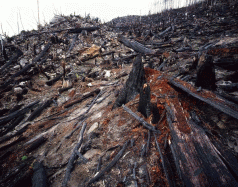

The photos are from Coupe RS142E, upstream from the Tombstone Creek Forest Reserve in the northeast highlands, headwaters of the water supply for Launceston.
This steep valley-side supported a wet and mossy forest characterized by myrtle, blackwood, tree-ferns up to eight meters high and groves of some of the largest sassafras that I have seen anywhere in Tasmania, (many with trunk diameters of one metre or more at chest height). And yes, I’m afraid that I was imprecise, as there were also old eucalypt emergents.
My main point was to illustrate the devastating impact of the operation on a mature native forest and although the eucalypt canopy would have exceeded 5% of the total canopy this forest was well on the way to being pure rainforest of the type that still survives a few km upstream.
The forest was clear-felled by cable-logging in the summer of 2005 and burnt in an exceedingly hot fire in April 2006. All of the rainforest trees were killed outright. The site is steep and soils are granitic and sandy. The valley side was left in a condition highly vulnerable to severe soil erosion in a region that is prone to extreme flooding.
The coupe is bordered by some areas that were logged within the last 10 years or so, and the regrowth in these adjacent coupes, and now in this coupe, is a dense mix of primarily silver wattle and eucalypt.
A narrow strip of the original forest remains at the new coupe’s lowest edge, along Tombstone Creek, but recolonization by the rainforest trees will not occur, due to the competitive advantage of the eucalyptus and wattles in a full sunlight situation and the projected rotation period.
Simply put, the process enacted here is conversion, in this case from a mature mixed forest dominated by myrtle and sassafras, with some eucalypt emergents, to an uncultivated crop of wattle and the aerially sown eucalypt species.
In such a process of conversion, which is far from being confined to this particular coupe, two options are precluded. Firstly, the option for the natural forest to continue to develop towards rainforest, a point from which, given the age of the eucalypts, it was not far removed. The second opportunity forgone is for alternative uses of trees other than (tightly crammed) wattle and eucalypt.
Other negative and significant ecological impacts have occurred here, including devastating effects on wildlife, altered hydrology, weed invasion and the release of massive amounts of carbon, previously sequestered within soil and living vegetation, into the atmosphere. The closely packed eucalypt and wattle regrowth is a pyrogenic time-bomb.
From this …


… to this:


This comment was first published on:
South Esk headwaters clearfalls: All endorsed by PEFC and AFS
Meanwhile, elsewhere:
Swiss look forward to Year of Forests
The Swiss Environment Office has launched a website as part of the United Nations International Year of Forests, focusing on the major role forests play.
The new site, www.wald2011.ch, in German, French and Italian, describes different ways in which forests are important. It also has a calendar of events being held during the year.
Almost a third of Swiss territory is covered by forest. A third of this acts as protection against natural hazards for settlements, the transport network and power lines.
Forests are home to some 26,000 species of plants, animals and fungi, about half Switzerland’s flora and fauna.
They are a popular recreational area and also play an important role in reducing climate warming by binding CO2 and filtering rain water, helping to make it fit to drink.
“The law ensures that Swiss forests are exploited in a natural and sustainable way, so that future generations can also benefit from what it has to offer,” the website says.
Andreas Götz, deputy director of the Environment Office, said Switzerland could “present itself as an international model” since its laws have for many years encouraged sustainability while keeping the forests as natural as possible.
swissinfo.ch and agencies: HERE