Environment
Brewing for the whales …

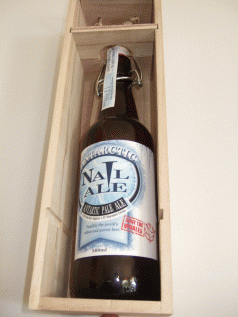

This week at the Sea Shepherds auction in Fremantle, the number one bottle (of 30) of Antarctic Nail Ale was sold for $800. The unique beer which was brewed with ice brought back from the Antarctica from the Sea Shepherd’s last campaign. The Sea Shepherd will soon leave on their seventh campaign to stop Japanese killing whales in the Antarctic sanctuary. All proceeds from Antarctic Nail Ale go to the Sea Shepherd.
The previous most expensive beer in the world was a $765 bottle of “The end of History” brewed by Brewdog’s. In a high alcohol level beer brewing war earlier this year, Scottish brewery “Brewdog’s” brewed eleven bottles of 55% Alc beer sold in animal carcasses.
Nail Brewing Australia’s brewer John Stallwood says “It is great to sell the most expensive bottle of beer in the world but it is all about a good cause. It is also good that a beer about saving the whales is now most expensive beer in the world rather than high alcohol beer sold in animal carcasses. I think future beers that sell for over $800 won’t just be unique but will also be for good causes.
Antarctic Nail Ale over takes Crown Ambassador Reserve ($90) as Australia’s most expensive beer. Nail Brewing’s own “Clout Stout” a 10.6% alc Russian Imperial Stout brewed to age was Australia’s second most expensive beer at $60 a bottle (only 300). Victoria’s Holgate Breweries “Beelzebub’s Jewels” and Moo Brews Imperial Stout are also above the $30 a bottle mark.
The bottled beers that sell for over $30 are usually limited numbered, high alcohol specialty beers brewed for aging. Microbreweries small batches enable small brews of really unique beers. They take a lot of time, ingredients and money.
Australia has some of the best breweries in the world. Most of our beers are about 4-5% alcohol and of varying styles. Australian microbreweries struggle to supply standard alcohol beers at competitive prices due to excise. Excise is paid on alcohol strength. The cheapest rate that microbreweries/consumers pay for a standard 4.6% full strength beer is over $1/litre of beer. This is for draught beer and bottled beer is a higher rate.
John Stallwood says, “If any publicity message is taken from Antarctic Nail Ale being the most expensive beer in the world, I hope it is that the Sea Shepherd is on its seventh campaign to save whales in the Antarctic because no one is stopping the Japanese killing whale for commercial profits in food.” John also hopes that the message of high excise to microbreweries in Australian beer (over$1/full strength litre) is stopping small business growth to a growing market yet struggling industry”.
Nail Brewing thanks the Elliot Syndicate for buying the #1 bottle and all the helpers that put Antarctic Nail Ale together. Sea Shepherd has bottle #2 to 10 available if you would like to support the Sea Shepherd.
For more information:
http://www.nailbrewing.com.au/specialstories (updates and more information)
http://www.youtube.com/watch?v=yrsGoBLzQIM (video)
Todd
Founder & Chief Executive BeerAdvocate
From: http://beeradvocate.com/news/3162053
And,
GREENS TABLE TASMANIAN WHALE SANCTUARY BILL
Offers Formal Safe Harbour
Cassy O’Connor MP
Greens Environment spokesperson
Thursday, 11 November 2010
The Tasmanian Greens today tabled their Whales Protection (State Sanctuary) Amendment Bill 2010 to establish a formal Tasmanian Whale Sanctuary, as the world braces itself for yet another summer Japanese whaling season in the Southern Ocean, which officially commenced last weekend and which could result in the killing of more than 1000 whales.
Greens Environment spokesperson Cassy O’Connor MP said that while Tasmanian law seeks to protect whales and dolphins, it does not specifically declare state waters a Whale Sanctuary, which would probably surprise and disappoint many Tasmanians who would presume that these magnificent mammals are afforded every possible recognition and protection.
“Many Tasmanians are horrified that once again the senseless slaughter of these magnificent mammals is set to occur in the Southern Ocean, and our proposal for a Tasmanian Whale Sanctuary would state very clearly that these magnificent creatures have a permanent and formal safe harbour in our waters,” Ms O’Connor said.
“The Greens’ proposed legislation will see Tasmania’s recognised state waters, which extend from our coastline for three nautical miles, formally declared a Tasmanian Whale Sanctuary, and also clarify that it is an offence to assist anyone attempting to take a whale in these waters.”
“Most Tasmanians would presume our waters are a Whale sanctuary and would not realise that in fact there is a gap between our coastline and where the Commonwealth waters commence off-shore. This is the gap which the Greens are proposing to fill as a formal sanctuary by amending the State’s Whales Protection Act 1988.”
“Our proposed amendments would also prohibit anyone assisting in the taking of, or interfering with, whales, which currently the law does not stipulate.”
“A formal Tasmanian Whale Sanctuary further enhance our clean, green brand, and would also boost appropriate tourism based on promotion of a contiguous sanctuary from coast to Commonwealth waters.”
“Over the last twelve months Tasmanians have been delighted to see whales returning to our waters, including the first birth of a southern right whale calf in the Derwent estuary for the last 190 years.”
“We have been treated to growing numbers of sightings along our east-coast as humpbacks and southern right whales make their annual migration south, as well as in coastal waters including Frederick Henry Bay, and off Kingston and Taroona.”
Ms O’Connor also explained that the Australian Whale Sanctuary, established under the Environment Protection and Biodiversity Conservation Act 1999 (EPBC Act), includes all Commonwealth waters from the three nautical mile state waters limit out to the boundary of the Exclusive Economic Zone, and the Greens’ proposal would see Tasmania formally declare those three nautical miles not covered by Federal law as a State Whale Sanctuary.
The Greens’ Whales Protection (State Sanctuary) Amendment Bill 2010:
• Amends the state’s Whales Protection Act 1988 to specify State waters as a Whale sanctuary.
• Fills the 3 nautical mile ‘gap’ between the State’s waters and the Australian Whale Sanctuary in Commonwealth Waters.
• Amends the same act to clarify that it is an offence to assist an entity to take whales from our waters.
Background:
1 Tasmania’s legislative right:
Tasmania (like all other states) can legislate on areas of territorial sea adjacent to the State, which extend 3 nautical miles (roughly 5.5 kms) out to sea.
– Coastal Waters (State Powers) Act (Federal)
– Coastal Waters (State Title) Act (Federal)
– Living Marine Resources Management Act 1995 (Tasmanian)
2 Current legislative arrangement:
• Environment Protection and Biodiversity Conservation Act 1999 (Federal)
• Commonwealth has already declared water to 200 nautical miles (extent of Australia’s EEZ) to be covered. Expressly does not include the area up to 3 nautical miles from shore as this is considered State Water.
• Whales Protection Act 1988 (Tasmanian)
• This Act imposes a general prohibition on the taking of whales (not assisting in the taking of whales). It does not specifically declare State Waters a “Whale Sanctuary” (and does not actually use the term).
3 Recent Whale Sightings
• November 2009 – Humpbacks sighted off the Tasman Peninsula and Wedge Island
• May 2010 – Several humpback whales sighted near Coles bay and Eaglehawk Neck
• July 2010 – Southern Right Whale sighted in Sullivans Cove, and more off Taroona and Kingston
• August 2010 – Mother and calf Southern Right Whale in the Derwent and Channel area
4 Annual Japanese Whale Hunt:
• Annual Southern Ocean hunt expected to kill more than 1000 whales in the Southern Ocean (source: International Fund for Animal Welfare)
• Targets: approx 935 minke whales, 50 endangered fin whales and 50 humpback whales.
• Australian Government’s case against the Japanese whaling activities in the Southern Ocean was filed in June 2009 at the International Court of Justice in the Hague. The final judgements could be as late as 2013.