Economy
I’ve had enough of the secrecy

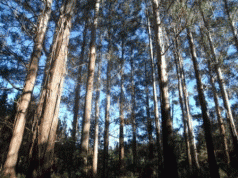

The secret selective harvesting trial on Warra 8G.
On several threads I’ve recently raised questions about the selective harvesting trial FT ran a few years ago on the coupe Warra 8G.
As I understand it, the trial (despite its limitations) showed that selective harvesting in wet eucalypt forest was safe, profitable and resulted in acceptable eucalypt regeneration.
As far as I am aware, that trial has never been reported publicly.
Recently, on the thread “Forestry Tasmania Woodchip price war” in post #44 I asked Mark Poynter “What’s your view of the proposition that clearfell/burn/sow works principally because it destroys the chemicals produced by eucs to inhibit germination of potential competitors, allowing unfettered germination of the seed sown.”
His reply (post #47) included the following, “The effect of fire is important because it removes the litter layer and therefore allows the seed to access the soil; it temporarily removes competition for water and nutrients; and it creates a variety of suitable micro-environments.
“In Mountain Ash, this may also include removing some antagonistic factors which have been found to reduce seedling vigour in unburnt situations.
These are thought to include exudates from the living root mat of mature E.regnans and Hazel Pomaderris, the allelopathic effects of soil lipids or the aqueous phase of essential oils from leaves (Keane, 2000). “
I responded (post #76) Mark
“It is interesting that you quote Keane as saying that fire may remove some antagonistic factors which have been found to reduce seedling vigour in unburnt situations.
From your experience, how would explain the frequently prolific germination of eucs along the sides of snig tracks and areas of similar soil disturbance? Is there more to this than simply opening up the canopy? “
To which he replied (post #77)
“#76 John
Regeneration of ash species requires both opening the canopy to allow seedbed to be in full sunlight, and removal of litter and debris to expose a mineral earth seed-bed. This is what fire does, but it can also be achieved by mechanical means using a dozer with root rake to push debris into heaps or windrows for later burning. Prolific regrowth along snig tracks is associated with disturbance which exposes soil to the seed, which would otherwise not successfully germinate on undisturbed litter. “
My response (post #84) was
“Mark #76
Thanks for that. What you say is in accord with what I understand has been observed in the Warra 8G selective harvesting trials.
(And to) Michael #81
On the contrary. There is much, much more to be said. It is time FT came clean on the Warra 8G trial. Woody says he has a copy of the report (presumably a draft) but it appears not even an interim report has been released.
With the industry in a situation where change is being forced upon it, all decision makers should know the options, and know that clearfell/burn/sow is not the only option.
To repeat: as I understand it, the Warra 8G selective harvesting trial (despite its limitations) showed that selective harvesting in wet euc forests could be safe, profitable and result in acceptable euc regeneration.
What’s FT’s problem? “
This morning I received a direct email from George Harris (who posts as “Woodworker”) to the effect that he had talked yesterday with FT’s chief forest scientist about Warra 8G.
He offered to discuss this with me in a phone conversation.
Sorry George. I’ve had enough of this secrecy, both from FT and from the so-called Round Table Conference.
With the industry now in a situation of forced change, all options need to be available for public discussion.
Anything your secret FT agent wants to say to me privately via you should be said in public – for example in a story on TT, an excellent place to publish the final (or even an interim) report on the selective harvesting trial of Warra 8G.
What’s FT’s problem?
—
Read oldtt.pixelkey.biz… for news and views you won’t find in the newspapers