Economy
Gunns ‘bullied’. NGOs. FT’s ‘new loser’. Bartlett: Wrap it, and, Yes, FT still converts


In the keynote address to the Forestworks industry conference in Melbourne in early September, the new CEO of Gunns Ltd, Greg L’Estrange, announced that Australia’s largest timber company would move away from harvesting native forests and divest its hardwood sawmilling assets. To many in the audience, this wasn’t particularly surprising given that Gunns had already sold off its freehold native forests – around 30,000 hectares of largely harvested and regenerating Tasmanian forest bought by a philanthropist to create a private conservation preserve!
Choosing his words carefully, L’Estrange professed that after a long career in the timber industry he was “…. a believer in the science of forestry. We have many outstanding contributors to the field, who lead the world in the sustainable management of natural forest areas.” But he acknowledged that the timber industry and the environmental movement were “pitted in a fierce battle for the support of the Australian people, who in turn balance the political debate”, and asserted that “we have lost the public debate and the support of the broader community”.
Regarding the debate, he went on to say that “the industry has been out-thought and out-played, with the ENGO’s [environmental non-government organisations] using three key leverage points: public emotion, multi-level government involvement; and certification – market action. Whilst the industry has maintained a stance that science will prevail ……”
Few in the forestry sector would disagree with the broad thrust of this summation, but most are troubled by its inference that the environmental movement has been “successful” while the industry has “failed”. While such labels infer a fair debate, the ENGO’s have in reality run deceitful campaigns that have misrepresented the scale and extent of timber production while either ignoring or skewing the science without regard for the implications; while the forestry sector has, for the most part, defended itself using facts, statistics and science.
The ENGO “success” has been substantially assisted by elements of the city-based media which have virtually promoted their cause almost without question. In the mainland capitals, broadsheet daily newspapers have consistently reported the forests debate from the green perspective. While at the national level, the ABC has been overly reliant on ENGO views for their reportage of forestry issues – programs such as Four Corners’ “Lords of the Forests” and Australian Story’s “Something in the Water” come immediately to mind. Both were subsequently discredited, but not before they had heavily influenced community sentiment.
The forestry sector is inclined to beat itself up over its inability to get fair media treatment. However, it is up against wealthy, professional corporations whose very existence relies on creating environmental conflict specifically to inhibit resource-use industries. They also have a far simpler and more marketable message. The visual and moral imagery of “saving” beautiful forests from the grim – albeit temporary – devastation of logging, appeals to both the media’s need for sensationalism and it’s craving to be a popularly acclaimed agent for public good.
Counteracting this is almost impossible in a modern media designed for the superficial and simplistic rather than the complex and scientific. The city-based media which reaches the majority of the population has rarely given sufficient time or space to the forestry sector’s views and has at times further blunted their effectiveness by applying more rigorous editorial standards.
That unscientific and unprincipled ENGO campaigns have helped to push our timber industry out of native forests is hardly something that Australian society should be proud of given that native hardwood production is a small-scale, renewable activity posing a negligible environmental threat. Nevertheless, celebrations greet each sawmill closure betraying a disconnected community that has lost perspective to such an extent that urban myths are unquestionably accepted as absolute truths, while rural realities are dismissed as self-serving myths.
With regard to its native forest operations, Gunns has never acted illegally or corruptly. Yet ENGOs have routinely accused it of doing so, despite the reality that the company’s operations in Tasmania’s public forests (which receive almost all the scrutiny) are undertaken in accordance with a Parliamentary Act, are regulated by a forest practices authority, and controlled by a government agency, Forestry Tasmania, which decides where and how logging is undertaken.
Gunns has every right to move away from native forests, and it is not too hard to be sympathetic to such a move given the extent to which the company and its reputation have been vilified over the past decade. However, the company’s prosecution of this change of direction so soon after acquiring substantial additions to its native hardwood sector in Victoria and Western Australia raises some questions.
While L’Estrange articulated a view of Gunns coming to a pragmatic realisation that there was no future except as a plantations producer, he admitted that “Our customers, shareholders, employees, contractors and other stakeholders have given us a clear message” However, the manner in which former Gunns’ CEO, John Gay, was forced out by corporate bullying orchestrated by self-styled anti-forestry crusader, Geoffrey Cousins, suggests that this message was foisted upon the company rather than arrived at after considered thought.
In an interview on ABC’s Lateline program in June, Cousins was quite forthright in explaining how he and the Wilderness Society had “put pressure on the financiers of the company ….. we put pressure on the customers ….. we put pressure on the shareholders, finally” For their part, the Wilderness Society’s annual review outlined how it had pressured a company being courted by Gunns as a financial partner in its planned Tasmanian pulp mill:
…
Read the full article on Online Opinion HERE
What Gunns says about the Hinman Wright and Manswer transition:
27 September 2010
Company Announcements Platform Australian Securities Exchange
HINMAN, WRIGHT & MANSER AND THE HAZELL BROS GROUP
Gunns Limited and Hazell Bros Group Pty Ltd have reached an ‘in principle’ agreement to transition Hinman, Wright & Manser (a division of Gunns Limited) to Hazell Bros as existing projects are completed. This outcome will provide certainty for employees of Hinman, Wright & Manser as they will be engaged by the progressive ‘construction-focussed’ Hazell Bros. Hazell Bros will also assist in the completion of all existing projects under construction.
Or HERE
Christine Milne:
Good Faith Demands Moratorium on Logging High Conservation Value Forests Now
Canberra, Monday 27 September 2010
The opportunity for a 100% solution to Tasmania’s long standing forest conflict is compromised every day that logging continues in high conservation value forests, the Greens said today following reports that the coupe at the top of the list for a moratorium has just been logged.
“A moratorium must be placed on the highest conservation value coupes immediately,” Australian Greens Deputy Leader, Senator Christine Milne, said.
“For months now the forest industry and conservationists have been engaged in discussions about exiting native forest logging. At the same time the loggers have been driving harder and harder into the extremities of the forests on the back of taxpayer subsidies.
“How does pushing into the furthest coupes to destroy wilderness values constitute negotiating in good faith?
“I am disgusted to learn that the coupe with the highest score on the preliminary list for moratorium, CM192 has six machines working in it and is almost completely flattened. This coupe is contiguous with the Tasmanian Wilderness World Heritage Area and is not far from the South Coast Track.
“This area was proposed for World Heritage listing during the Labor Green Accord and ever since but was kept out for logging by David Llewellyn and successive forest ministers who now will live with the legacy of their decisions.”
French naturalist Jacques Labillardiere described this area of forest on 2 February 1793 as follows:
“The air was extremely calm; and about midnight I awaked, when, solitary in the midst of these silent woods the majesty of which was half disclosed to me by the feeble gleam of the stars, I felt myself penetrated with a sentiment of admiration of the grandeur of nature, which is beyond my power to express.”
“Nearby Coupe CM 19E is being cable logged and although a high priority for conservation is almost gone as well,” Senator Milne said.
“There is such a thing as walking the talk and Forestry Tasmania and the logging industry need to demonstrate that they can do it.”
And …
Stench from factory hangs over downtown Macon (Georgia, USA)
By CARL LEWIS – clewis@macon.com
Many downtown residents and business owners had to hold their noses Sunday morning after routine maintenance at a south Macon pulp mill left a foul odor permeating through the air.
By Sunday afternoon, the stench still covered parts of downtown as a steady northerly wind combined with high humidity created perfect conditions for a lingering odor.
Click here to find out more!
Macon-Bibb Fire Chief Donnie Mercer would not say the name of the factory that released the chemical causing the smell, saying he wants to wait until the company has had time to issue a release to the public. He said the chemical posed no danger to residents.
“This is not a hazard at all. It could cause some people to have eye irritation, but a lot of that’s psychological,” Mercer said.
Mercer said he doesn’t know how long it will take for the chemical to clear the air, but that a forecast of evening showers could cause the stench to stick around for a while.
Carey Pickard, who lives downtown on Magnolia Street, said he could still notice the odor at around 2 p.m. Sunday afternoon.
“It smells like used oil, and it’s weird because it’s a smell I’ve never been around before,” Pickard said.
Fire and EMA officials plan to meet to discuss the odor Monday morning.
Examiner: Stakeholders meet on future of NE sawmill
28 Sep, 2010 08:40 AM
THE Dorset Council has met key government heads and other stakeholders to ensure the future of Scottsdale’s last big sawmill.
General manager John Martin said yesterday that he and Mayor Barry Jarvis had met Resources Minister Bryan Green and Forestry Tasmania chief executive Bob Gordon late last week to talk about the North-East region’s forestry industry future.
Senior council officers have also opened discussions with unions, private enterprise and timber giant Gunns to maintain the 35,000 hectares of softwood and hardwood plantation in the region, Mr Martin said.
The moves have been prompted by fears that Gunns might close the Scottsdale mill if it successfully bids to take over Forest Enterprise Australia’s Bell Bay plant.
Gunns chief executive Greg L’Estrange has confirmed that the company will review the viability of the Scottsdale mill over the next few months whether or not it takes on the FEA mill.
Read the full story HERE
Environment Tasmania, The Wilderness Society, Australian Conservation Foundation …
Media Release 28 Sept 2010
Next steps for Forest Peace Talks
Tasmanian Environmental NGO’s have supported Premier David Bartlett’s suggestion that the current peace talks around the future of Tasmania’s native forests and forest industry need to be brought to a conclusion soon.
Environment Tasmania Director Phil Pullinger said that the industry is in crisis as markets are now demanding timber products that don’t destroy native forests.
“We are engaged in peace talks which aim to deliver a solution to the conflict over forestry that protects our natural environment, supports rural communities, and sets the industry on a stronger and more sustainable long term pathway,
“The talks have made enormous progress in finding common ground on key principles. Soon, there will be a need for urgent action to restructure the industry in order to protect our native forests and to protect the jobs that will be lost if no action is taken.”
The Wilderness Society’s Paul Oosting said the negotiations had come a long way and looked forward to the opportunity for a solution to the conflict over forestry.
“These talks represent a huge opportunity for our state. Many stakeholders understand that this is a once-in-a-generation opportunity.
“We welcome the Premier’s recognition of the crisis and the need for action. We look forward to working with him to see action taken to resolve this thirty year long conflict.
“Together, forest industry representatives, forest workers unions and the environment groups have achieved significant progress, and we believe that the peace talks can come to a conclusion and be further strengthened through the involvement and support of both governments and all political parties at a State and Federal level,” concluded Lindsay Hesketh, from the Australian Conservation Foundation.
Kim Booth:
CONTENTIOUS MINI-PEELER LOGS REJECTED BY CHINESE MARKET
As Forestry Tasmania Backs Yet Another Lo$er
Kim Booth MP
Greens Forests spokesperson
The Tasmanian Greens today exposed the rejection of Forestry Tasmania’s recent load of mini-peeler logs to China, which has left thousands of tonnes of export-prepared mini-peelers stockpiled in Tasmania, requiring forest contractors to now cut the gangnailed ends off the logs and send the trimmed logs on for woodchipping.
Greens Forests spokesperson Kim Booth MP said Forestry Minister Bryan Green must reveal how much public money has been lost by Forestry Tasmania on this ill-advised venture, whether or not the forest contractors will be paid for the additional work they have done to prepare these logs and to now de-prepare them, and how it is that Forestry Tasmania have once again misread the market situation so badly.
Mr Booth also noted that the gangnail endplates, which are now required to be removed from these peeler logs, were supplied by Forestry Tasmania, were oversized, and have been responsible for cutting and injuring a number of contractors.
“Forestry Tasmania have once again backed a loser and misread the market so badly that the entire load of mini-peeler logs that were recently sent to China have been rejected out-of-hand.
Subsequently, six thousand tonnes of these stockpiled and prepared mini-peeler logs have had their gangnailed ends cut off, and the logs have been woodchipped,” said Mr Booth.
“The forest contractors were paid a pittance to prepare the logs for export, including using over-sized gangnail endplates supplied by Forestry Tasmania that regularly cut the contractor’s hands, and now they are being required to cut off these endplates so these mini-peeler logs can now be woodchipped. How much is this costing the long-suffering contractors, and will they be paid for their work?”
“Once again Forestry Tasmania has demonstrated that it is an out of control rogue agency, that continues to trash public resources and waste good public money, whilst at the same time exploiting its contractors,” said Mr Booth.
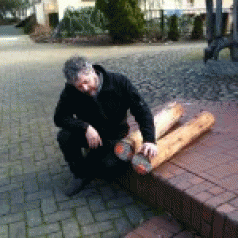
*Photo of Greens MP Kim Booth with example of mini-peeler logs prepared for export, and shortened for ease of transport (Tyler). [Photo for example purposes only and is not depicting logs sent to China.]
Hansard
Tuesday 28 September 2010
Hansard – Draft Unconfirmed
FORESTRY – ROUND-TABLE TALKS
[10.22 a.m.]
Mr HODGMAN (Question) – My question is to the Premier. Premier, this morning Tasmanian sawmillers are reported as expressing serious concerns about the future of their businesses, including one, Mr Ike Kelly, whom you visited at his sawmill at Dunalley on 28 July this year when you ‘walked in the shoes of workers’. Premier, is it a fact that sawmills such as Mr Kelly’s will close if Tasmania’s native forest industry is shut down, as has been proposed in the forest round-table talks? Given the threat of job losses in our forest sector, and given that our forest asset is owned by the people of Tasmania, as Leader of the Tasmanian Government, will you advise whether you have been briefed on the status of these talks? Will you rule out supporting the proposal to lock up Tasmania’s native forest resources? If not, will you agree to walk in the shoes of Tasmanian sawmill workers when they are inevitably forced to join the dole queue?
Mr BARTLETT – I thank the member for his question. I am very pleased to confirm to the House that, as part of my monthly ‘walk a mile in the shoes of everyday Tasmanians’ program, I spent a day at Ike Kelly’s sawmill at Dunalley. I did it quite deliberately so that I could talk directly to workers in that sawmill and to the owner himself. It is a fine family business with a long history and a very proud group of men and women who work there.
I can inform the member that the answer to his question is quite simply no. I want to see sawmills such as Ike Kelly’s having sustainability and longevity into the future. I also want to see that this sustainability has real weight and genuine indicators of sustainability behind it – financial, economic and environmental sustainability. That is what we will be working towards. The news today was of Gunns chopping the price that they are prepared to pay for off-cuts, sawdust and chips and so on from mills like Ike Kelly’s and many others around the state.
As I have said very clearly in this place, there is significant and serious change coming to the forests and forest industries sector in Tasmania.
We have some choices to make here. It is in this place, particularly on this side of the House, that those choices will need to be carefully considered, well understood and made in the interests of all Tasmanians. We have two choices at the moment. We can let these global circumstances that are affecting Gunns’ business, and therefore affecting Ike Kelly’s business in the price he gets paid for waste materials, rush over us like a tsunami, we can play politics with it and pretend that it is not going to happen and blame those sitting on this side of the House for it. We can do that or we can take a leadership position and say there is change coming so how do we best deal with this in the interests of Tasmanian jobs, the Tasmanian environment and Tasmania’s overall position in the global economy, particularly as a brand across the planet. These are the things we need to take into consideration and we have a window of opportunity here to consider them.
Opposition members interjecting.
Mr BARTLETT – I note the interjections from the opposite side and it has become clear, despite the sawmillers and the foresters giving them a whack and telling them to shut up, that they cannot help themselves. We saw Mr Shelton deeply embarrassed the other day when he was out flapping his gums and his own constituency, the Country Sawmillers, came and told him to shut up and butt out.
I call on the Opposition through this debate to grow up, show a bit of maturity and recognise that change is coming to the Tasmanian forest sector whether we like it or not. This change is driven by global factors and we need to position ourselves so that we deliver the best sustainable outcomes for the forest sector in Tasmania and for businesses like Ike Kelly’s and the 14 or 15 men and women who work there. We want to deliver sustainable outcomes rather than simply burying our head in the sand and pretending it is not coming, or playing the rank negative politics of yesteryear. Even your own constituencies, the people you seek to represent, are telling you to butt out and not do it, but you just cannot help yourselves. It is pathological.
Mr Hidding – They are on the phone to us saying –
Mr BARTLETT – I know what they are saying on the phone. I saw them coming out of your offices the other day and they told me exactly what they told you.
Firstly, the Liberals need to grow up and enter this debate maturely because that will be in the best interests of all Tasmanians. Secondly, I say with great respect to those groups around the table who have been working with great diligence, passion, heart and real knowledge of their areas that over the coming weeks we need to wrap up these talks. We need to finalise these principles so we can get on and implement them in the best interests of all Tasmanians for the future of the forest industry, the sector and the workers. We need to get on and do that so I am encouraging those talks over the coming weeks to wind up. I have been meeting with stakeholders and I will be meeting with the full array of groups in the coming weeks. Yes, I will be encouraging them to wrap up these talks, to put the stake in the ground so that we can move forward with certainty in the forest sector.
Mercury: FT may buy woodchip mill
…
Tasmanian Greens politician Kim Booth asked Mr Green if Forestry Tasmania was considering buying the East Coast mill and port.
Mr Green did not answer the question directly.
But he said Tasmania needed a future forest system in which woodchips generated income, but in a “sustainable way”.
“We will continue to seek ways to operate the Triabunna chip mill – it’s an important part of the forest business in Tasmania,” Mr Green said.
“There are discussions going on as to how that might operate.”
Premier David Bartlett also used Parliament this morning to call for the secret forest talks between industry and environmental groups to conclude, so action on a new strategy can begin.
The talks are believed to have reached agreement on a phased exit from the logging of Tasmania’s native forests, in return for in-principle approval from environmental groups for a pulp mill being built in Tasmania.
…
The talks are believed to have reached agreement on a phased exit from the logging of Tasmania’s native forests, in return for in-principle approval from environmental groups for a pulp mill being built in Tasmania.
Kim Booth:
PREMIER INTERVENES TO STOP FT PURCHASE GUNNS’ WOODCHIP MILL
As Minister Forced to Admit Plantation Conversion still Happening Despite 2007 Commitment
Kim Booth MP
Greens Forest spokesperson
Wednesday, 29 September 2010
The Tasmanian Greens today said that they achieved two very important concessions from Labor with regard to Forestry, with one being the Premier ruling out allowing Forestry Tasmania to purchase Gunns’ Triabunna woodchip mill.
Greens Forestry spokesperson Kim Booth MP also received a belated admission that Forestry Tasmania is still converting native forest to plantation despite claims that the practice had ceased in 2007.
“I welcome the Premier’s response to my question in which he ruled out allowing the purchase of the Gunns Triabunna wood chip mill,” Mr Booth said.
“These concessions made by Labor are a huge step forward for a great result for all Tasmanians.”
“Forestry Tasmania has been flat out converting high conservation value native forests to plantation despite spin to the contrary that they ceased in 2007.”
“This dishonesty has irreparably damaged Tasmania’s international reputation and the admission by Minister Green that it had been still occurring was a welcome change in attitude.
“Even more important was the commitment by Minister Green that the proposed conversions in the three year plan would no longer proceed.”
“Premier Bartlett’s commitment to prevent Forestry Tasmania proceeding with it’s plan to purchase the Gunns wood chip mill is a major victory and will enable the Forest roundtable talks to proceed without sabotage or attempts to pre-empt any agreement by Forestry Tasmania.”
“There is a long way to go towards creating a sustainable forest industry in Tasmania, however today’s commitment to stop the planned conversion and the Premier’s intervention in the proposed Forestry Tasmania Triabunna wood chip mill are welcome signs,” Mr Booth said.
The Greens had earlier exposed that despite a 2007 Government commitment to end converting native forest to monoculture plantations that there are at least six coupes listed in the Forestry Tasmania 3 year plan, 2010 – 2013.
ABC Online: Bartlett warns of dire fate for forestry
Tasmania’s Premier has warned of dire consequences if Tasmania’s forestry peace talks fail.
The forestry sector and conservationists are attempting to strike an historic deal on the future of the industry in Tasmania.
David Bartlett has tried to avoid making public comment on the negotiations but he says he would like to see an agreement reached within weeks.
“It is time to start thinking about wrapping this up,” he said.
First published: 2010-09-27 04:13 AM