Economy
Forests peace plan ‘revealed’

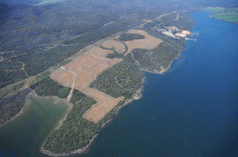

A draft forests peace plan obtained by the ABC reveals logging in high conservation value forests could be stopped, in exchange for green groups accepting Gunns’ Tamar Valley pulp mill.
Loggers would stop felling publicly-owned native forests in exchange for conservationists agreeing to a go-ahead for a plantation-based Tamar Valley pulp mill, if a draft Tasmanian forests peace plan is agreed to.
The draft agreement being discussed by peak forestry and environmental groups includes financial assistance for logging contractors.
But it relies on agreement being reached between the protagonists, and then the State and Federal Governments bankrolling the plan.
In June, the peak forestry and environmental groups started talks in an attempt to end the decades-long conflict over Tasmanian forests.
At the table are all the major interest groups, including Timber Communities Australia, the National Association of Forest Industries, the CFMEU (Construction, Forestry, Mining and Energy Union), Environment Tasmania, The Wilderness Society and the Australian Conservation Foundation.
Now a “final negotiating draft” discussed by the groups has emerged.
In the draft, all the parties ask the State and Federal Governments for a fully-funded package to implement an agreement; interim financial assistance for contractors; help for some to exit the industry; and a guaranteed, sustainable quantity and quality of wood for those remaining.
The conservation side is seeking a moratorium on logging high-conservation-value forests within 30 days of the agreement being signed, with a full moratorium within three months.
Conservationists also want a ban on new companies entering the industry while negotiations are underway.
The roundtable is also looking at agreeing to principles that would move the industry out of public native forests into plantations; changing government agencies, policies and laws to facilitate the implementation of any agreement; seeking funding to improve carbon outcomes; and encouraging Forestry Tasmania to obtain Controlled Wood accreditation and full Forest Stewardship Council certification.
The group is also considering using waste left over from plantation forest harvesting as biomass fuels.
However a note on the document says environment groups oppose wood-based biomass fuels, while the National Association of Forest Industries supports it.
Greens adamant on mill
So far politicans have been kept out of the negotiations.
The Tasmanian Greens say the draft negotiating documents appear quite reasonable, but the party will never accept Gunns’ proposed Tamar Valley pulp mill.
The Greens’ Forests spokesman Kim Booth has welcomed moves from both sides to create a sustainable timber industry, but says the pulp mill is a big sticking point.
“Were it to be that support was made for the Longreach pulp mill that Gunns is proposing, then that would be completely unacceptable to not only the community, but the Tasmanian Greens would continue to fight against the building of a pulp mill through that corrupt approval process.”
The only negotiator prepared to speak says there is no final agreement.
Terry Edwards from the Forest Industries Association of Tasmania is disappointed the draft has been leaked.
Tasmanians Against the Pulp Mill says …
Leaks from the forest “round table” discussions mean nothing.
The two-legged forest round table discussions have no legitimacy – without a third (community) “leg” they will fall over.
The Tasmanian community is excluded from the secret round table. The Wilderness Society and Enviromnment Tasmania do not represent the 80% of Tasmanians who have consistently opposed a pulp mill in Tasmania over the past 6 years.
There has been no dialogue between the community and the environmental negotiators; this renders the process invalid and will not prevent massive protests against Gunns’ controversial pulp mill.
The fact that high conservation value “old growth” and threatened species habitat should be preserved is not disputed; but to lock up all native forest is an absurdity. This is especially true in the context of exchange for a pulp mill in Northern Tasmania ( and there is only one proposal in the public domain ) and the threat of additional plantations encroaching further into Tasmania’s rich faming land and our ambition to be the “food bowl” of Australia.
Gunns claim they are to be 100% plantation, so what do the conservation negotiators have to negotiate? We understand that Forestry Tasmania are not at the table and into the future may pursue their own agenda; this could well include operating wood chip plants and wood fired power stations. which would continue to devour our native forests.
Sue Neales, Mercury: Pact reached in forest talks …
Pact reached in forest talks
SUE NEALES | August 26, 2010 08.28am
SECRET talks to bring peace to Tasmania’s long-running forest conflict have reached a deal, trading off an end to native forest logging in exchange for a green light to the Gunns pulp mill.
Under the nearly finalised peace plan, environmentalists involved in the top-level talks have agreed to a Tamar Valley pulp mill based on plantation timber, provided all logging in Tasmania’s high conservation public forests halts immediately.
The draft plan, in its final stages of negotiations between national forest industry and environmental groups, also includes a costly plan for large numbers of logging contractors to leave the industry.
The negotiating document, headed “final negotiating draft”, was leaked to the ABC in Hobart yesterday.
…
Key details of the deal include:
• A halt to all logging in high-conservation native forests within 30 days of the agreement being signed.
• A full moratorium on logging in all public native forests other than in some agreed low-value regrowth areas within three months.
• Agreement from environmental groups for Gunns to build its $2.5 billion pulp mill in the Tamar Valley, without protest and obstruction in financial markets.
• All parties to ask the state and federal governments for a fully funded package to implement the native forest exit deal, including financial assistance for contractors.
• A guaranteed, sustainable quantity and quality of wood for remaining contractors.
• Restructuring of government agencies such as Forestry Tasmania.
Forest Industries Association of Tasmania executive director Terry Edwards said last night he was disappointed the plan had been leaked to the media.
He said it remained a draft plan that had not been signed off on by all parties yet.
Friends of the Tamar Valley:
MEDIA RELEASE 26/08/2010
FRIENDS OF THE TAMAR VALLEY INC
– FORESTRY NEGOTIATIONS
– NO PULP MILL IN TAMAR VALLEY
– DOSSIER RELEASED
The breaking news of a leaked document indicating that conservation groups will not oppose a Tamar Valley pulp mill in exchange for protecting native forest is of little consequence to FTV.
“Even if a small number of conservation groups flipped in their opposition to the pulp mill this will not lead to the pulp mill proceeding” spokesperson for FTV, Vanessa Bleyer said.
“FTV is opposed to any pulp mill in the Tamar Valley and will continue to campaign vehemently at a local, national and international level to stop the proposed Tamar Valley pulp mill”
“There are good reasons why a Pulp Mill is non-negotiable to the people who live in the region, and why it will not proceed. They are set out in the dossier recently released by FTV (download below).
“The proposed Tamar Valley pulp mill will:
• Seriously compromise existing jobs, pulp mill sensitive businesses and the iconic Tamar Valley’s $500million a year tourism industry;
• adversely affect the health of the 100,000 people that live in the Tamar Valley;
• verify an improper assessment process for approval of the mill;
• dump 64,000 tonnes of toxic effluent off the northern shores of Tasmania every day.
Download dossier:
FTV_Dossierx_(20_8_10).pdf
Pulp The Mill:
MEDIA RELEASE
In response to the recent articles about the leaked draft final report from the round table forestry talks where other environmental groups are reported to support the Tamar Valley Pulp Mill , Pulp the Mill spokeswoman, Lucy Landon-Lane clarifies the position of this anti-pulp mill group which has state and national support.
She says, “There are only three environmental groups involved in these round table discussions which is less than half the number of groups opposed to the proposed Tamar Valley pulp mill. While we agree that there is an urgent need to have a moratorium on native forest logging, Pulp the Mill will never agree to the proposed mill.
“Before Gunn’s withdrew from the RPDC assessment process, this mill proposal was deemed “critically non-compliant” in areas of environmental and social impact. Pulp the Mill believes that the pollution from the Tamar Valley mill, if it goes ahead, would have seriously detrimental effects on the health of the 100,000 residents who live in the Tamar Valley; its effluent will destroy marine life (some of which is endangered) within the pristine water’s of Bass Strait; sustainable industries already in existence within the valley will be totally undermined; and the safety of people travelling on our highways will be threatened by an unacceptable increase in log trucks.
“On top of all this, the fast track assessment process was totally inadequate and lacked any public participation. We will continue to vehemently oppose this proposal until it is dead and buried.” she said.
Our Common Ground …
Ongoing forest talks must be given the space to succeed
Russell Warman, Environment Tasmania policy coordinator said “The forest talks have focussed around finding a positive solution to the 30-year long problems around forestry in Tasmania.”
Environment groups involved in the talks believe that it is crucial for Tasmania’s future that the forestry talks continue in good faith and not be derailed by a media-driven forestry debate based on a draft negotiating document.
“Tasmania’s environment, economy and community stand to greatly benefit from resolving and putting this long-running forest conflict behind us.
“We know that the majority of Tasmanians want to have a sustainable timber industry for the future and to protect our magnificent native forests such as in the Upper Florentine, the Blue Tier and the Tarkine.
“That’s why industry and conservation groups have come together in good faith and with open minds to find common ground.
“And we’ve been able to make significant progress because the talks have been held out of the potentially divisive political and media spotlights and we would ask all politicians to continue to give this process the space and time needed to succeed.
On the pulpmill, Mr Warman stated that “We understand that the logging industry see a pulpmill as an important part of their future, but the proposed mill and its approval process has been damaging and divisive in the community. These talks will not give a green light to the pulp mill. We do support a sustainable timber industry with plantation-based timber processing – including a pulp mill. However, any pulpmill proposal must have a proper community consultation process and address all environmental issues – unlike last time.”
All the groups involved feel that these talks are the best chance to solve the forest conflict in many years. But they need the space to succeed.
If they are successful, it will be great news for all Tasmanians. Those who value our unique and beautiful environment. Those who value secure and lasting timber jobs. Those who value climate-saving storage of carbon in native forests. And particularly of interest to the tourism industry who will now have those areas protected and have a good clean, green brand to market.
Wilderness Society
Historic opportunity to end years of conflict over Tasmania’s forests
The Wilderness Society today responded to media reports on the ongoing discussions about the protection of Tasmania’s native forests with environment and forest industry representatives.
The Wilderness Society’s national forest coordinator, Tim Birch said the discussions were focused on the protection of Tasmania’s native forests, creating a sustainable timber industry in Tasmania, and ending the long-standing dispute which has divided the Tasmanian community.
The talks offer the prospect of a truly historic solution to the conflict over Tasmania’s forests.
“We are attempting to reach agreement with the industry on a solution to the protection of Tasmania’s native forests and immediate cessation of logging in the high conservation zones, such as Upper Florentine, the Blue Tier and the Tarkine,” said Mr Birch.
These spectacular forests are currently unprotected and are home to many species including the threatened Tasmanian Devil and Tasmanian Wedge-tailed Eagle.
“We are not negotiating on the establishment of a pulp mill,” said Mr Birch.
“It should be made very clear, that if we reach agreement on these principles it will not give a green light to the Tamar Valley pulp mill. There are a range of environmental and social concerns that must be addressed in relation to this proposed mill, including a proper community consultation process.
“The ongoing discussions have been extremely worthwhile and our objective remains to reach common ground on the need to create a sustainable forest industry in Tasmania, provide jobs for workers and keep Tasmania clean and green. These talks are about a new path forward on the forestry debate in Tasmania, a path which finds acceptable outcomes to all sides.
“If State and Federal governments support any agreed principles, a program for formal negotiations can commence. To be successful, the negotiations will require significant input from a much broader range of stakeholders, experts and the broader community,” said Mr Birch.
Nick McKim, ABC Online:
Greens play down chances of pulp mill deal
By Meredith Griffiths and staff
Tasmanian Greens leader Nick McKim says it is unlikely Gunns’ planned pulp mill will ever be built in the Tamar Valley.
Leaked documents have revealed a possible deal between conservation groups and the forestry industry on a highly controversial pulp mill proposed in the north of Tasmania.
Conservationists and representatives from the timber industry have been in talks for months, trying to find a common vision for the future of forestry in the state.
The documents, obtained by the ABC, outline the broad terms for a draft agreement including a moratorium on the logging of high conservation value forests within 30 days.
In exchange, conservation groups would need to drop their opposition to a plantation-based timber processing facility.
But Mr McKim says the Greens will not support Gunn’s current pulp mill proposal.
“As I said, we don’t support the current proposal, but we will look at any future proposal if there is one for a pulp mill in Tasmania on a case-by-case basis and with an open mind,” he said.
Leaked document
The parties involved are playing down the significance of the leaked document.
The Wilderness Society says it is only one of many drafts.
“Whatever agreement is reached there is no green light for a Tamar Valley pulp mill. That’s absolutely clear,” the group’s national forest coordinator Tim Birch said.
The Forest Industries Association says the pulp mill is one of a range of sensitive topics being discussed in the negotiations, which remain ongoing.
Ed Vincent, who represents contractors hired by forestry companies to log timber, many of whom are struggling to get enough work, says although negotiations are far from over, there is substantive agreement.
Will Hodgman, ABC Online:
Libs claim massive jobs losses from forestry peace deal
Related …
WEST AND NW COASTS NEED TARKINE ROAD FUNDS REALLOCATED
Use Greens’ Diverse Economic Vision as Roadmap
Paul ‘Basil’ O’Halloran MP
Greens Member for Braddon
mps.tas.greens.org.au
The Tasmanian Greens today called on the Minister for Tourism Michelle O’Byrne to announce the re-allocation of the $23 million set aside for the now-abandoned Tarkine loop road into a range of local job-creating projects, as proposed by the Tasmanian Greens in their Diverse Economic Vision for the Tarkine Region, and also by the Cradle Coast Authority.
Greens Member for Braddon, Paul ‘Basil’ O’Halloran MP, said that the reallocation of the Tarkine Road funding into local job-creating projects, as outlined in the Greens’ Diverse Economic Vision, would lead to the creation of up to 1100 new jobs and an injection of $58 million into the economy of the West and North West Coasts.
“The economy of the West and North West Coasts is suffering due the government’s failure to re-invest the funds that they had previously allocated to the now-abandoned Tarkine Road proposal,” said Mr O’Halloran.
“There would be widespread economic benefits for the entire region, including Rosebery, Smithton and Wynyard, if the government saw sense and re-allocated the $23 million.”
“The Greens are calling on Minister O’Byrne to announce that the $23 million has been re-allocated into a range of local job-creating projects right around the region, as suggested in our Diverse Economic Vision for the Tarkine Region,” said Mr O’Halloran.
Reference: “A Diverse Economic Vision for the Tarkine Region,” released by Nick McKim MP and Cassy O’Connor MP, March 2009, http://mps.tas.greens.org.au/wp-content/uploads/2010/06/March2009_AlternativeTarkineSpend.pdf
RESEARCH INTO ALTERNATIVES TO 1080 MUST CONTINUE
Minister Must Rule Out Replacing One Cruel Poison With Another
Kim Booth MP
Greens Forests spokesperson
The Tasmanian Greens today called on the Primary Industries Minister to commit to continuing research into non-lethal alternatives to 1080 poison, and to rule out replacing the use of 1080 with another controversial poison, Feratox, which contains cyanide.
Greens Primary Industries spokesperson Kim Booth MP said Feratox is currently being trialled in Tasmania as a prelude to its registration for use, despite one of the trials resulting in the death of a Long-Nosed Potoroo, which is a wholly protected species in Tasmania.
“The replacement of one cruel and controversial poison with another is a ridiculous approach that will continue to undermine Tasmania’s vital clean and green brand, and the Minister must commit to continuing research into non-lethal alternatives to 1080,” said Mr Booth.
“Feratox is known to cause suffering before death and it is known to kill non-target species. The replacement of 1080 with Feratox will not end the controversy over the poisoning of Tasmania’s native animals, it will simply entrench it.”
“The government must rule out replacing the use of one cruel and controversial poison with another, and instead remain focussed on supporting the development of non-lethal control methods,” said Mr Booth.
FORESTRY TASMANIA EXPORTING TIMBER JOBS WITH WHOLE LOGS
Why are Chinese Importers Paying Less for Our Logs Than Tasmanian Millers?
Kim Booth MP
Greens Forests spokesperson
The Tasmanian Greens today continued their calls for the Forestry Minister to reveal the public return, if any, on the recent and very contentious export shipment of whole logs from the port of Burnie to China.
Greens Forests spokesperson Kim Booth MP said it is his understanding that Forestry Tasmania will receive less than $1 per tonne in royalty on the exported logs, and that not one single Tasmanian mill has been offered the same quality logs at the same price.
Mr Booth also said that Tasmania’s forest industry will never be sustainable while Forestry Tasmania continues to interfere with market forces by virtually giving away logs for export, a practice that is effectively exporting timber workers jobs along with the logs.
“The Minister must reveal the public return, if any, from the recent and very contentious export of whole logs from Burnie to China,” said Mr Booth.
“Why are Chinese importers being offered logs at lower prices than Tasmanian millers?”
“Forestry Tasmania are distorting the market and undermining the sustainability of the entire forest industry through deals such as this.”
“After spending most of this Parliamentary week asking the same question I am yet to receive a proper answer. It is obvious that Forestry Tasmania have virtually given away this shipment of logs and are now trying to conceal the truth to prevent the understandable public outrage that will occur if the real story ever comes out,” said Mr Booth.
Jacqui Street, ABC Online: Forestry talks: who was behind the leak?
The reason the draft was leaked to the ABC is the same reason that more than 5,000 people marched through Launceston to oppose the pulp mill. It’s not about the merits of the agreement. It’s not about trying to destabilise the talks. It’s about people feeling they haven’t been heard, that they have been excluded from a process.
There is growing concern, particularly in small north-eastern communities that rely heavily on the timber industry, that ordinary people have been kept out of these negotiations. Farmers for instance, who grow many of the plantations discussed in the draft, have no seat at the table.
There is no representative from local government. There is a perception, rightly or wrongly, that decisions are being made by big industry and big environment groups based in Sydney, without consulting the smaller players.
Several sections of the draft refer to getting approval from stakeholders and consulting communities. But people in the small local shops, timber yards and country sawmills don’t want consultation after the fact. They want a seat at the table. It is the perceived failure of process that, once again, could see the forestry debate turn from a roundtable into a merry-go-round.
ABC Online:
Council backs Hampshire pulp mill option
The Burnie Council says the forestry peace talks could restart plans for Hampshire. (7.30 Report)
A north-west council says it is would be “more than willing” to back Hampshire as a viable alternative to Gunns’ controversial pulp mill in the Tamar Valley.
Gunns will not comment on any alternatives to its Tamar mill proposal.
A leaked draft peace agreement from forest industry talks shows industry and conservationists might be willing to accept a plantation-fed pulp mill in exchange for the protection of native forest.
Conservation groups say they are not giving the green light to the proposed Tamar Valley mill but might support a mill at a different site.
Burnie City Council’s general manager Paul Arnold says the forestry peace talks could restart plans for an alternative pulp mill at Hampshire.
“Of course, we’d be more than willing to have Hampshire back in the game,” he said.
“Burnie City Council’s always been open to a pulp mill at Hampshire and been very, very supportive of it.
“In fact we did a lot of community consultation on it in the earlier days. However, we have respected Gunns’ decision to commercially go for Bell Bay but if that is not ultimately approved, of course we’d be more than willing.”
Industry analyst Robert Eastment says a pulp mill’s essential for the forestry industry.
“If we do not have a pulp mill then we would certainly be faced with the closure of the forest industry in Tasmania
ABC Online:
Forestry wins court battle to conceal costs
Forestry Tasmania has won its court battle to keep secret the amount of money it spent on a television series.
The state-owned forest company rejected a Freedom of Information request from Greens MP Kim Booth to release the money it has invested the TV series “Going Bush.”
Forestry Tasmania argued some of the information would expose it to a competitive disadvantage.
But Mr Booth successfully appealed to the Ombudsman who concluded the company should release the information.
Forestry Tasmania took the matter to the Supreme Court and today Justice David Porter found in its favour.
Outside court Mr Booth said he was disappointed by the decision.
He says in the interest of openness and accountability Forestry should disclose the cost of the programs.
First published: 2010-08-25 08:33 AM