Economy
Banks Grow Wary of Environmental Risks

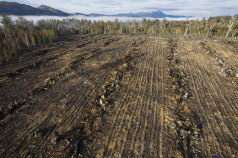

Blasting off mountaintops to reach coal in Appalachia or churning out millions of tons of carbon dioxide to extract oil from sand in Alberta are among environmentalists’ biggest industrial irritants. But they are also legal and lucrative.
For a growing number of banks, however, that does not seem to matter.
After years of legal entanglements arising from environmental messes and increased scrutiny of banks that finance the dirtiest industries, several large commercial lenders are taking a stand on industry practices that they regard as risky to their reputations and bottom lines.
In the most recent example, the banking giant Wells Fargo noted last month what it called “considerable attention and controversy” surrounding mountaintop removal mining, and said that its involvement with companies engaged in it was “limited and declining.”
The bank was a small player in the sector, representing about $78 million in bonds and loan financing for such companies from 2008 to April of this year, according to data compiled by the Rainforest Action Network, an environmental group tracking the issue.
But the policy shift by Wells Fargo follows others over the last two years, including moves by Credit Suisse, Morgan Stanley, JPMorgan Chase, Bank of America and Citibank, to increase scrutiny of lending to companies involved in mountaintop removal — or to end the lending altogether.
HSBC, which is based in London, has curtailed its relationships with some producers of palm oil, which is often linked to deforestation in developing countries. The Dutch lender Rabobank has applied a nine-point checklist of conditions for would-be oil and gas borrowers that includes commitments to improve environmental performance and protect water quality.
In some cases, the changing policies represent an attempt to burnish green credentials in areas where the banks had little interest, and there is no indication that companies engaged in the objectionable practices cannot find financing elsewhere.
Still, banking analysts and others suggest that heated debate over climate change, water quality and other environmental considerations is forcing lenders to take a much harder — and often uncomfortable — look at where they extend credit, and to whom.
“It’s one thing if your potential borrower is dumping cyanide in a river,” said Karina Litvack, the head of governance and sustainable investment with F&C Investments, an investment management firm based in London. “But if they’re dumping carbon dioxide into the air, which is not exactly illegal — what do you do? Banks are in kind of a quandary, because they are competing for business, and if they get holier-than-thou and start to play policeman, they risk allowing other banks to take that business.”
…
The Rainforest Action Network, which has headed a campaign to highlight financial institutions with connections to the mining, said this month that the policy shifts were chipping away at the financing.
Citing Bloomberg data, for example, the group noted that Bank of America — listed as recently as 2008 as one of the “syndication agents” on a $175 million revolving line of credit to Massey Energy — has eliminated that and all other connections to the company. The group also pointed to JPMorgan, which had previously underwritten $180 million in debt securities to Massey, but no longer has any financial ties to that company. In May, the bank said it would be subjecting all future engagements with companies involved in mountaintop removal mining to “enhanced review.”