Economy
Bleaney-Scammell and pulp mill fallout

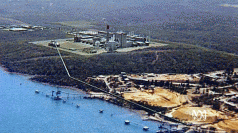

ONE OF THE most disturbing outcomes of the Bleaney-Scammell investigation into water toxicity in the George River, St Helens, was the almost complete indifference of the public health authority to toxic scum on the river and the overwhelming silence of those government agencies responsible for maintaining safe and viable fisheries in our coastal and inter-tidal waters. This doesn’t auger well for oversight of the potential impacts of effluent from the proposed Tamar pulp mill, if it were built.
Dr Stuart Godfrey (TT “The toxic blowback”, 8 August 2007, HERE ) warned that “potentially toxic substances in the effluent – including bacteria and dioxins – could attach themselves to an ultra-thin layer of oil on the surface of the ocean, and thereby concentrate in foam that blows back to the shore”. The Chief Scientist in his report ( September 2007) states that “the likely consequence is that fine particulate matter and attached contaminants such as dioxins will … ultimately accumulate in deposition zones with low bottom stress, either in deeper water further offshore or in sheltered bays and estuaries inshore”.
The ongoing problems with oyster growth and mortality in Georges Bay (particularly associated with heavy rainfall events) provides compelling evidence that such surface scums and other contaminants, possibly entrained in the water column, can lead to significant deleterious impacts on commercial fisheries. The issue for the State regulatory authorities was not that the toxic scums existed, but whether they were “natural” or not. This misses the point. It is the gross volume of such contaminants in the water which is having the effect. The issue is not whether the contaminants are natural, but rather whether the gross volume of such contamination is natural.
This latter issue, that of gross volume of contamination, is the problem with the proposed pulp mill and its effluent pipeline (which is sited in a key nursery area for fish species such as flathead, yellow-eye mullet and Australian salmon). While highly toxic dioxins have been the toxicant of primary interest, there are increasing indications that naturally occurring compounds in wood are having significant disruptive impacts on fish and other biota near pulp mill outfalls. The results of the first three cycles (12 years) of the Canadian Environmental Effects monitoring program found that mill effluents still affect the local receiving environment, and that endocrine and metabolic disrupters are interfering with sexual differentiation and affecting the reproductive cycle of fish populations. In Sweden, significant male bias in fish was observed near a large pulp mill on the Baltic coast; in Finland, measured sterol levels are significantly higher than background levels in sediment near a pulp mill in Lake Saimaa.
An issue over-looked here in Tasmania – highlighted by the indifference of authorities to the impact of toxic river flows at St Helens – is that there are no State or Federal environmental limits for concentrations of such contaminants in the environment. No baseline studies have been carried out and identification of potential toxins has been largely ignored. The issue is serious, as Dr Linda Campbell of Queen’s University, Ontario (Environmental Impacts of Pulp and Paper Mills, 2007) points out: “reproductive impacts may be hard to detect, but can eliminate fish populations as effectively as acute mortality”.
As part of the National Water Quality Management Strategy, the Commonwealth sets limits for contaminants through the Australian and New Zealand Guidelines for Fresh and Marine Water Quality (ANZECC). These guidelines need to be updated urgently to include naturally occurring contaminants such as sterols in wood fibre and the toxins occurring in leaves and other forest / plantation debris. With respect to the proposed pulp mill, under the conditions of the Minister’s Approval Decision, such contaminants are clearly “contaminants of potential concern” (para 36) and must be included in the proponent’s assessment of “chemical and ecotoxicological assessments including assessments of endocrine disrupting ability, and ecological assessments” (para 41).
Drs Bleaney and Scammell must be congratulated for their dogged pursuit of the issue of toxicity of the George River – in the public interest, and against the odds.