Economy
Levelling the Playing Field is not a moral judgment but a statement of necessity


Tasmania, the land mass which has wandered across the globe from the Equator to the Antarctic over millions of years, is our home.
The locals have been here for over 35,000 years. Some of us, the boat people, have settled here only in the last 200 years as a consequence of the traumas of war, policies of nation states, and the desire of people to lead a better life. From the refuse of the English prisons, the turbulence of Ireland, the displaced from Europe, and, more recently, the turmoil of Asia, the Middle East and Africa, we have formed a community with common pride and identity as Tasmanians, Australians and citizens of the world. Our activities have spanned the gamut of human endeavour, from firestick farming to globalisation. We have lived with and struggled against our environment. But we have loved where we live.
We have seen or participated in a range of discourses about our home. Early lovers of nature fought for Cradle Mountain, Hastings Caves and the like. A later generation, encouraged by an unlikely alliance of the middle class and the construction workers of the unions, fought for our colonial heritage under the banner of the Green Bans. That process was followed by an impetus to plan our cities, to regulate the use of resources, and to retain wild lands for future generations.
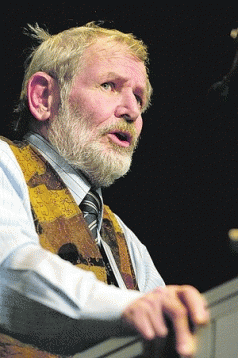
But there was a price. My generation – I am now aged 66 – was required to pay for the sins of the past and the hopes of the future. The Italian Left, in analysing the political future, posed the question succinctly in the European context: ‘The Greens ask all the right questions, but what is the answer?’
This paper, Levelling the Playing Field, commissioned by Environment Tasmania, is an attempt to answer that question. Dr Wynne Russell and her colleagues have produced an analysis of both where we are and where we wish to go. It is about self governance as citizens and recognition of modern economics. We might be proud Tasmanians and care for our families but we have limited resources. One of those resources is forestry.
This paper recognises the sometimes competing needs of protecting our home and generating income to provide for our families. It accepts the need of a nation state to function within the global economy. It sets out a series of decisions and procedures whereby we can reconcile human needs, legal processes and the response of government for our future. The paper is not one of rhetoric, special pleading or modern spin. It compiles research, case studies, public opinion and a detailed analysis.
Levelling the Playing Field is a recognition of reality. It is not judgmental. It accepts both the interests of those who work within the forest industries and of the community as a whole.
The slogan ‘Think globally, act locally’ has served us well. It took us away from despair and made us believe that what we did mattered. It has generated positive actions and achievements for a sustainable future. But the slogan had had limitations. Sometimes it was hijacked for self-interest by people who contrived to equate localised personal agendas with broader issues. It led to the NIMBY – or ‘not in my back yard’ – syndrome. The slogan remains valid, but only if it recognises the interconnected complexities of the modern world. This paper – an unfinished discourse – does that.
Critics might seek to meet the paper by arguing that it seeks to end the use of a natural resource. They would be wrong. It does no such thing. A consequence of its recommendations is the reform of the legislative and administrative processes through which we as Tasmanians shape our community. It recognises the interests of those within the forestry industry and those public officers charged with regulating the industry who need to know that they are asked to do. We, as a community, have served each badly. Levelling the Playing Field is not a moral judgment but a statement of necessity.
An outcome of the report might be, as some critics might claim, a change in the aims and duties of a public authority, Forestry Tasmania, and, if so, it would be a desirable outcome. Some critics might claim that the report’s recommendations would be harmful to the long-term interests of an important corporation, Gunns. They would be wrong. The corporation has already—and commendably—changed direction, moving towards plantation farming.
No one is presently gaining advantage through the present system. Local government is not properly informed; logging contractors have no certainty or profit; and the community is confused. Both natural resources and taxpayer subsidies are being lost.
Critics may contend that the paper does no more than argue for the end of logging oldgrowth forests. The paper does not—it seeks the speeding up of the transition to other resources. Logic tells us that continual misuse will destroy those forests eventually. Logic tells us that if we are to cater for future generations then we need to conserve their inheritance. Logic is at the heart of this discourse.
This paper does not prevent Tasmania from wandering across the globe, either by tectonics or through economics. But it is a guide to how we can keep wandering but remain a wonderful and cohesive community.
Download: Levelling_the_playing_field_FINALx.pdf
Red the Media Release: HERE: Environment Tasmania seeks input from the public about forestry governance