Economy
GMO Forests Could Sink Canada’ s Pulp Industry

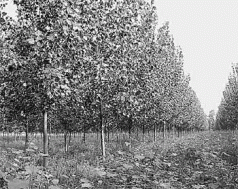

Biotechnology is poised to deal another blow to Canada’s distressed pulp and paper industry. The sector has been reeling from a parade of bad market news and even worse macroeconomic conditions. Now word from the USA that ArborGen LLC, a joint venture of International Paper Co. and MeadWestvaco Corp., is pushing for US approval to establish large-scale GMO eucalyptus plantations in the deep south. ArbonGen’s GMO eucalyptis is a frost-tolerant variant of the rapidly growing Australian tree that dominates tropical plantation forestry around the globe.
Much criticism has already been leveled on the ArborGen plan to add GMO forestry to the already prevalent use of GMO food crops (e.g. corn, soy, canola). Many see the push to create ‘Franken-forests’ alongside a pantheon of ‘Franken-foods’ as nothing less than playing a form of Russian roulette with native species conservation and ecosystem integrity. ArborGen counters that it has inserted a gene into the eucalyptus DNA that effectively stops reproduction, hence preventing the spread into native forests. The tree’s genetic alteration to withstand mild frosts enables this tropical species to grown in the temperate climes of the south, but won’t make it suitable north of the border.
The GMO eucalyptus proponents argue this modified species will allow the US to replace some of it’s southern pine plantations with up to 10 million acres of the super fast growing tropical hardwood, placing it in on a level footing with South American and Asian competition. Eucalyptus can be grown for pulp logs in less than 6 years, and for wood biofuels in half that time.
The Canadian pulp and paper producers are already poorly positioned to play the high-volume, low-cost global wood fibre game. Pulp markets are dominated by short-rotation tropical operations, and Canada’s niche in high-quality paper fibres is suffering from an eroding end market. The proverbial paperless office is now upon us and it has been joined by the slow death of directories (replaced by internet search), newspapers and books moving to the electronic sphere with the growing popularity of electronic readers. A flood of additional cheap wood fibre into North America could be the proverbial ‘last straw’ for the Canadian pulp sector and similarly quash the emerging market for wood pellet biofuels.
Plantation forestry has turned countries like Brazil into major pulp exporters. China, and other southeastern Asian countries have also ramped up short-rotation tropical plantations and soon will be adding to global fibre supplies. The development of enormous pulping facilities in the tropics coupled with their lower labour costs and lax environmental standards have turned a cornerstone of Canada’s manufacturing sector into a slowly disappearing relic of the past.
Canada does have some short-rotation forestry options, in the form of conventional tree hybrids and some introduced European species, but nothing that can rival the growth rates of eucalyptus. In the world of low-cost producers with even lower environmental standards it’s time for the sector to recognize the fact that it can’t continue to chase the bottom of the forestry market. The only way forward is to build a competitive advantage around sustainability and quality.
If there is going to be turnaround, the sector needs to focus its efforts on developing unique, high-value bioproducts from pulp-grade wood and niche solid wood materials with an emphasis on quality and ‘branding’ sustainability. In the interim, expect more mill closures and job losses while the industry loses markets and market share.