What an interesting thread; this is a discussion that really does seem to be getting to the problems that the government faces.
The two key points that I want to pick up on are firstly the clear evidence from Saul that the cost of providing public services is too high.
So how do we best identify where savings can be made in order to make the provision of services more cost efficient?
It seems that the Treasurer is not proposing to do it.
So should Parliament (via a Select Committee and with the existing resources of the Parliament) or would this be seen as the parliament interfering with matters that are soley the responsibility of the government?
If such a committee were established it could at least explain what is the additional cost caused by of our dispersed and older population, though I doubt that it would explain the 6% gap.
It might even be able to report to the community where the differences are between the costs for each department compared with each other State?
It is possible that the numbers in at least one of the Houses of Parliament might just be found for such an inquiry.
If we had this information perhaps then we could put some pressure on the Treasurer to improve the performance of the administration of the public services delivery, if that is where the featherbedding is; if that is not the problem perhaps we might just find out what is the problem.
I am keen to hear any other suggestions as to how we might find the real reasons for the 6%, which clearly adds up to a large bucket full of $ and has the inbuilt assumption that there is no savings to be made (on average) in the other states.
Secondly I want to pick up on the comments about the state taxation system, as the reason I initiated the debate last year that has led to the Taxation review panel being established was because it was very apparent that Payroll Tax had become so narrow and applied at such a high level that it had become a serious disincentive for businesses just below the threshold to grow, because as soon as they came into the system their first years payment would be at least $60,000!
The Land Tax system has had so many exemptions that for those who have not managed to get themselves excluded are paying very high levels.
The last two straws for me:
• tenants, often those on low and fixed incomes have to pay land tax, via their rent, and they cannot claim the ‘principal place of residence’ exemption that owners get.
• the cynical vote buying exercise by Labor to promise the ‘shack’ exemption, and then the Liberal attempt to outdo this by proposing to abolish Land tax altogether.
Just why do we continue to exempt corporate farming; surely with the prices for poppies and livestock at present they can afford it?
The exemption for the hundreds of thousands of hectares of plantations and commercial forests (designated as a PTR) is just another subsidy to an industry that should pay its fair share.
I am very much inclined to see the broadening of the base of both of the above taxes, even if such a change only collects the same amount of revenue.
If one or both were raised slightly then we could probably get rid of the more perverse taxes like that on insurances which provide a significant disincentive for individuals and businesses to insure and are costly to administer and collect.
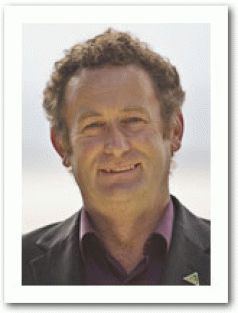
Tim Morris MP
Tasmanian Greens
Member for Lyons