The George River Water Quality Panel has found there are no water quality issues in the George River, giving a clean bill of health for treated drinking water to the local community and ruling out fears of a cancer cluster in the St Helens area, pesticides in the water as well as Eucalyptus nitens toxicant issues for local oyster growers.
However, the Panel has recommended to the State Government that improved and coordinated management and administration of the waters in the St Helens catchment area should be implemented as a priority.
Further information on the use of chemicals should be recorded and made available to assist with monitoring and the security of the water.
In releasing the findings of the report, Panel spokesperson and water quality expert, Dr Graeme Batley said the bottom line is that there is no indication that the treated water is not safe to drink at St Helens.
“In essence the panel found that the river foam samples that were referred to in the Australian Story report broadcast by the ABC in February this year were not representative of the naturally occurring water in the Georges River,” Dr Batley said.
“The method that was used to sample the foam concentrated the sample so much that it became toxic when tested on sensitive water organisms.
“There are very minor levels of naturally occurring toxicants in the George River like any other catchment area, but at naturally occurring levels they pose no health risk to the community.
“All water bodies have a very thin film of less than 0.3 mm on the surface which contains ‘insoluble’ organic matter including surfactants and when mixed with air held in the water and rising to the surface they can form foam bubbles. The foams were what the Scammell Bleaney report said were a major source of toxicants.
“So, yes there are toxicants in the water, but at naturally occurring levels they pose no health risk to the community.”
Other findings include:
– Community health records from 1993 to 2007 show no abnormal cancer rates within the St Helens drinking water area and there are no characteristics of a ‘cancer cluster’.
– Oysters growing in Georges Bay are subject to a number of stressors, such as water temperature, toxic algae, oyster stocking densities as well as antifouling ship paint. Contaminants associated with river or bay foam may also be a minor stressor to oyster health.
– There is no evidence of pesticides in the water supply that could pose a health risk to the community. Insecticides have never been detected, while only traces of herbicides have been detected only during high water flow periods; the concentrations has been well below safe human health guidelines.
Dr Batley said the findings of the report have been handed to the Premier, David Bartlett, earlier today and a number panel members would now travel to St Helens to meet with members of the St Helens community.
“Once the consultation process is complete, unless further investigations are requested by the Premier, then the panel will disband.
“I would like to thank all those who assisted in this investigation, particularly Drs Bleaney and Scammell for their efforts in cooperating with the panel.”
Included in the release of the report are the other reports which helped make up the study, which will be placed by close of business today on the George River Water Quality website. The community is encouraged to examine the findings at:
www.georgeriverwater.org.au
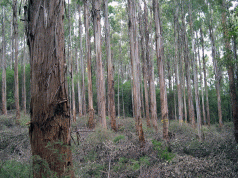
The George River Water Quality Panel is an independent scientific panel convened to investigate claims that toxicants from eucalypt plantations are having an adverse affect on both human health and the health of oysters in oyster farms in St Helens.
It was convened at the direction of the Premier of Tasmania in March to investigate information reported on Australian Story in February 2010
Download:
QA_re_Panel_Report_280610_FINAL.pdf
GRWQP_Summary_Report_WEB_READY.pdf_.zip
GRWQ_report_web_ready.pdf_.zip