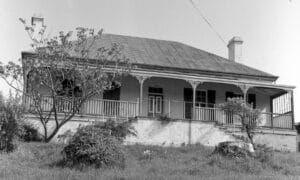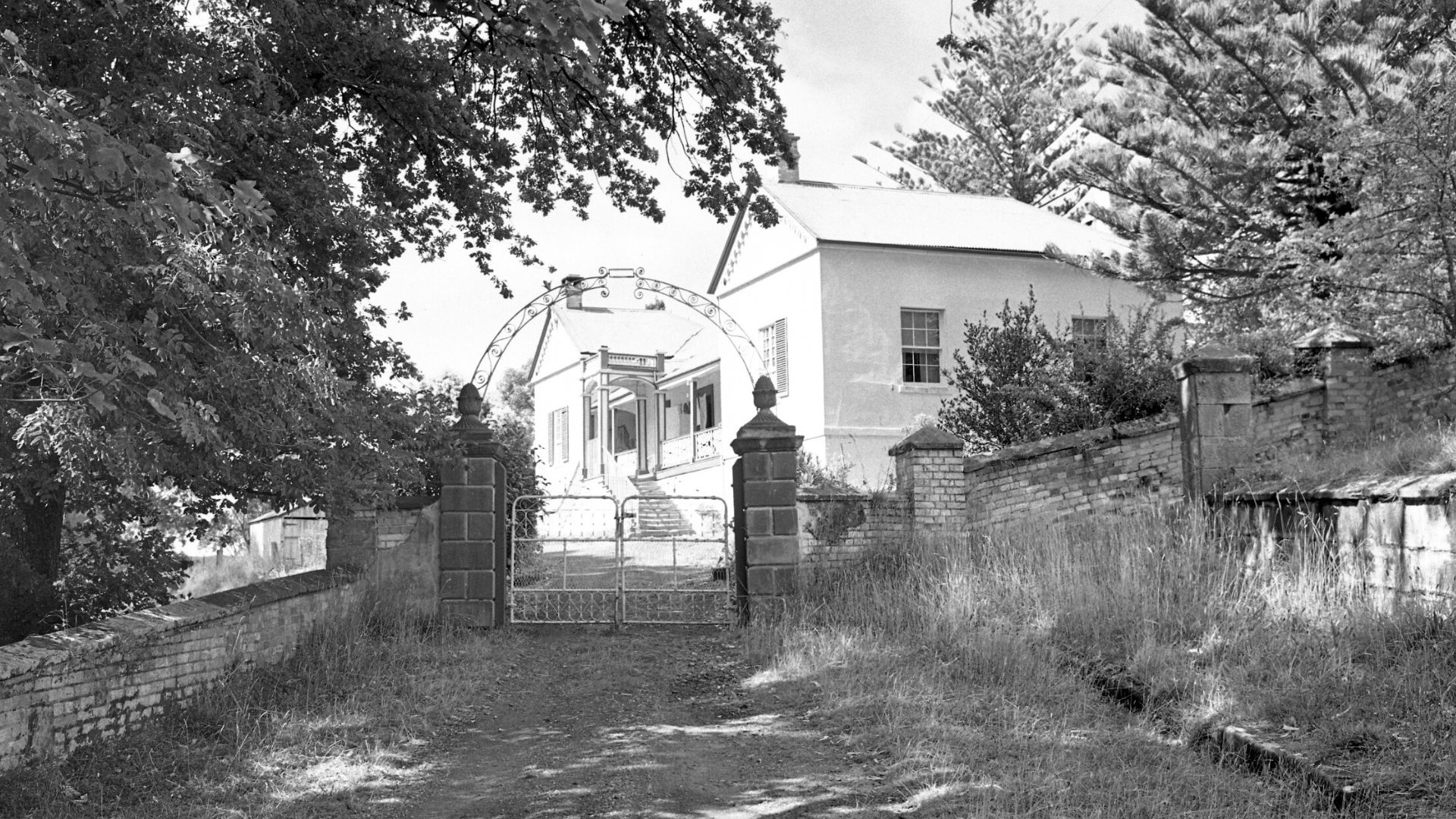
From the outside, the Commandant’s House at Port Arthur looks like a grand old mansion, but step inside and you’ll immediately notice that the interior is ‘all over the place’. This is due to decades of additions and renovations that were made without a single guiding plan.
Nineteenth Century
The house started life around 1833 as a modest timber cottage for Charles O’Hara Booth, an English-born army officer who served as Port Arthur’s fourth commandant from 1833 to 1844. It sat on the hillside overlooking the harbour, and was surrounded by a garden that would, in time, have almost every plant you might find in a typical English garden.
Thomas Lempriére, Port Arthur’s commissariat officer at the time, wrote in 1838 that the cottage was “surrounded by a veranda enclosed by Venetian blind windows” – but acknowledged that it was “small, and badly planned, and certainly unfit for the residence of a Commandant”.
To address this, and to reasonably accommodate their families, Booth and the commandants who followed him made additions and alterations to the building.
When Booth first moved into the Commandant’s House, the kitchen was housed in a separate structure to reduce the risk of a fire spreading to the main residence. By 1837, Booth ordered a new kitchen to be built and had the old one connected to the house and converted into a study. After marrying and starting a family the following year (1838), he arranged for extra rooms to be built at the back of the home.
Booth’s successor as commandant, William Champ – who would later become Tasmania’s first Premier – oversaw more renovations and additions to the Commandant’s House. New stairs were built leading to the front veranda, one of the front bedrooms was transformed into an entrance hall, and a new separate kitchen was constructed.
In 1848, the authorities decided to replace the role of Port Arthur’s commandant with that of a ‘superintendent’. Champ was then essentially made redundant, and the new superintendent, George Courtenay, took charge of Port Arthur – but didn’t live in the Commandant’s House.
Five years later, in 1853, the position of Commandant was reinstated for Courtenay’s replacement, James Boyd. He was the only person with a background in the prison service to be appointed to the role.
Boyd linked the kitchen Champ had built to the house and reconfigured it as living quarters for servants. He also had more servant accommodation built at the back of the residence, added another kitchen – this one actually inside the main house – and gave the front of the building a stone-like finish.
By this point, the Commandant’s House had become a mish-mash of different rooms and hallways.
Boyd stepped down as Port Arthur’s commandant in 1871, and his successor, Adolarius Humphrey Boyd* (no relation), built a photographic studio in the garden. He likely used it to take portrait shots of the convicts, which still survive today.
Twentieth and Twenty-First Century
After Port Arthur was decommissioned as a penal settlement in 1877, the Commandant’s House became a hotel. Murals were painted on some of the walls** and a large dining room was added to the side of the building in the 1920s, but it was later demolished.
The hotel eventually closed, and the Commandant’s House became a rental property managed by the Scenery Preservation Board, the precursor to the current Parks and Wildlife Service. The terms of the lease stipulated that the home would only be rented out until renovations and restoration works had been carried out.
Only basic repairs were ever done, and the Commandant’s House fell into such a state of disrepair that it was declared unfit to be lived in by 1972.
During the 1980s, when the Port Arthur Conservation and Development Project was underway, the Commandant’s House was repaired and restored to resemble how it likely appeared in the 1850s, 1860s, and 1870s.
The conservation of the house and its surrounding garden is an ongoing process.
The Commandant’s House is open to visitors every day except Christmas Day. It is occasionally closed when major conservation work is being done.
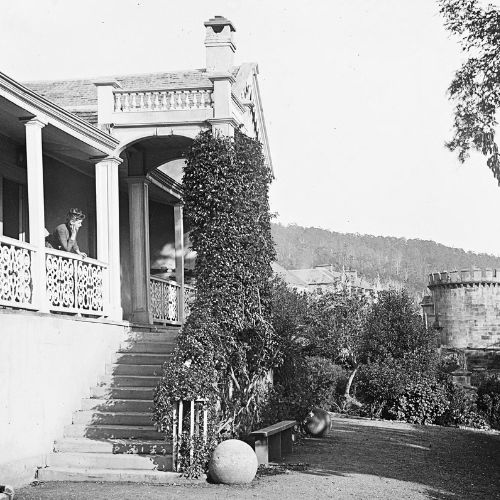
A woman on the veranda of the Commandant’s House in 1900.
* Adolarius Humphrey Boyd, a career public servant, holds the distinction of being the first and only Tasmanian-born commandant of Port Arthur.
** The remnants of these murals can still be seen today.
Tas That Was is a column that includes:
- anecdotes of life in Tasmania in the past;
- historical photographs of locations in Tasmania; and/or
- documentaries about locations in Tasmania.
If you have an anecdote or photograph you’d like to share with us, please send it to [email protected].
Callum J. Jones studied English, History and Journalism at the University of Tasmania and lived in western Sydney from 2022 to 2024 while working as a journalist for Professional Planner, a leading online publication for financial planners. He has written for Tasmanian Times since 2018 and has also been published in a range of other outlets, including Quadrant and the BAD Western Sydney anthologies.
Tasmanian Times (TT) is a community-based news and current affairs service covering the island state of Tasmania. It exists to provide a diverse presentation of Tasmanian issues. TT creates and supports independent media content utilising the best of modern technologies and tried-and-true practices of public-interest journalism.
Support us in expanding our coverage and developing new content by and for Tasmanians.
New initiatives on the way include … what our contributors and readers suggest! Please get in touch with your suggestions.