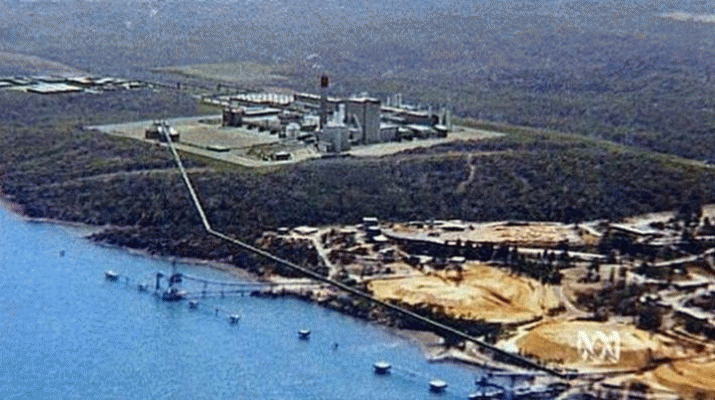
This week the Tasmanian parliament will debate, and presumably pass, the Pulp Mill Assessment Amendment Bill 2014 – the so-called ‘doubts removal’ legislation requested by Gunns’ liquidators KordaMentha to assist them to flog the pulp mill project and its permits.
The bill provides that the Pulp Mill Permit, which first saw the light of day in August 2007, is valid as long as the project is ‘substantially commenced’ within 10 years of that date, not four years as previously required by the permit’s enabling legislation, the Pulp Mill Assessment Act 2007.
It also specifically provides that the ‘holder of the Pulp Mill Permit may sell, assign or otherwise transfer the Pulp Mill Permit to another person’ – proposed section 10A (1).
The apparent purpose of the bill is to circumvent proceedings taken in the Supreme Court of Tasmania by the Tasmanian Conservation Trust challenging the continuing validity of the permit, and seeking definitive judicial pronouncement on the question of what constitutes ‘substantial commencement’.
But how iron-clad is the proposed legislation? Is it nothing more than window dressing for a dud product, and an equally useless government campaign for re-election?
Let’s forget for a moment the brazen flouting of the time-honoured doctrine of the ‘separation of powers’. Since when is it okay in a state that claims to be offering fair, democratic government for the legislative branch of government to overtly prevent the judicial branch from exercising it function of legislative interpretation?
Maybe the proposed bill is just a hastily cobbled together sop for Gunns’ major creditors and their hired muscle, with the incidental benefit that naïve voters may be persuaded that the pulp mill mirage and it’s associated ‘jobs’ have some substance?
The proposed section 10A(1) noted above refers to the ‘holder of the Pulp Mill Permit’, but the Permit itself refers to Gunns Limited (ACN 009 478 148) as the ‘person responsible’ in respect of obligations under the Permit, and the long title of the Pulp Mill Assessment Act describes it as ‘(a)n Act to provide for the assessment of the proposal by Gunns Limitedfor the development and operation of a pulp mill in Northern Tasmania’.
[Incidentally, the Pulp Mill Permit implies that the ‘person responsible’, i.e. Gunns Limited, is able to transfer its responsibilities under the Permit to another party, as follows:
‘”person responsible” means Gunns Limited (ACN 009 478 148), including its
officers, employees, agents or contractors, or any body corporate or joint venture, or other person, their officers, employees, agents and contractors, to which Gunns Limited sells, assigns or otherwise transfers in whole or in part its rights and obligations underthe Pulp Mill Permit; (italics added) ]
Why is the entity with the right to transfer the Pulp Mill Permit described as the ‘holder of the Pulp Mill Permit’ in the proposed legislation, but is clearly noted as being Gunns Limited in the Permit itself? Could it be that the would-be transferring entity has changed character between the time the Permit was issued and now?
In August 2007, Gunns Limited was a going concern with a proposed pulp mill project in dire need of a legislative free ride. In 2014, Gunns is a delisted company in liquidation, complete with non-functioning directors and under the sole care and control of it major creditors’ appointed liquidators. Two completely different fictional persons.
Stay with me here – you’ve heard of creative accounting, so how about a bit of creative legal interpretation?
The legal proceeding undertaken by the Tasmanian Conservation Trust refers to the actions of Gunns Limited, and whether the company ‘substantially commenced’ the project, which was the subject of the Pulp Mill Permit, within the required four-year time frame. The Pulp Mill Permit Amendment Bill purports to amend the time requirement for substantial commencement without acknowledging that the project proponent is no longer Gunns Limited – it is Gunns Limited (in liquidation) under the control of liquidators, KordaMentha.
The primary obligation of Gunns Limited and its directors was to the company’s shareholders. The primary obligation of Gunns Limited (in liquidation) and its liquidators is to its major creditors. Gunns Limited proposed to undertake the pulp mill project and see it to completion. Gunns Limited (in liquidation) is interested only in selling the proposal for the best price possible, in the shortest time possible.
It is arguable that the above mentioned court proceedings may not be obviated by the new legislation. The bill cannot be retrospectively applied to an entity that no longer exists, i.e. a going concern Gunns Limited. The proceedings were taken against Gunns Limited BEFORE it entered voluntary administration and liquidation, so can perhaps safely remain on foot.
It might also be useful to know whether the liquidators have determined whether Gunns was trading whilst insolvent, and if so, from what date. Have the actions of Gunns’ directors been appropriately investigated? Have any preferential payments to creditors prior to liquidation been scrutinised?
• Mill can operate in breach of permit conditions if legislation passes