

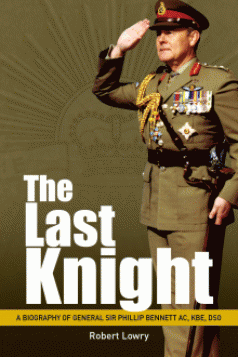
Within the pages of The Last Knight author Robert Lowry exposes what made General Sir Phillip Bennet a great leader.
Lowry describes Sir Phillip as open minded, reserved but affable, determined, dedicated, insightful and decisive: Attributes that Sir Phillip developed in pursuit of a career that spanned a time of great change.
Sir Phillip was a Korean war veteran, a battalion commander in Vietnam, Chief of the Australian Defence Force and Governor of Tasmania.
He was also the last knight to command the Australian Defence Force. His career spanned the evolution of the post-Second World War Army and the bureaucratic tensions that followed the centralisation of defence policy-making and the formation of the Australian Defence Force. An amazing journey for a soldier with less than prosperous beginnings.
Lowry evokes the sense of what it would have been like as Sir Phillip was making his ascent into Military and Australian history through the accounts of his commanding officers and those who knew him.
Although The Last Knight is not an official biography Sir Phillip authorised the release of his personal military career records and the Department of Defence granted access to the official records of the time.
The Last Knight is a powerful biography that highlights how application, dedication and luck can take a career to the highest level.
The Last Knight
A Biography of General Sir Phillip Bennett AC, KBE, DSO
Robert Lowry
General Sir Phillip Bennett is a good example of what makes a great leader. With a good combination of innate personal qualities, education, broad experience and the hardening that comes with survival on the battlefield he prospered. As a young officer he survived the first and most perilous year of the Korean War, including the Battle of Kapyong. He also withstood the rigours of battalion command in South Vietnam in 1968-69, including the Battle of Coral, one of the most intense operations of the war in South Vietnam for the Australian forces.
Bennett’s story is not only one of great battles and heroic exploits, but also a story of the contest for ‘policy dominance’between the civil servants and the military leadership illustrating what was involved in forging the foundations of the Australian Defence Force we have today. He was also a marker of changing times as the first post-Second World War officer and the last Korean War veteran to reach the most senior ranks as well as the last Chief of the General Staff to be knighted. He was the last knight to command the Australian Defence Force.
Phillip Bennett retired at the age of fifty-eight and, five months later, accepted the post of Governor of Tasmania where he served the people of Tasmania for eight years.
Phillip Bennett’s story is characterised by dedication, tragedy, luck, and great achievement. His career spanned the evolution of the post-Second World War Army and the bureaucratic tensions that followed the demise of the separate departments of Navy, Army and Air Force, the centralisation of defence policymaking within the Department of Defence, and the formation of the Australian Defence Force. This is his life; the story of The Last Knight.
For more information: www.bigskypublishing.com.au

About the author:
Bob Lowry was born in Tasmania in 1946 and joined the Australian Army in 1963 retiring as a lieutenant colonel in 1993. He served around Australia and in Vietnam, Singapore and Indonesia during that time. He graduated from the Australian Staff College in 1980 and the Indonesian Army Command and Staff College in 1984 and was a military attaché in Jakarta for two years thereafter.
Since then he has worked at various times for the Australian Institute of International Affairs, the Australian Defence Studies Centre, and the International Crisis Group (Jakarta). He has also undertaken contract research on defence and security related issues and was contracted as adviser to the East Timorese National Security Adviser 2002-03, and to chair the Fiji national security and defence review in 2004.
He has a BA (Asian Studies) from ANU and a MDefS from UNSW.

Launch details:
are being finalised …










