

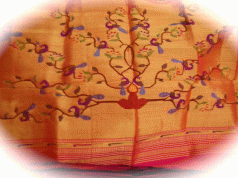
There is a textile tradition in North West India that spans several thousand years and has delivered to the World some of the most beautiful woven cloth, ever seen in the history of fabric. Rich in illustrious 24 carat gold and silver thread and weighty with some of India’s finest silk, this bedazzling tradition is known as The Paithani.

I first came across Paithani about a decade ago when one of my friends from Maharashtra heard that I collected sarees and insisted I add a Paithani to the collection. She explained to me that the dress was originally woven for a Queen in the state of Maharashtra and is now regarded as an heirloom textile, handed down from one generation to the next and, as such, very expensive. It was years before I saved up to buy my first Paithani saree and when I did, my expectations were surpassed.
The beauty of the garment, lies not only in the quality of raw materials used, but in the elaborate head piece design and exciting emblems used across the body and in the borders. Renown for their overwhelming colours, the dress usually comes in mango orange, mahendi green, imperial purple, shocking pink, Persian blue, bottle green or a stunning black. Double shades that reveal different colours depending on the angle of the viewer are also popular. Border colours usually complement the body to provide an extra thrill to the visual feast.

Motifs commonly used in the headpiece and body are parrots, peacocks, flowers, stars, paisa (coin), vases, vines, lotuses, mangos and various stylised geometric patterns like the traditional coconut border.


It was not until I met Rashmi Tapadia, owner of award-winning Paithani business ‘A Touch of Class’, that I came to know the antiquity of this garment. According to Rashmi, thousands of years ago, this garment was
woven by hand before the invention of the loom. Considering that shuttles for silk weaving and remnants of silk threads have been found at the excavations at Mohenjo Daro (3500 BCE) this gives some indication of the antiquity of the silk weaving tradition of North West India.
Over the millennia the tradition of Paithani has undergone several changes, with the royal dynasties of the area making a range of additions and alterations to various aspects of the garment. At one point the tradition almost died out, due to a large shift in cultural values, but it has undergone a fierce revival and is currently prospering with renewed input from designers and appreciation amongst consumers.
The colours and designs of Paithani are really a celebration of sublime nature and the splendour of femininity and these motifs have deep meanings of traditions that ignite strong emotions in those who recognise and respect this ancient tradition.


Paithani captures everything that a saree is supposed to represent – female strength, modesty, beauty, passion and the divine grace that is present in all of nature’s gifts of beauty – birds, flowers, fruit, leaves, vines, trees and geometry.
For more information visit http://www.touchofclass.co.in/handout.html
For connoisseurs of fine garments or for the texilury adventurous it is possible to buy one of these from the same company.










