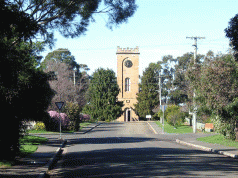
Leo the Lionheart, dedicated defender of Tasmanian heritage values that others who should be responsible disregard, has fired another salvo.
This time he has taken aim at the Anglican Church and its quest for money – a quest impacting on important old church properties. In his latest Mercury column he has targeted what he sees as an outrageous plan to subdivide land next to historic St Luke’s church in the tourism magnet that is Richmond.
And in it he touches on a point that is capturing the attention of other concerned people – of the church having long enjoyed a tax-free status. Now that the church has clearly launched into the business sector and the pursuit of Mammon with a spate of property sales, perhaps it’s time to reconsider its taxation exemptions.
Here’s what Leo Schofield wrote, his column headed “Ungodly move by the church”:
“Announcing that his diocese, the richest in Australia, has lost a breathtaking $160m through poor investments, the Anglican Archbishop of Sydney, Peter Jensen, wondered if God had decided to punish his diocese.
“If so, was He (or She) punishing the faithful for worshipping Mammon?
“One has to wonder about these holy folks and their obsession with money. What investments are they in? Hedge funds? Pork belly futures? Real estate? In whatever field of commerce they choose to indulge, they invariably emerge looking like rank amateurs and that applies to their ability to attract congregations.
“Their churches are near empty and so it seems are their coffers, otherwise how do you explain their wholesale disposal of assets that belong not so much to them as to the public. Now we learn of an Anglican Church application to subdivide land near St Luke’s church in Richmond, here in Tassie.
“This is an outrageous proposal. The church was given this land. They have had it rent- and rate-free since 1834. They pay none of the taxes ordinary people do. Now they want to flog off the curtilage.
“Forget the fact that the colonial architect John Lee Archer designed this historic building. Forget that the clock set so dramatically in the tower is an historic one, made in 1828 and originally installed in St David’s in Hobart.
“Forget the fact that the church, beautifully sited and is listed on the Commonwealth Government’s Heritage Register; forget the way in which the church tried to weasel the development application through in the Christmas New Year period, hoping that no one would notice.
“Forget the fact that the community was given only a couple of days to rally objections; forget the parishioners, whose money after all, has, over the years, gone into maintaining the building.
“Forget the tourism authorities who feature the church on their brochures to lure visitors here.
“This looks like a re-run of the shameful long-term neglect of Holy Trinity and the subsequent disposal of this Hobart landmark.
“The value of historic properties is not just in their stone, bricks and mortar but also in their settings and few churches on this island could have been more felicitously placed than Holy Trinity and St Luke’s.”