

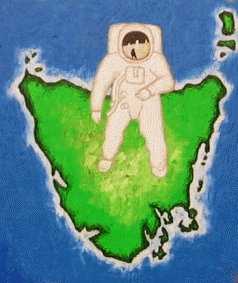
Could the greatest threat to human survival be the loss of space technology?
Global heating is a reality and the climate is changing due to human activities pumping greenhouse gases, including carbon dioxide, into the atmosphere. As a consequence the oceans are getting warmer, the polar ice is melting, sea levels are rising, glaciers are disappearing and deserts are migrating north and south from the equator.
We need global action to cut back on greenhouse gases and remove carbon dioxide from the atmosphere. However, because the supertanker of human politics does not easily respond to calls for a change in direction, our future may depend on individual awareness translated into action.
We need to keep in mind that developing nations like China and India are driving their development with a vengeance, with a keen eye on gaining access to the resources of the
Moon and beyond.
Will they act alone in competition with the United States and other nations, or will a new era of cooperation dawn in the celestial realm? Another consideration is the fact that the Sun
is now 25 per cent hotter than at the dawn of life 3.5 billion years ago and it will continue to get hotter until life is no longer possible on Earth.
In the light of this, the best long-term solution for the survival and health of life on Earth is in building an adjustable sunshade in space, located between the Earth and the Sun
at Lagrange 1. This would be safer than other forms of geoengineering to cool the planet, such as pumping sulphur particles into the upper atmosphere in imitation of a large volcanic
eruption.
Should we build a sunshade in space of either sulphur or mirrors, this will weaken the amount of solar energy reaching the Earth’s surface. There are many ways of generating energy on Earth, but the best long-term energy supply is from the Sun itself.
The most efficient way to take advantage of solar energy would be to build solar power stations in space, where sunlight is stronger and our star never sets. All Earth’s energy needs could be supplied from space, indefinitely and cleanly, allowing fossil fuels to remain fossils.
These two space solutions to Earthly problems could serve to kick-start serious human activity in space and open the Solar System for development. A large human presence
will not be needed in the early phases of space development, where factories in space can be automated and activities involve robots and remote control systems.
People will want to go into space for exploration, science, education and tourism, or simply to live in cities among the stars. Once we have successfully established a sustainable human presence in space, we will have ensured our future survival in a rather dangerous old Universe.
From a sustainable presence in space, we will be in a confident position to work toward a sustainable human presence on Earth, save the Earth, maximize biodiversity and deliver a creative life for all Earth’s children.
This could in turn result in a more peaceful world, should this be achieved through international cooperation. As we work toward survival in space, like two pages in a book, we can also fight for survival on Earth.
If we attempt to save the Earth on Earth alone, keeping all our eggs in one place, we run the risk of messing the Earthly nest beyond repair, all our eggs going rotten and falling
from the evolutionary tree of life to join the dinosaurs in the dust of Earth’s fossil record.
There would be zilch to gain in risking that, but should we fail to take advantage of our space options now while we have the chance, we may well be dragged back through time into a new Stone Age by a global heating crisis.
Any human survivors trapped on a hotter desert Earth would be justified in cursing the dust that we were made of. With key resources depleted and with the loss of the technological edge, space development may no longer be possible in a post-collapse future.
Why doom our descendants to being trapped on a desert island in space with no lifeboats. If we can imagine the future, we can build it. We need a vision of hope for the future that will inspire the whole Human family to work together to save the Earth and save ourselves.
Yelling STOP is not enough. We need the green light of GO as well, to direct our immense energies and creative abilities toward building a better future. In the age of democracy, we each hold the key to human survival, but we will need to live beyond politics and greed to achieve this.
We have no right to gamble with the future of our children, when such a gamble may result in the loss of all that we have gained. As members of the Human family we must share responsibility for all Earth’s children; we need to make sure that they are loved, healthy and able to enjoy a creative life, whether on Earth or among the stars. If the loss of space technology is the greatest threat facing humanity today, then we need to act now on our window of opportunity to secure a sustainable presence beyond the Earthly nest, for the future of humanity and for all the children of Earth.
I have explored some of this in my 2006 article Creating A Solar Civilization (found on an Italian web site via Google):
http://www.tdf.it/2006/2/peart_eng.htm
I am now revising this article with more recent research and insights.
Kim Peart
Island Earth
[email protected]











